


























Views
Downloads
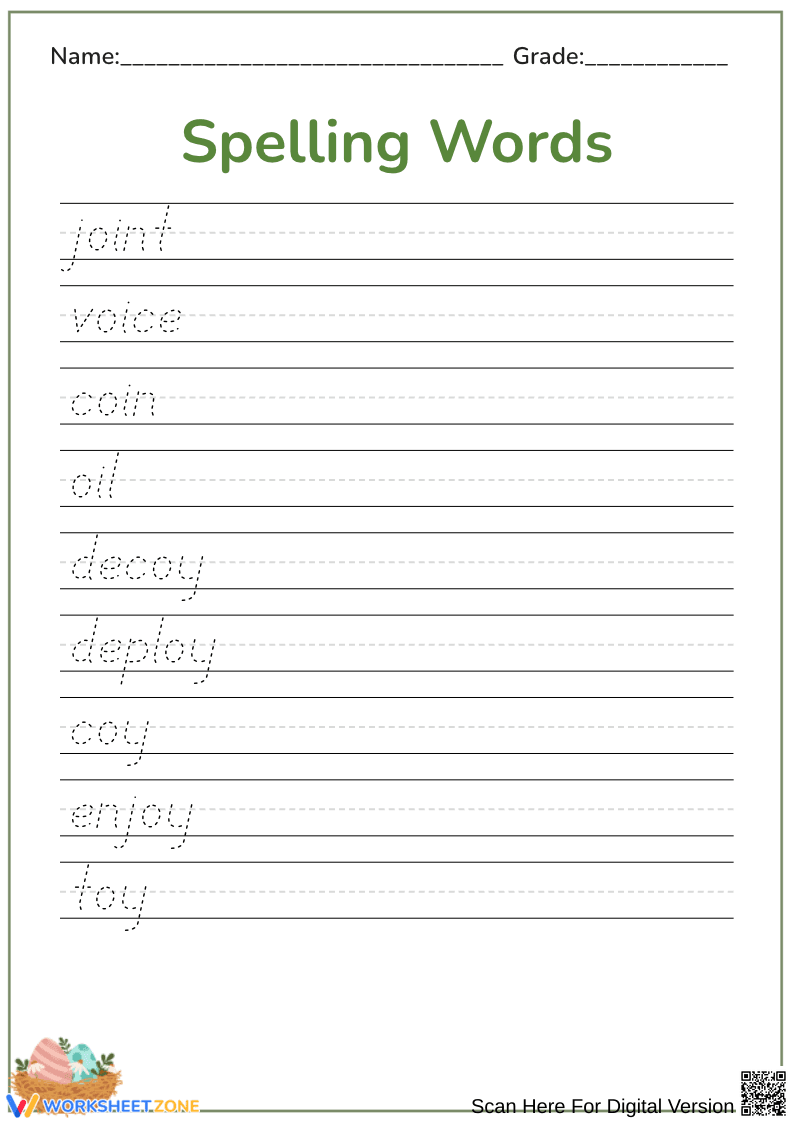

Grade 2 Spelling Words — Printable No-Prep Worksheet
Paste this activity's link or code into your existing LMS (Google Classroom, Canvas, Teams, Schoology, Moodle, etc.).
Students can open and work on the activity right away, with no student login required.
You'll still be able to track student progress and results from your teacher account.
This spelling words tracing worksheet develops essential handwriting fluency and phonics pattern recognition in second-grade students. By combining targeted fine motor practice with explicit spelling instruction, students master foundational spelling patterns for diphthongs while establishing proper letter formation habits that support long-term writing automaticity.
At a Glance
- Grade: 2 · Subject: ELA
- Standard:
CCSS.ELA-LITERACY.L.2.2.D— Generalize learned spelling patterns when writing words- Skill Focus: Spelling patterns and handwriting tracing
- Format: 1 page · 9 problems · Answer key included · PDF
- Best For: Independent practice and morning work
- Time: 10–15 minutes
What's Inside
This 1-page worksheet features 9 spelling words in clear, dotted tracing font on primary handwriting guide lines. The vocabulary focuses on vowel diphthong patterns oi and oy, including joint, voice, coin, oil, decoy, deploy, coy, enjoy, and toy. Each line provides precise baseline guides. A complete answer key is included for quick verification.
Zero-Prep Workflow
This worksheet requires zero teacher setup or advanced preparation. The streamlined workflow ensures maximum instructional time:
- Print (30 seconds): Select the single-page PDF file and send it directly to the printer. No cutting required.
- Distribute (30 seconds): Hand out sheets directly to students during morning arrival or literacy center rotations.
- Review (45 seconds): Display the reference answer key on the smartboard or check completed tracing lines quickly.
With total teacher prep time under 2 minutes, this resource serves as an excellent emergency sub-plan activity.
Standards Alignment
This resource aligns to primary standard CCSS.ELA-LITERACY.L.2.2.D, requiring students to generalize learned spelling patterns when writing words. It also supports standard CCSS.ELA-LITERACY.RF.2.3 by reinforcing grade-level phonics through decoding diphthong patterns. Both standard codes can be copied directly into lesson plans, IEP goals, or district curriculum mapping tools.
How to Use It
This worksheet functions effectively across multiple instructional moments. Teachers can assign it after direct instruction on vowel diphthongs to reinforce spelling patterns through motor practice. Alternatively, it serves as an excellent morning work routine before formal instruction begins. As a formative-assessment observation tip, monitor students to ensure they start letters at the correct top guideline. The expected completion time range is 10 to 15 minutes.
Who It's For
This resource is designed for second-grade general education students developing spelling automaticity. For differentiation, struggling writers benefit from the structured dotted font and baseline boundaries, while advanced learners can write sentences using each traced word on the back. This worksheet pairs naturally with an anchor chart displaying rules for using oi and oy.
Effective elementary literacy instruction requires explicit integration of spelling patterns and motor memory practice to build long-term writing automaticity. This structured worksheet targets standard CCSS.ELA-LITERACY.L.2.2.D, focusing directly on the plain-English skill of generalizing learned spelling patterns when writing words. According to comprehensive educational research highlighted in EdReports 2024, high-quality instructional materials that combine foundational phonics practice with direct handwriting application significantly improve student encoding accuracy and reading fluency. By engaging students in tracing specific diphthong vocabulary words like coin, voice, and enjoy, the activity reinforces essential neural pathways connecting visual letter strings with physical kinesthetic execution. This dual-focus instructional approach ensures that young learners do not merely memorize isolated word lists but actively internalize the underlying orthographic structures necessary for independent writing success across all academic subject areas in the elementary curriculum.


