


























Views
Downloads
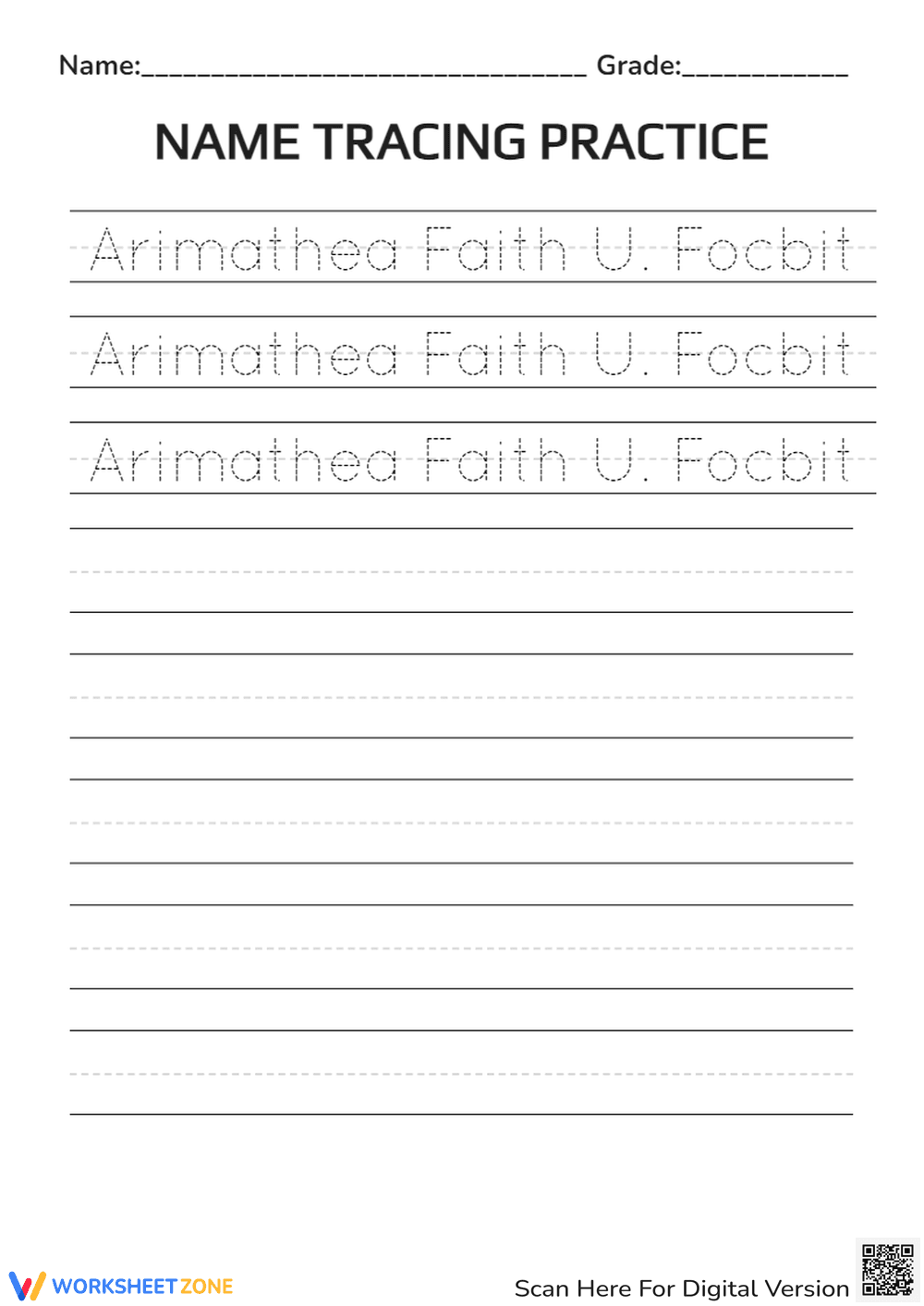

Essential Name Tracing Worksheet | Grade 1 Handwriting
Paste this activity's link or code into your existing LMS (Google Classroom, Canvas, Teams, Schoology, Moodle, etc.).
Students can open and work on the activity right away, with no student login required.
You'll still be able to track student progress and results from your teacher account.
Handwriting mastery begins with personal identification. This Grade 1 name tracing worksheet helps students master the specific letter forms in 'Arimathea Faith U. Focbit' while developing the fine motor control necessary for legible writing. By focusing on a familiar name, students engage more deeply with the mechanics of penmanship and spatial awareness.
At a Glance
- Grade: 1 · Subject: Handwriting
- Standard:
CCSS.ELA-LITERACY.L.1.1.A— Print all upper- and lowercase letters accurately and legibly- Skill Focus: Name tracing and letter formation
- Format: 1 page · 13 lines · Answer key included · PDF
- Best For: Morning work and fine motor practice
- Time: 10–15 minutes
This 1-page PDF features 3 guided tracing lines with dashed fonts and 10 blank primary-ruled lines for independent practice. The layout uses standard 3-line spacing—top, middle, and baseline—to ensure proper letter height and alignment. No additional teacher setup is required, making it a truly ready-to-use resource for busy classrooms.
The workflow for this resource is designed for maximum efficiency: Print (30 seconds), Distribute (30 seconds), and Review (1 minute). Total teacher prep time is under 2 minutes. This resource is ideal for morning work, early finishers, or as a reliable sub-plan activity that requires no prior instruction or complex materials.
This resource aligns with CCSS.ELA-LITERACY.L.1.1.A, which requires students to print all upper- and lowercase letters. This worksheet specifically targets the formation of complex capital and lowercase sequences within a proper noun context. This standard code can be copied directly into lesson plans, IEP goals, or district curriculum mapping tools for easy tracking.
Use this during the first 10 minutes of the school day as a calming morning work routine. It also serves as an effective formative assessment tool; observe the student's pencil grip and stroke direction during the guided tracing phase. Expected completion time is 10–15 minutes depending on the student's current motor skill level.
This worksheet is designed for first and second-grade students needing targeted fine motor practice or letter formation reinforcement. It pairs naturally with alphabet anchor charts or direct instruction on letter 'basements' and 'attics.' It is particularly helpful for students who are just beginning to transition from tracing to independent writing.
According to the RAND AIRS 2024 report, repetitive motor tasking in early childhood education significantly correlates with long-term writing fluency and cognitive load reduction during composition. This worksheet addresses CCSS.ELA-LITERACY.L.1.1.A by providing structured repetition of letter forms. By mastering the specific strokes required for their own name, students build the foundational muscle memory needed for broader literacy tasks. Research from Fisher & Frey (2014) suggests that personalizing handwriting tasks increases student agency and persistence. This resource provides 13 lines of focused practice, transitioning from scaffolded tracing to independent production. This dual-mode approach ensures that students not only recognize the visual form of letters but also internalize the physical movements required for neat, legible penmanship in a classroom setting.


