


























Views
Downloads
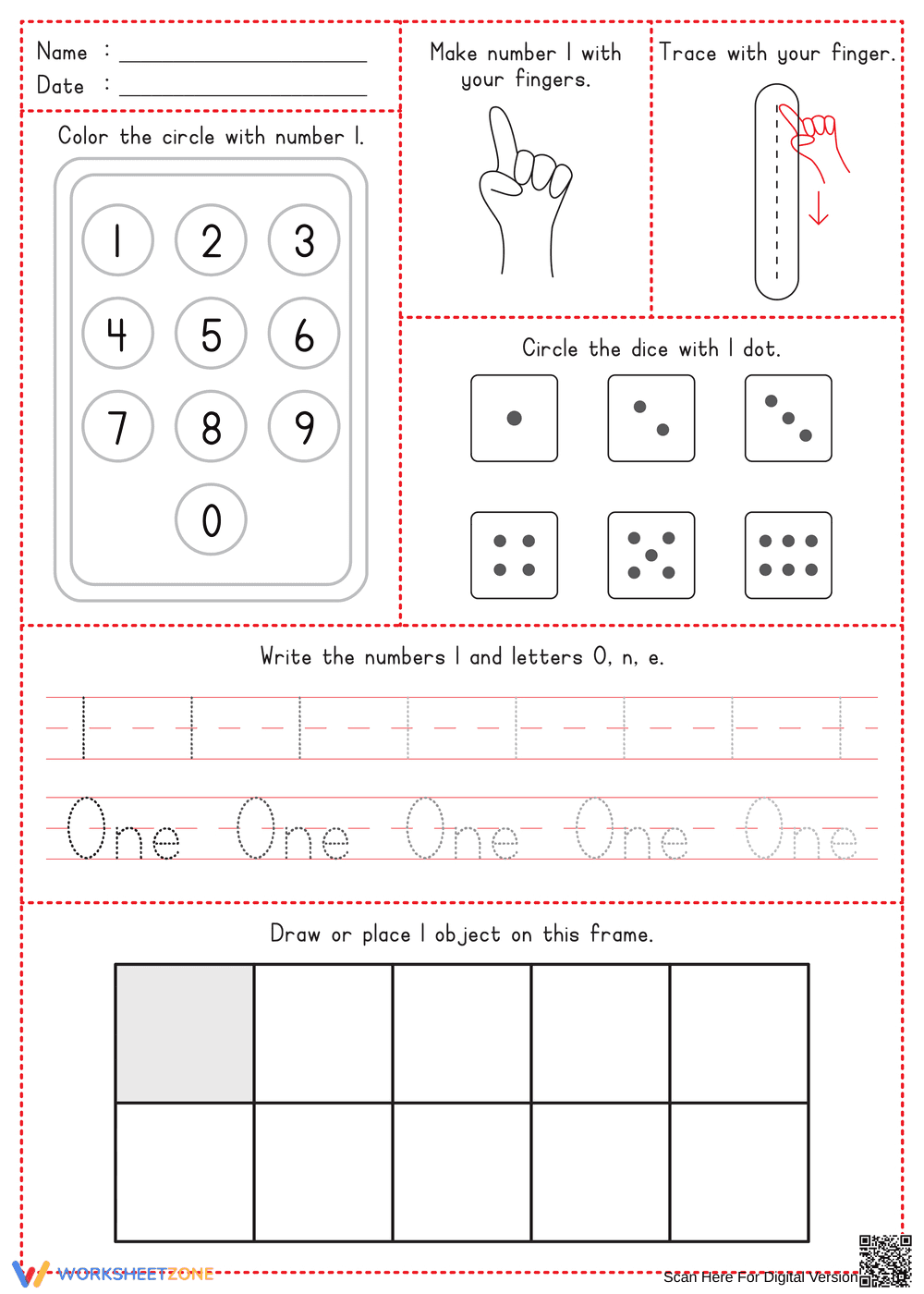

Printable Number 1 Worksheet for Kindergarten
Paste this activity's link or code into your existing LMS (Google Classroom, Canvas, Teams, Schoology, Moodle, etc.).
Students can open and work on the activity right away, with no student login required.
You'll still be able to track student progress and results from your teacher account.
This printable worksheet helps kindergarteners master the number 1 through tracing, writing, and counting. Students build number recognition and fine motor skills by completing six interactive tasks. This resource provides immediate practice to reinforce early math concepts and establish a strong foundation for future counting skills.
At a Glance
- Grade: Kindergarten · Subject: Math
- Standard:
CCSS.MATH.CONTENT.K.CC.A.3— Write numbers and represent quantities from 0 to 20- Skill Focus: Number 1 recognition, tracing, and counting
- Format: 1 page · 6 tasks · No answer key · PDF
- Best For: Morning work or independent math centers
- Time: 10–15 minutes
This single-page PDF contains six distinct activities to engage early learners. The layout features a keypad number search, a finger-counting visual, a finger-tracing guide, a dice-counting task, a tracing section for the numeral and word, and a ten-frame drawing space. These varied exercises support multiple learning modalities, combining visual, kinesthetic, and tactile approaches to number formation.
This resource offers a zero-prep workflow designed to save valuable classroom time. First, print the single-page PDF in under 1 minute. Second, distribute the sheet to students during morning arrival or transition periods, requiring less than 1 minute of setup. Finally, review student work in 2 minutes by checking their ten-frame drawings and tracing accuracy. The entire process takes under 5 minutes of teacher preparation, making it an ideal choice for emergency sub plans or quick formative assessments.
This activity aligns directly with the Common Core State Standard CCSS.MATH.CONTENT.K.CC.A.3, which requires students to write numbers from 0 to 20 and represent a number of objects with a written numeral. Additionally, it supports early subitizing skills by asking students to identify a single dot on a die. Both standard codes can be copied directly into lesson plans, IEP goals, or district curriculum mapping tools.
Use this worksheet during direct instruction as a guided practice tool after introducing the number 1. Alternatively, assign it as an independent exit ticket to assess student understanding of numeral formation and quantity representation. Teachers can observe students during the ten-frame task to check if they correctly place exactly one object, providing a quick formative assessment of their counting skills. Expected completion time is 10 to 15 minutes.
This worksheet is designed for preschool, kindergarten, and early first-grade students who need targeted practice with number formation. It is highly beneficial for English language learners and students requiring intervention, as the visual cues and tracing lines offer strong scaffolding. Pair this worksheet with physical counters or a number 1 anchor chart to enhance concrete learning.
This worksheet aligns with early childhood mathematics standards by targeting numeral writing and quantity association. According to research from EdReports 2024, structured tracing activities combined with visual representations like ten-frames significantly improve number recognition and fine motor control in early childhood education. By integrating multiple modalities—including tactile finger tracing, visual subitizing on dice, and spatial representation in a ten-frame—this resource helps students build a concrete understanding of the number 1. The inclusion of the standard code CCSS.MATH.CONTENT.K.CC.A.3 ensures that the tasks directly support foundational math benchmarks. Teachers can confidently integrate this worksheet into their curriculum, knowing it aligns with evidence-based practices for early numeracy development. This structured approach ensures students transition smoothly from basic recognition to independent writing and counting.


