


























Views
Downloads
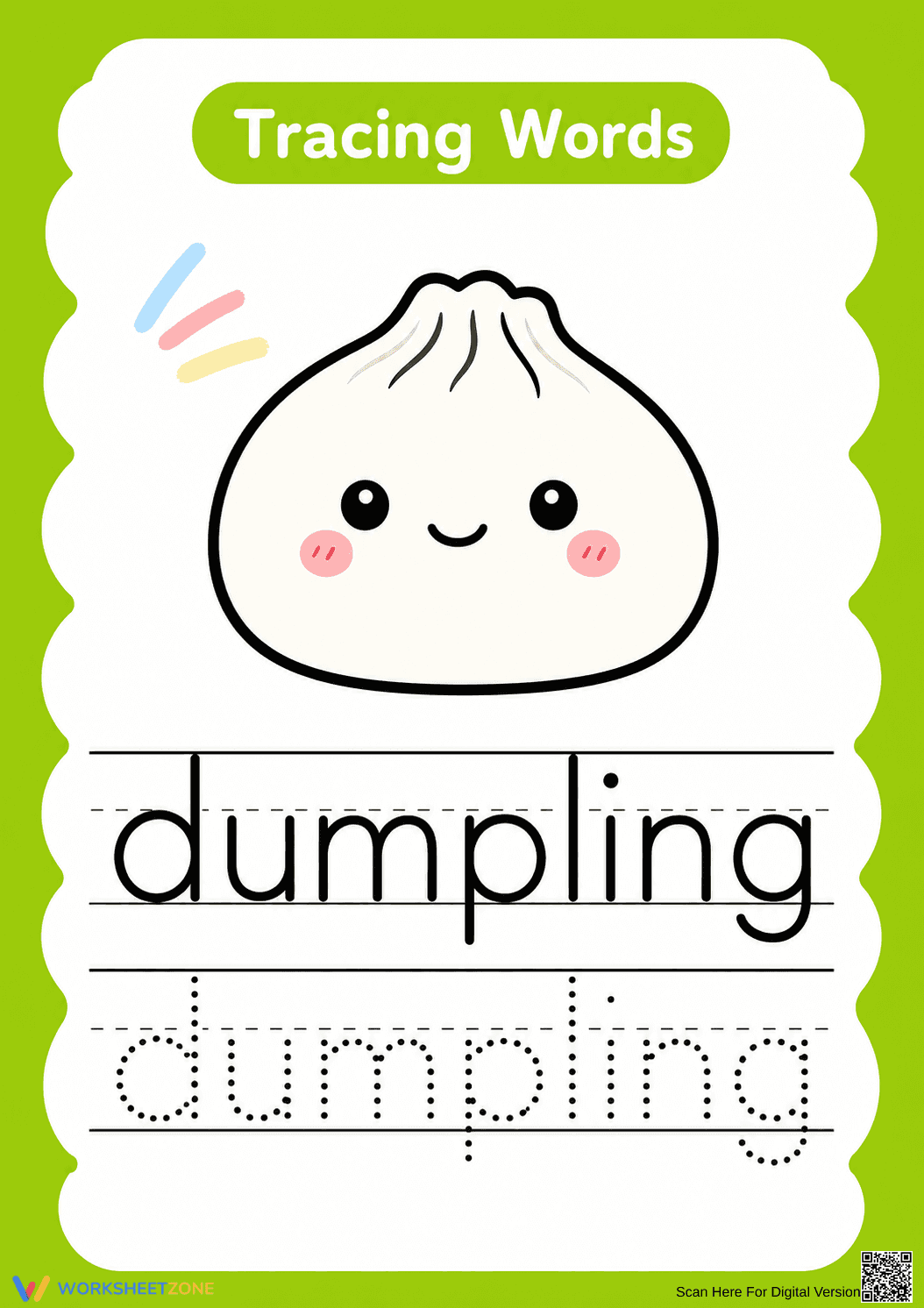

Printable Dumpling Word Tracing | Grade K ELA
Paste this activity's link or code into your existing LMS (Google Classroom, Canvas, Teams, Schoology, Moodle, etc.).
Students can open and work on the activity right away, with no student login required.
You'll still be able to track student progress and results from your teacher account.
This single-page tracing worksheet provides early learners with targeted practice in letter formation and fine motor control. By tracing the word "dumpling," students develop the muscle memory required for legible handwriting while reinforcing letter recognition, specifically focusing on the beginning consonant sound of the letter D.
At a Glance
- Grade: K · Subject: ELA
- Standard:
CCSS.ELA-LITERACY.L.K.1.A— Print upper- and lowercase letters- Skill Focus: Word tracing and letter formation
- Format: 1 page · 1 tracing task · No answer key · PDF
- Best For: Independent morning work
- Time: 5–10 minutes
Inside this resource, educators will find a straightforward handwriting activity. The page features an engaging dumpling illustration, followed by primary writing lines. The word is presented first as a solid model, then in a dotted format for tracing. This structure allows young learners to focus entirely on pencil grip and stroke sequence.
Zero-Prep Workflow
This resource requires under two minutes of teacher preparation time.
- Print (1 min): Download the PDF and print.
- Distribute (30 sec): Hand out with pencils. The layout needs no complex instructions.
- Review (30 sec): Check work for proper letter formation.
It is entirely self-explanatory and highly suitable for emergency sub plans or quiet transition periods.
Standards Alignment
This worksheet aligns directly with CCSS.ELA-LITERACY.L.K.1.A, which requires students to print many upper- and lowercase letters. By practicing the sequence of letters in a complete word, students also reinforce basic phonics concepts related to beginning sounds. Both standard codes can be copied directly into lesson plans, IEP goals, or district curriculum mapping tools.
How to Use It
This tracing activity fits perfectly into a morning work routine. Place the worksheet on desks before students arrive for a calm start to the day. Alternatively, use it as a targeted literacy center station. As a formative assessment tip, watch students trace the letter "d" to ensure correct stroke direction. Expected completion time is 5 to 10 minutes.
Who It's For
This resource is primarily designed for Kindergarten students developing their foundational handwriting skills. It is also appropriate for preschool students who are ready for structured tracing, or first-grade students who need remedial practice with letter sizing and line placement. For differentiation, provide students who struggle with fine motor control a thicker marker or crayon to trace with. Pair this worksheet with a direct instruction lesson on the "D" sound or a read-aloud featuring foods to build vocabulary context.
Developing automaticity in handwriting is a critical precursor to expressive writing. According to research from Fisher & Frey (2014), providing students with brief, targeted practice opportunities helps solidify the motor patterns necessary for fluent text production. This worksheet supports that goal by focusing on a single, manageable task. Aligned with CCSS.ELA-LITERACY.L.K.1.A, the activity requires students to print upper- and lowercase letters accurately. By tracing the word "dumpling," early learners practice maintaining proper proportions and spacing on primary writing lines. This focused repetition reduces cognitive load, allowing students to concentrate entirely on their physical pencil control rather than spelling or composition. Integrating such straightforward, standards-aligned tracing exercises into daily routines ensures that foundational transcription skills do not become a bottleneck for future literacy development.


