




























Views
Downloads

Printable Letter N Tracing Worksheet | Kindergarten ELA

Paste this activity's link or code into your existing LMS (Google Classroom, Canvas, Teams, Schoology, Moodle, etc.).
Students can open and work on the activity right away, with no student login required.
You'll still be able to track student progress and results from your teacher account.
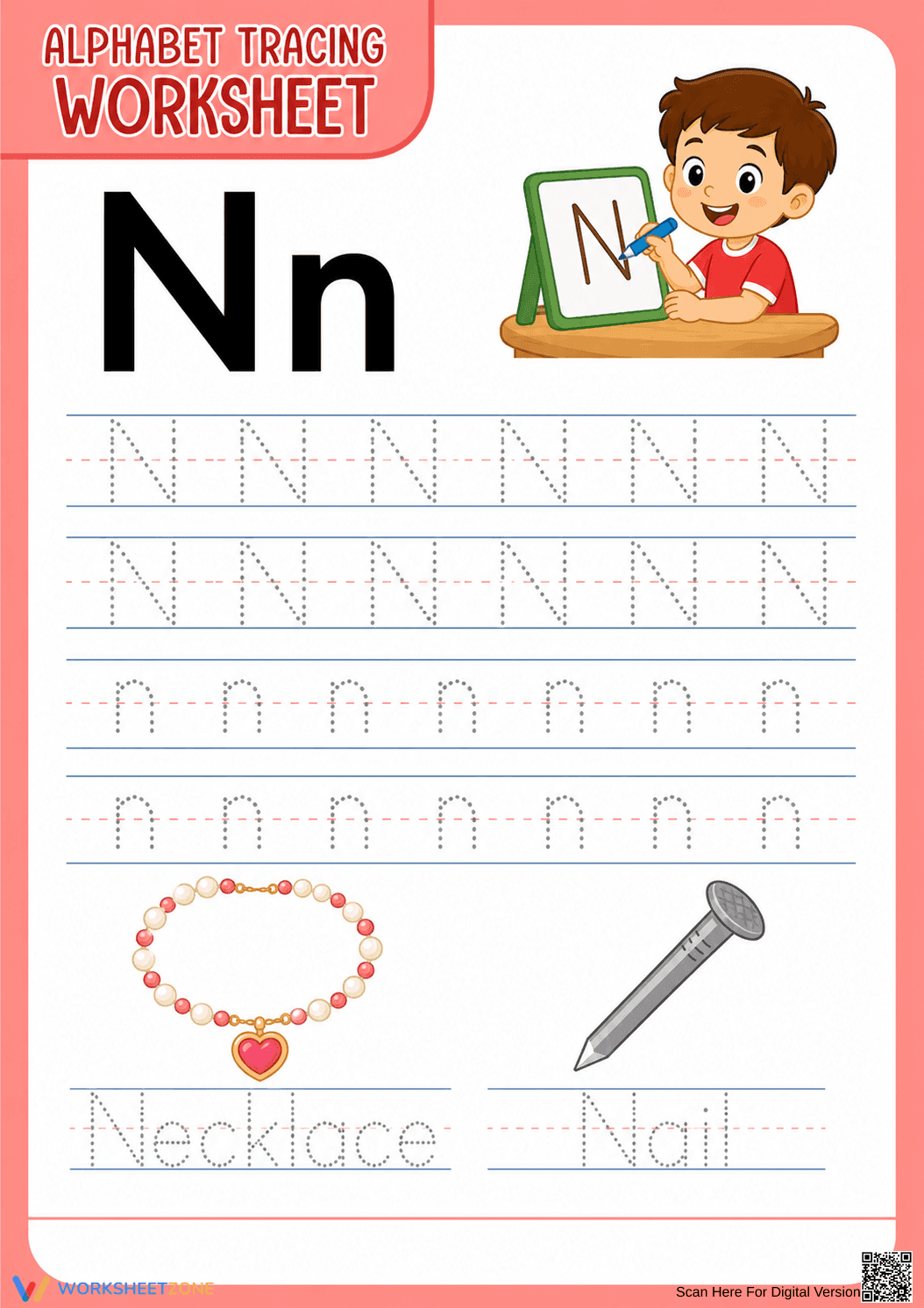
This foundational handwriting worksheet helps early learners master the formation of the letter N. Students practice tracing both uppercase and lowercase forms, reinforcing fine motor control and letter recognition. By connecting the letter to familiar vocabulary words, the activity builds essential early literacy skills in a highly structured format.
At a Glance
- Grade: Kindergarten · Subject: English Language Arts
- Standard:
CCSS.ELA-LITERACY.L.K.1.A— Print many upper- and lowercase letters- Skill Focus: Letter N Formation and Beginning Sounds
- Format: 1 page · 28 problems · No answer key needed · PDF
- Best For: Independent practice and morning work
- Time: 10–15 minutes
This single-page resource features 28 distinct tracing opportunities designed to build muscle memory. The layout includes two rows for uppercase N, two rows for lowercase n, and a final section for tracing the words "Necklace" and "Nail." Visual cues, including a helpful illustration of a student writing and colorful vocabulary images, provide context and keep young learners engaged throughout the task.
Zero-Prep Workflow
This resource is designed for immediate classroom implementation with absolutely no teacher preparation required.
- Print (1 minute): Simply download the PDF and print the required number of copies. The clear, high-contrast design ensures excellent reproduction on standard school printers.
- Distribute (1 minute): Hand out the sheets along with pencils or crayons. The intuitive layout means students understand the task immediately.
- Review (0 minutes): Because this is a tracing activity, students receive immediate visual feedback from the dotted guidelines, eliminating the need for complex grading or answer keys.
This activity is an ideal addition to any substitute teacher binder.
Standards Alignment
This worksheet is directly aligned with CCSS.ELA-LITERACY.L.K.1.A: Print many upper- and lowercase letters. It also supports early phonics development by connecting the target letter to specific beginning sounds. Both standard codes can be copied directly into lesson plans, IEP goals, or district curriculum mapping tools.
How to Use It
This activity works perfectly as morning work to settle students while reinforcing alphabet instruction. It also serves as an excellent literacy center station where students can practice independently. While observing students complete the page, teachers should watch for proper pencil grip and correct stroke order, intervening gently if a child starts their letters from the bottom rather than the top. Most kindergarteners will complete this activity within 10 to 15 minutes.
Who It's For
This resource is primarily designed for kindergarten students who are actively learning letter formation and basic phonics. It is also highly effective for pre-K students who demonstrate readiness for structured writing tasks, or first graders who need targeted intervention for handwriting legibility. Pair this worksheet with a read-aloud book that heavily features the letter N or a classroom anchor chart displaying N-words to maximize the instructional impact.
Developing automaticity in letter formation is a critical stepping stone for early literacy success. This resource targets CCSS.ELA-LITERACY.L.K.1.A, focusing on the ability to print many upper- and lowercase letters accurately. According to Fisher & Frey (2014), providing students with structured, repetitive practice in a low-stakes environment significantly improves their cognitive stamina for more complex writing tasks later on. When learners automate letter formation, they can focus entirely on composing meaning. By integrating visual vocabulary cues with targeted tracing exercises, this worksheet ensures that students build both the fine motor skills and the phonetic connections necessary for fluent reading and writing. The clear, predictable format allows educators to implement evidence-based handwriting practice efficiently.


