


























Views
Downloads
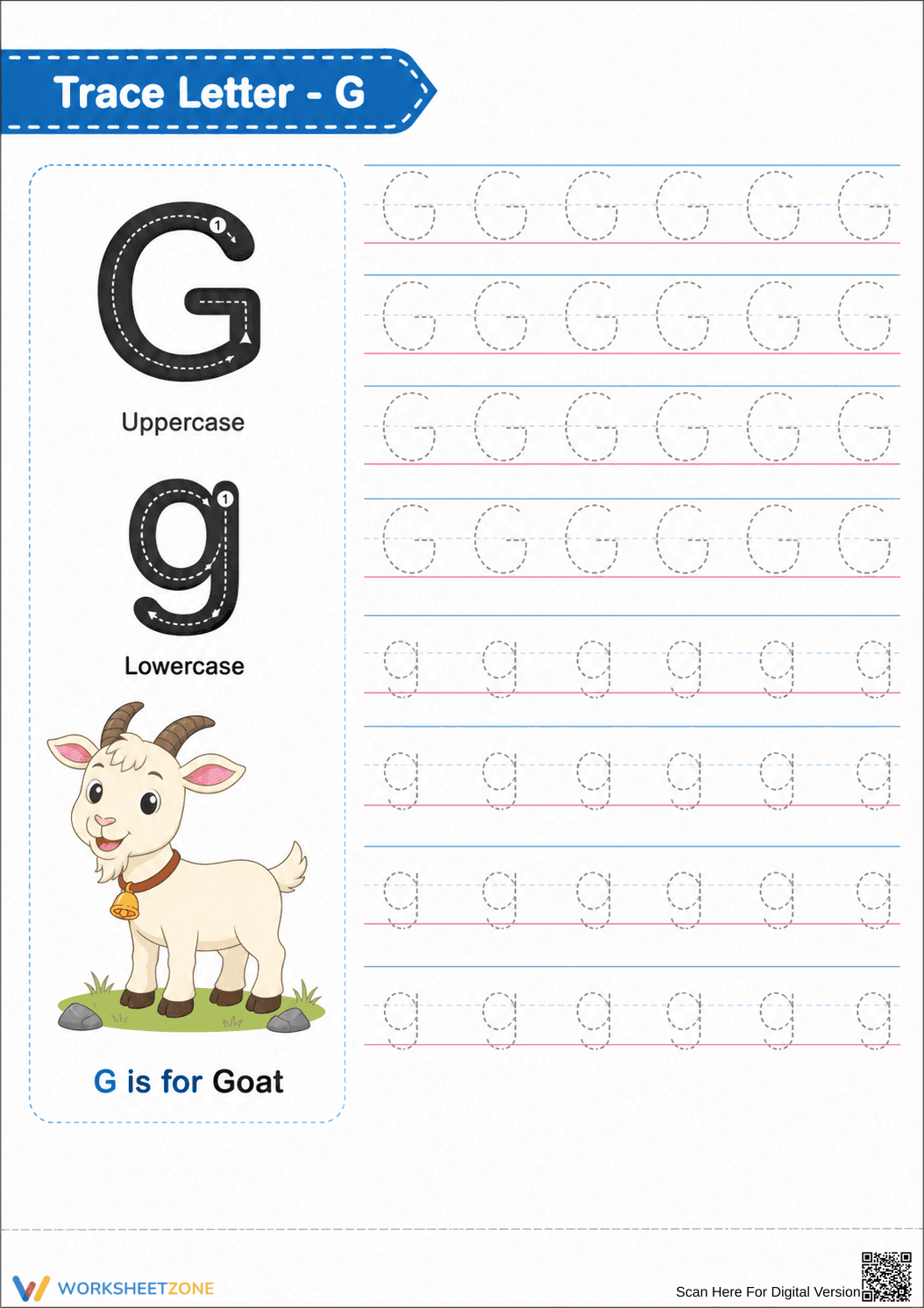

Trace Letter G Worksheet | Essential Grade K Phonics
Paste this activity's link or code into your existing LMS (Google Classroom, Canvas, Teams, Schoology, Moodle, etc.).
Students can open and work on the activity right away, with no student login required.
You'll still be able to track student progress and results from your teacher account.
This Kindergarten Letter G worksheet provides students with focused practice in letter formation and phonemic awareness. By tracing both uppercase and lowercase versions of the letter, learners develop the fine motor control necessary for legible handwriting while reinforcing the connection between the grapheme 'G' and its initial sound in words like "goat."
At a Glance
- Grade: Kindergarten · Subject: ELA Phonics
- Standard:
CCSS.ELA-LITERACY.L.K.1.A— Print many upper- and lowercase letters accurately and legibly- Skill Focus: Letter G formation and beginning sounds
- Format: 1 page · 56 tracing tasks · Answer key included · PDF
- Best For: Initial handwriting instruction and morning work
- Time: 10–15 minutes
This single-page PDF features a large visual guide for Letter G with directional arrows to assist with proper stroke order. The worksheet includes 4 rows of uppercase 'G' and 4 rows of lowercase 'g' tracing, totaling 56 individual practice opportunities. A "G is for Goat" illustration provides a concrete anchor for beginning sound recognition and vocabulary development.
Skill Progression
- Guided practice: Students begin by following the numbered directional arrows on the large model letters to understand the correct sequence of strokes.
- Supported practice: Learners move to 56 dashed-line templates across eight rows, providing high-frequency repetition to build muscle memory.
- Independent practice: Students transition toward autonomy as they complete the final letters in each row with decreasing visual support.
This structure follows the gradual-release model of instruction, moving from teacher-led modeling to independent student mastery.
Standards Alignment
This resource is aligned with `CCSS.ELA-LITERACY.L.K.1.A`, which requires students to print many upper- and lowercase letters. It also supports `CCSS.ELA-LITERACY.RF.K.1.B`, recognizing that spoken words are represented in written language by specific sequences of letters. Both standard codes can be copied directly into lesson plans, IEP goals, or district curriculum mapping tools.
How to Use It
Use this worksheet during the "You Do" phase of a phonics lesson after demonstrating the letter's shape on a whiteboard. It serves as an excellent formative assessment tool; teachers should observe the direction of the student's pencil strokes to ensure they are not drawing the letters from bottom to top. Expected completion typically takes 10 to 15 minutes during a literacy center or morning work block.
Who It's For
This activity is designed for Kindergarten students but is also appropriate for Grade 1 students needing remedial handwriting support or English Language Learners (ELLs) building foundational literacy. It pairs naturally with a "Letter of the Week" curriculum or a phonics anchor chart featuring the hard /g/ sound to reinforce the connection between writing and speech.
According to the RAND AIRS 2024 report on foundational literacy, explicit instruction in letter formation is a critical precursor to reading fluency and orthographic mapping. This worksheet addresses the specific need for repetitive, high-frequency tracing to build muscle memory for the letter G. By integrating the beginning sound "Goat" with the physical act of writing, the resource aligns with the Science of Reading's emphasis on multi-sensory phonics instruction. Research from Fisher & Frey (2014) suggests that such structured practice helps bridge the gap between phonemic awareness and written expression. The inclusion of 56 tracing tasks ensures that students receive sufficient dosage to move toward mastery of the CCSS.ELA-LITERACY.L.K.1.A standard. This printable provides a clear, distraction-free environment that supports cognitive load management for early learners, making it a reliable tool for daily classroom use.


