


























Views
Downloads

Printable Letter F Tracing Worksheet | Kindergarten ELA
Paste this activity's link or code into your existing LMS (Google Classroom, Canvas, Teams, Schoology, Moodle, etc.).
Students can open and work on the activity right away, with no student login required.
You'll still be able to track student progress and results from your teacher account.
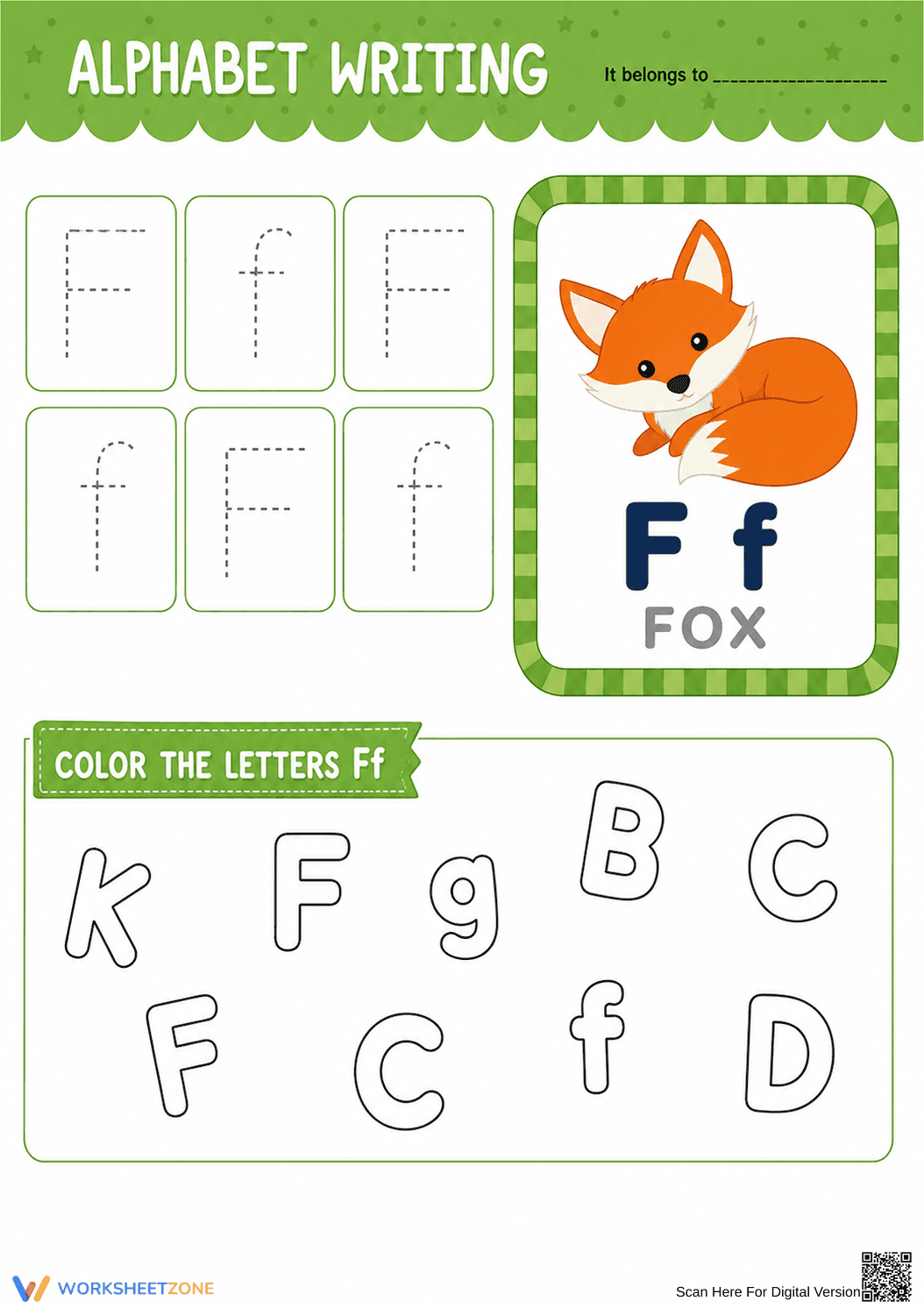
This printable Kindergarten phonics worksheet helps young learners master the letter F through targeted tracing and identification activities. Students practice proper stroke order for uppercase and lowercase letters before applying their visual discrimination skills to find specific characters among distractors.
At a Glance
- Grade: Kindergarten · Subject: ELA
- Standard:
CCSS.ELA-LITERACY.RF.K.1.D— Recognize and name all upper- and lowercase letters.- Skill Focus: Letter F Recognition and Tracing
- Format: 1 page · 7 problems · No answer key · PDF
- Best For: Morning work or literacy centers
- Time: 10–15 minutes
This single-page resource features three distinct activity zones designed for early childhood literacy development. The top section provides six guided tracing boxes with dashed lines for both uppercase 'F' and lowercase 'f'. A visual anchor chart displays a fox to reinforce the beginning sound. The bottom section includes a letter hunt where students must color only the target letters hidden among nine different bubble letters.
Zero-Prep Workflow
- Print (1 minute): The black-and-white design ensures crisp, clear copies without draining school ink supplies.
- Distribute (1 minute): Hand out the single page along with pencils and crayons. No cutting, gluing, or special materials are required.
- Review (3 minutes): Quickly check student work by scanning the colored bubble letters at the bottom of the page.
Total teacher preparation time is under two minutes, making this an excellent option for emergency sub plans or last-minute literacy center additions.
This activity aligns with CCSS.ELA-LITERACY.RF.K.1.D: Recognize and name all upper- and lowercase letters of the alphabet. It also supports early writing skills by having students print letters using guided dashed lines. Both standard codes can be copied directly into lesson plans, IEP goals, or district curriculum mapping tools.
Deploy this worksheet during morning work routines to establish a calm, focused start to the school day. It also functions perfectly as an independent station during guided reading rotations. While students work, teachers can conduct quick formative assessments by observing pencil grip and stroke direction during the tracing portion. Expect students to complete the entire page within 10 to 15 minutes.
This resource is designed for Kindergarten students and first graders needing foundational phonics review. The clear, uncluttered layout provides built-in differentiation for students who become easily overwhelmed by busy pages. Pair this worksheet with a read-aloud book featuring the target beginning sound or a classroom anchor chart displaying words that start with the letter F.
Mastering foundational alphabet skills requires consistent, targeted practice that integrates both motor and visual pathways. According to Fisher & Frey (2014), providing students with structured opportunities to interact with individual letters significantly improves their overall reading readiness and phonemic awareness. This resource directly supports CCSS.ELA-LITERACY.RF.K.1.D by requiring learners to recognize and name all upper- and lowercase letters. By combining tactile tracing exercises with visual discrimination tasks, the worksheet ensures that early learners build robust neural connections associated with the target character. The inclusion of a familiar animal image further anchors the abstract symbol to a concrete phonetic sound, facilitating better long-term retention. Educators can confidently rely on this evidence-based instructional approach to strengthen core literacy competencies, ensuring students develop the necessary decoding skills while maintaining high levels of active student engagement during independent classroom work periods.


