


























Views
Downloads

Printable Grade 5 Vocabulary Worksheet: Academic Expressions
Paste this activity's link or code into your existing LMS (Google Classroom, Canvas, Teams, Schoology, Moodle, etc.).
Students can open and work on the activity right away, with no student login required.
You'll still be able to track student progress and results from your teacher account.
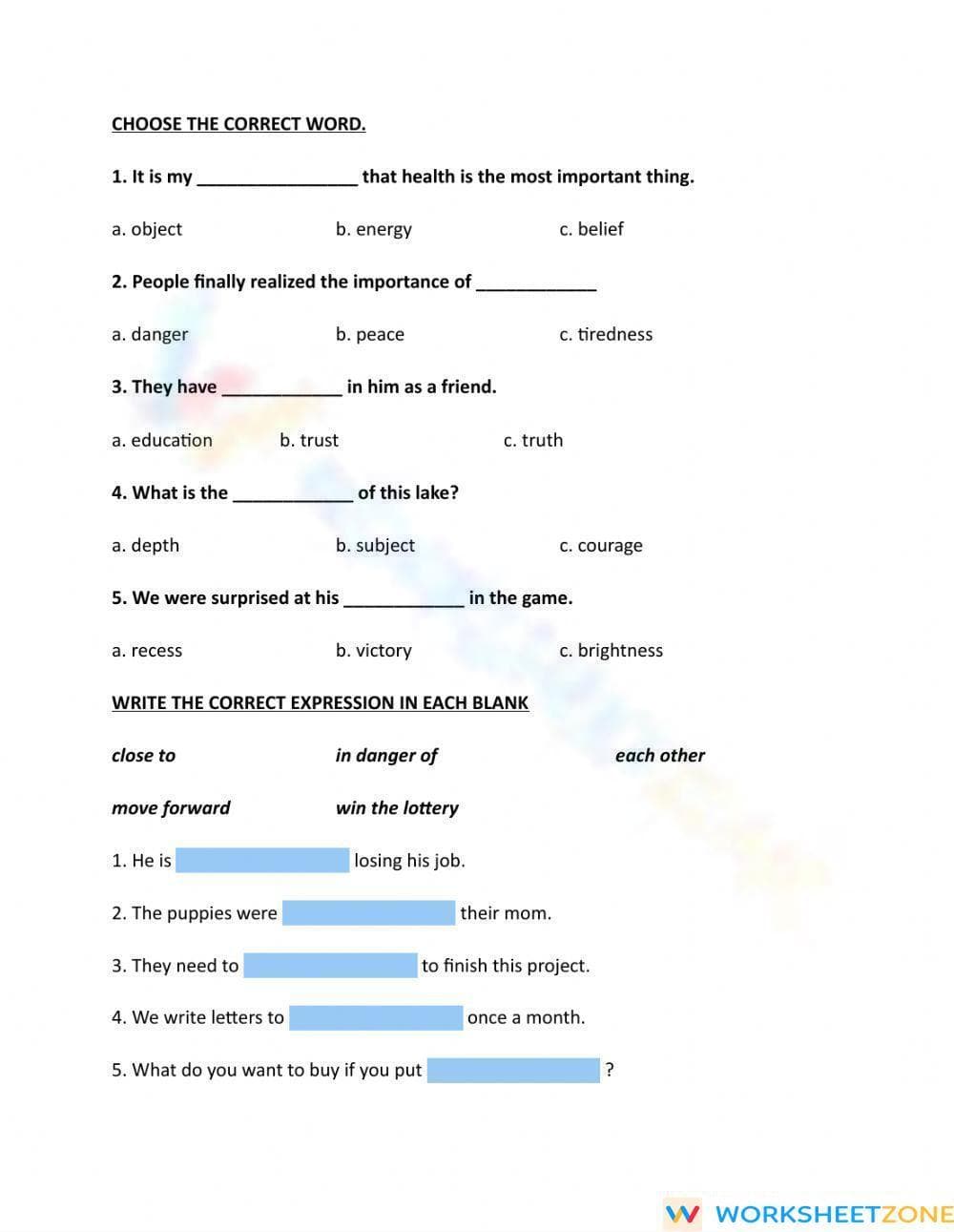
This Grade 5 vocabulary worksheet focuses on the acquisition and application of high-frequency academic nouns and common idiomatic expressions. By engaging with context-rich sentences, students transition from simple word recognition to meaningful usage in their own communication. This resource ensures students can accurately deploy words like "belief," "trust," and "depth" while mastering multi-word phrases.
At a Glance
- Grade: Grade 5 · Subject: English Language Arts (ELA)
- Standard:
CCSS.ELA-LITERACY.L.5.6— Acquire and use accurately grade-appropriate general academic and domain-specific words and phrases- Skill Focus: Contextual Vocabulary Usage
- Format: 2 pages · 10 problems · Answer key included · PDF
- Best For: Independent practice and vocabulary reinforcement
- Time: 15–20 minutes
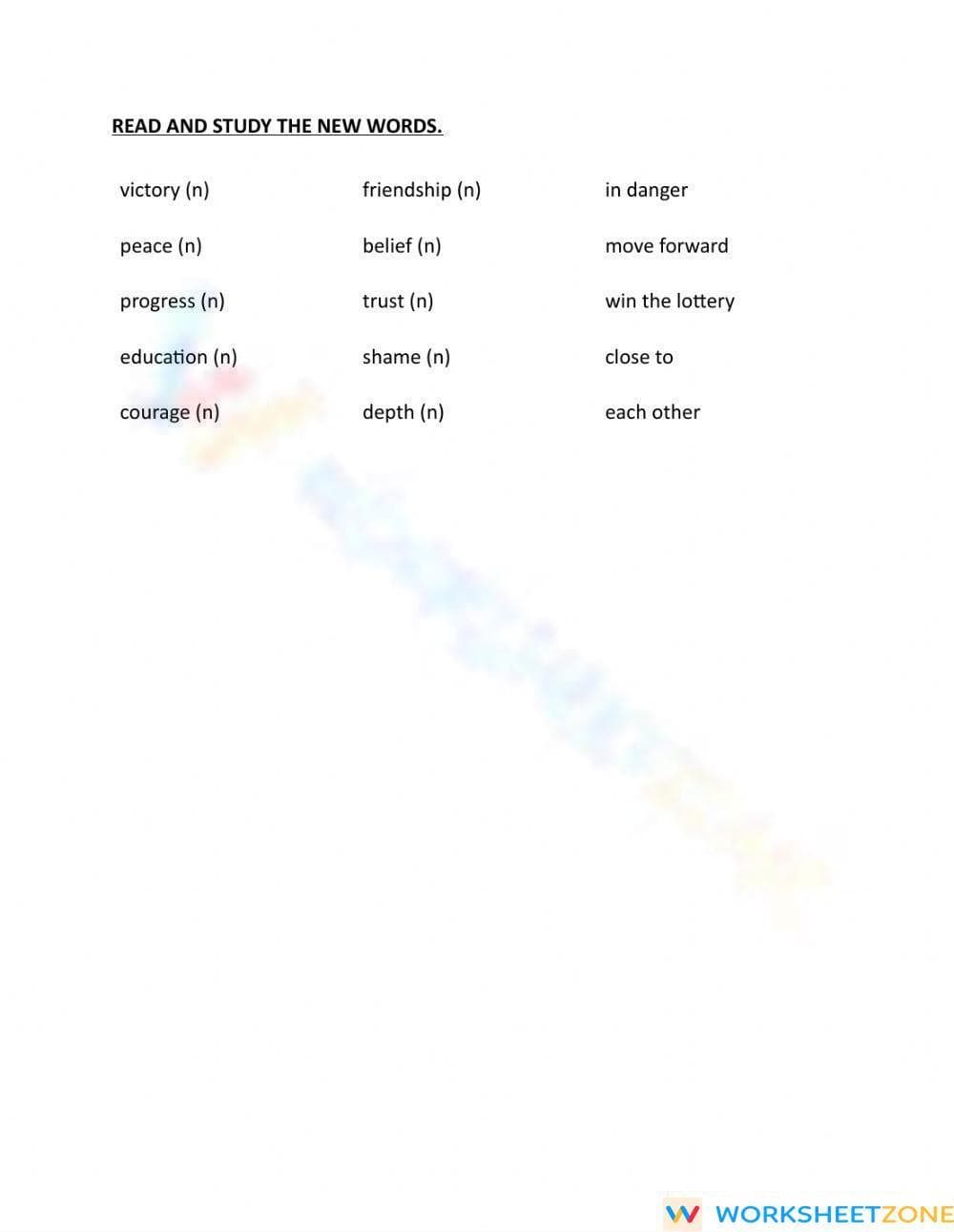
The two-page PDF starts with a study guide listing core academic nouns and five essential idiomatic expressions. The assessment features five multiple-choice questions where students select the correct noun to complete a statement, followed by five fill-in-the-blank exercises targeting complex expressions. A comprehensive answer key is provided for immediate feedback and grading.
The zero-prep design allows teachers to implement this lesson in under two minutes. Simply print the document (30 seconds), distribute to students to review the word bank (30 seconds), and begin independent practice. Reviewing answers as a group provides a powerful formative assessment moment with no prior teacher setup required, making it ideal for busy classroom schedules or emergency sub plans.
This worksheet aligns directly with CCSS.ELA-LITERACY.L.5.6, which requires students to "Acquire and use accurately grade-appropriate general academic and domain-specific words and phrases." By requiring students to distinguish between similar abstract concepts in context, the resource also supports sub-skills related to word relationships and nuances. This standard code can be copied directly into lesson plans, IEP goals, or district curriculum mapping tools.
Use this resource as a warm-up activity during a language arts block to activate prior knowledge of academic terms. Alternatively, assign it as a post-instructional check to verify that students can apply newly learned vocabulary in diverse sentence structures. For a quick formative-assessment observation, walk through the classroom and note which students struggle to differentiate between "truth" and "trust" in the multiple-choice section.
The content is designed for fifth-grade students working on Tier 2 academic vocabulary. It is particularly effective for English Language Learners who benefit from the explicit study of idiomatic expressions like "in danger of" and "move forward." This worksheet pairs naturally with a mentor text analysis where students identify these same abstract nouns and phrases within a professional narrative or informational passage.
The acquisition of academic vocabulary, as targeted by this resource and the CCSS.ELA-LITERACY.L.5.6 standard, is a critical predictor of long-term reading comprehension success. Research by Fisher & Frey (2014) emphasizes the importance of providing students with multiple exposures to new words in varying contexts rather than relying on isolated memorization. By requiring students to engage with 10 structured tasks that demand contextual reasoning, this worksheet facilitates the "deep processing" necessary for word ownership. This ensures that learners do not just recognize terms like "victory" or "courage" but can accurately employ them in complex syntactic environments. The inclusion of idiomatic expressions further bridges the gap between conversational fluency and academic proficiency. This transition is vital for Grade 5 developmental milestones, as evidenced by recurring NAEP reading performance data regarding vocabulary application in informational and literary contexts.


