


























Views
Downloads

Touch Dots 6-9 Math Worksheet | Grade K Printable
Paste this activity's link or code into your existing LMS (Google Classroom, Canvas, Teams, Schoology, Moodle, etc.).
Students can open and work on the activity right away, with no student login required.
You'll still be able to track student progress and results from your teacher account.
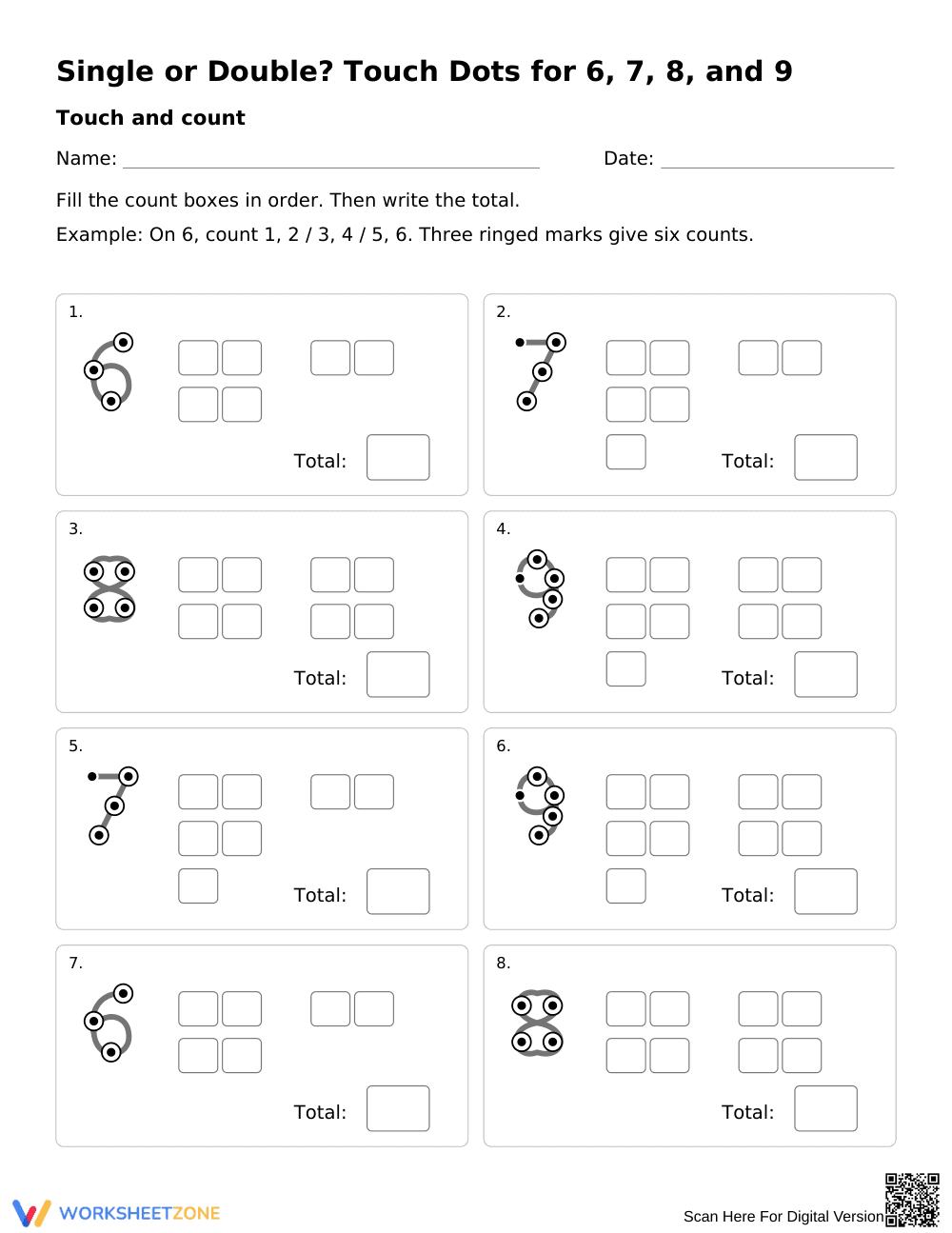
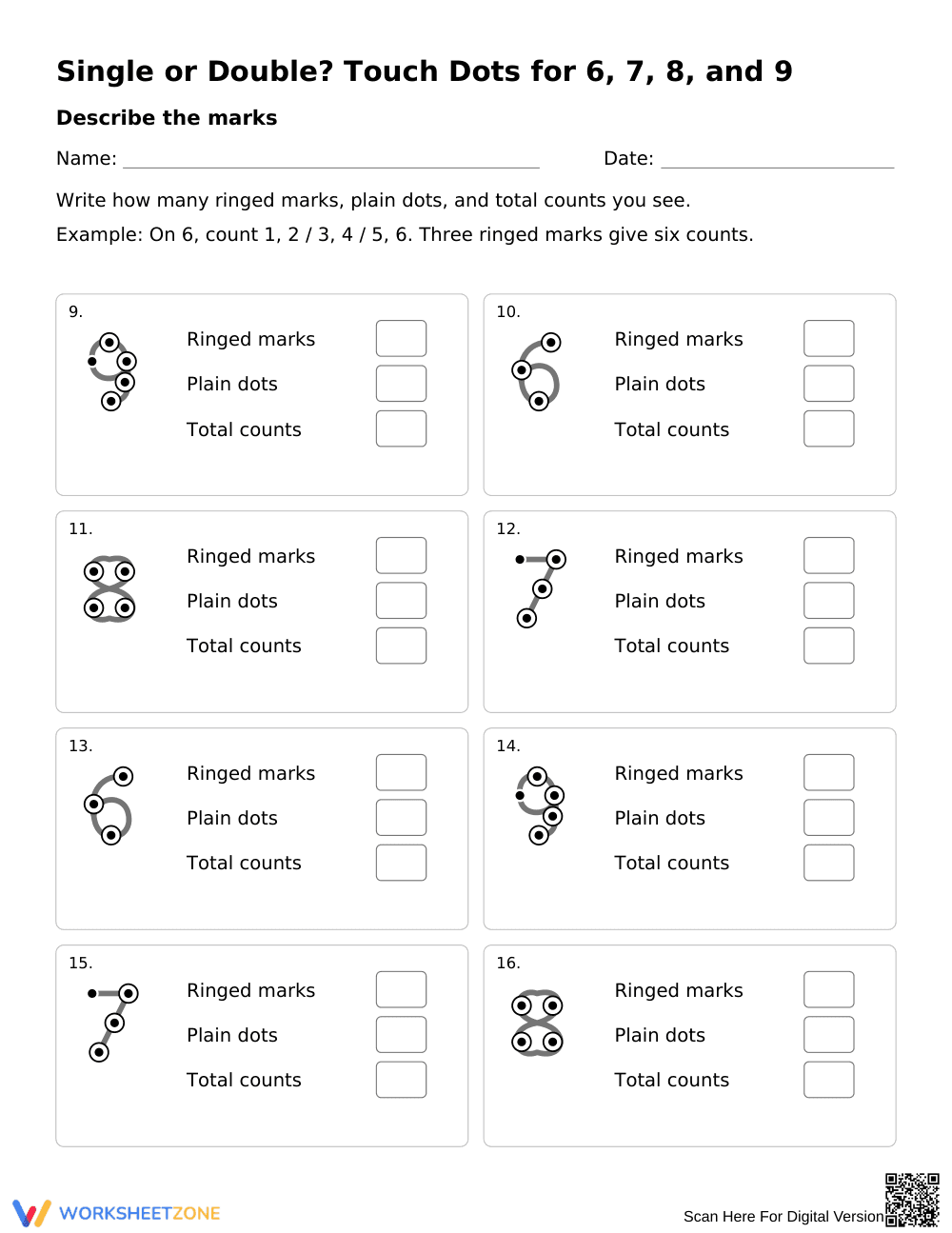
This printable math resource helps early learners master multi-sensory counting strategies for numbers 6, 7, 8, and 9 using single touch points and double-ringed marks. Students build one-to-one correspondence and number sense by systematically pairing touch points with oral counting sequences to find accurate totals.
At a Glance
- Grade: K · Subject: Math
- Standard:
CCSS.MATH.CONTENT.K.CC.B.4— Understand the relationship between numbers and quantities by connecting counting to cardinality- Skill Focus: Touch point counting for 6, 7, 8, and 9
- Format: 2 pages · 16 problems · Answer key included · PDF
- Best For: Multisensory intervention and guided small groups
- Time: 15–20 minutes
What's Inside
The 2-page student packet contains 16 focused counting items supported by visual models and graphic organizers. Page 1 delivers eight structured exercises where students record sequential numbers inside paired boxes to track double and single touches. Page 2 transitions to analytical tracking across eight problems, prompting students to count and record ringed marks, plain dots, and total quantities. A complete 1-page answer key provides clear solutions for rapid grading.
Skill Progression
- Guided practice (Problems 1–4): Students trace visual touch pathways using paired box scaffolds that explicitly organize two counts per ringed mark and single counts for solid dots.
- Supported practice (Problems 5–8): Learners reinforce sequential number writing for values 6 through 9 with repeated dot configurations to cement motor patterns.
- Independent practice (Problems 9–16): Visual box scaffolds fade into categorical recording where students analyze numerals independently, distinguishing between single dots and double rings to establish cardinality.
This structured progression follows the gradual release of responsibility model, ensuring emerging mathematicians solidify tactile anchors before computing mentally.
Standards Alignment
Primary alignment: `CCSS.MATH.CONTENT.K.CC.B.4` — Understand the relationship between numbers and quantities; connect counting to cardinality. When counting objects, say the number names in the standard order, pairing each object with one and only one number name and each number name with one and only one object. Supporting standard `CCSS.MATH.CONTENT.K.CC.B.5` applies as learners count structured pictorial configurations up to 10. Both standard codes can be copied directly into lesson plans, IEP goals, or district curriculum mapping tools.
How to Use It
Deploy this resource during tier-2 math intervention or small-group instruction after modeling how a ringed dot represents two counts. As a formative check, observe whether students tap ringed points twice rhythmically (e.g., "one-two") or accidentally rush past the outer circle. Most kindergarteners finish each 8-problem page in 10 to 15 minutes.
Who It's For
This activity is designed for kindergarten general education students, first graders needing foundational intervention, and special education students utilizing TouchMath strategies. Pair this worksheet with a tactile numeral anchor chart or textured counting cards to reinforce tactile memory pathways.
Multi-sensory math strategies provide vital cognitive scaffolding for early numeracy development. According to research synthesized by Fisher & Frey (2014) on guided instruction, explicit scaffolding bridges the gap between concrete manipulation and abstract mathematical notation. This 16-task worksheet operationalizes standard CCSS.MATH.CONTENT.K.CC.B.4 by translating abstract digits into clear, touch-guided quantities. As students count the single dots and double-ringed touch points on numbers 6 through 9, they construct essential cardinality connections that prevent common counting errors. Research demonstrates that pairing tactile gestures with structured visual boxes strengthens working memory retention during early arithmetic acquisition. This worksheet delivers systematic practice designed to establish automatic numerical fluency across foundational math settings.


