


























Views
Downloads

Touch Dot Detective Worksheet | Printable K Math
Paste this activity's link or code into your existing LMS (Google Classroom, Canvas, Teams, Schoology, Moodle, etc.).
Students can open and work on the activity right away, with no student login required.
You'll still be able to track student progress and results from your teacher account.
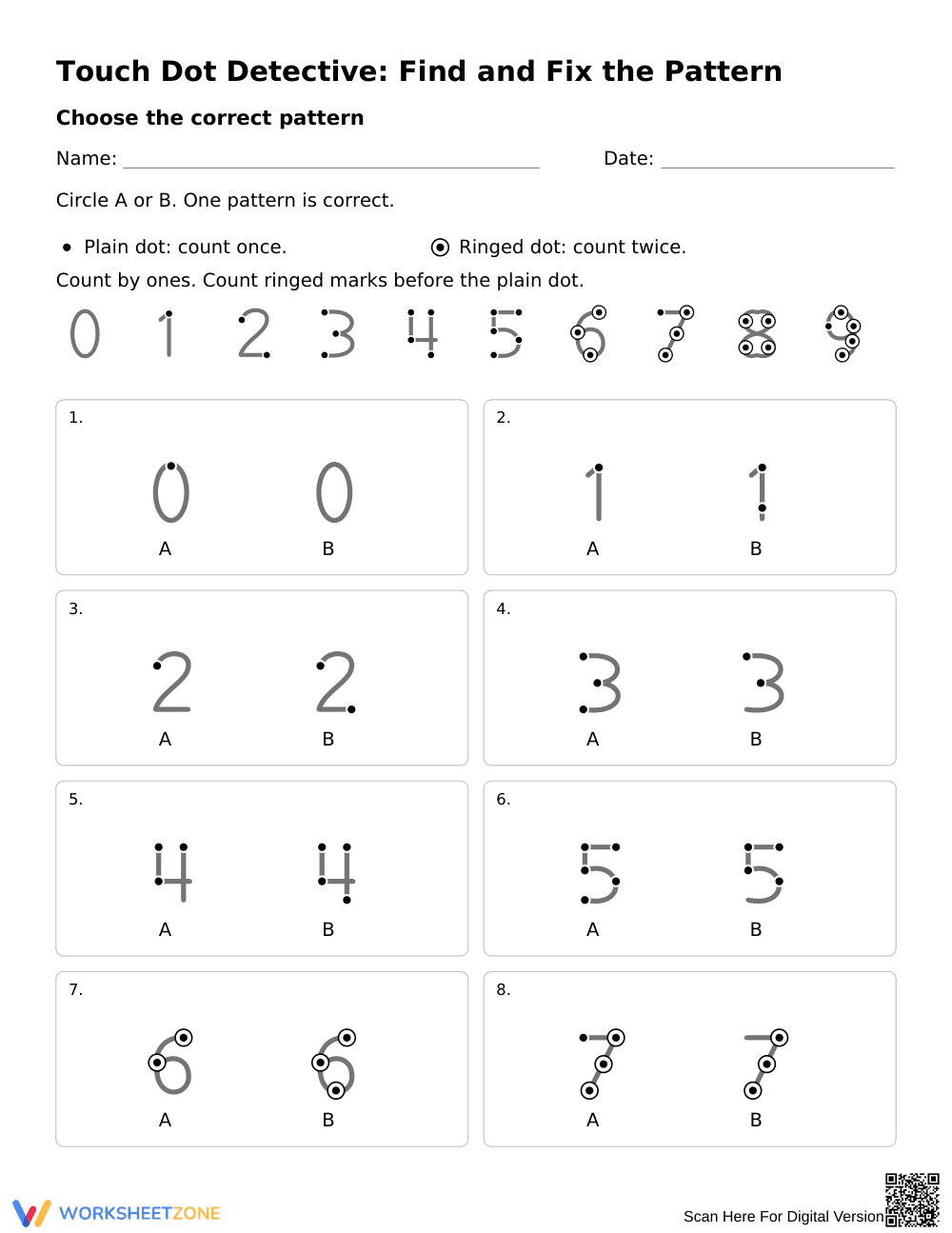
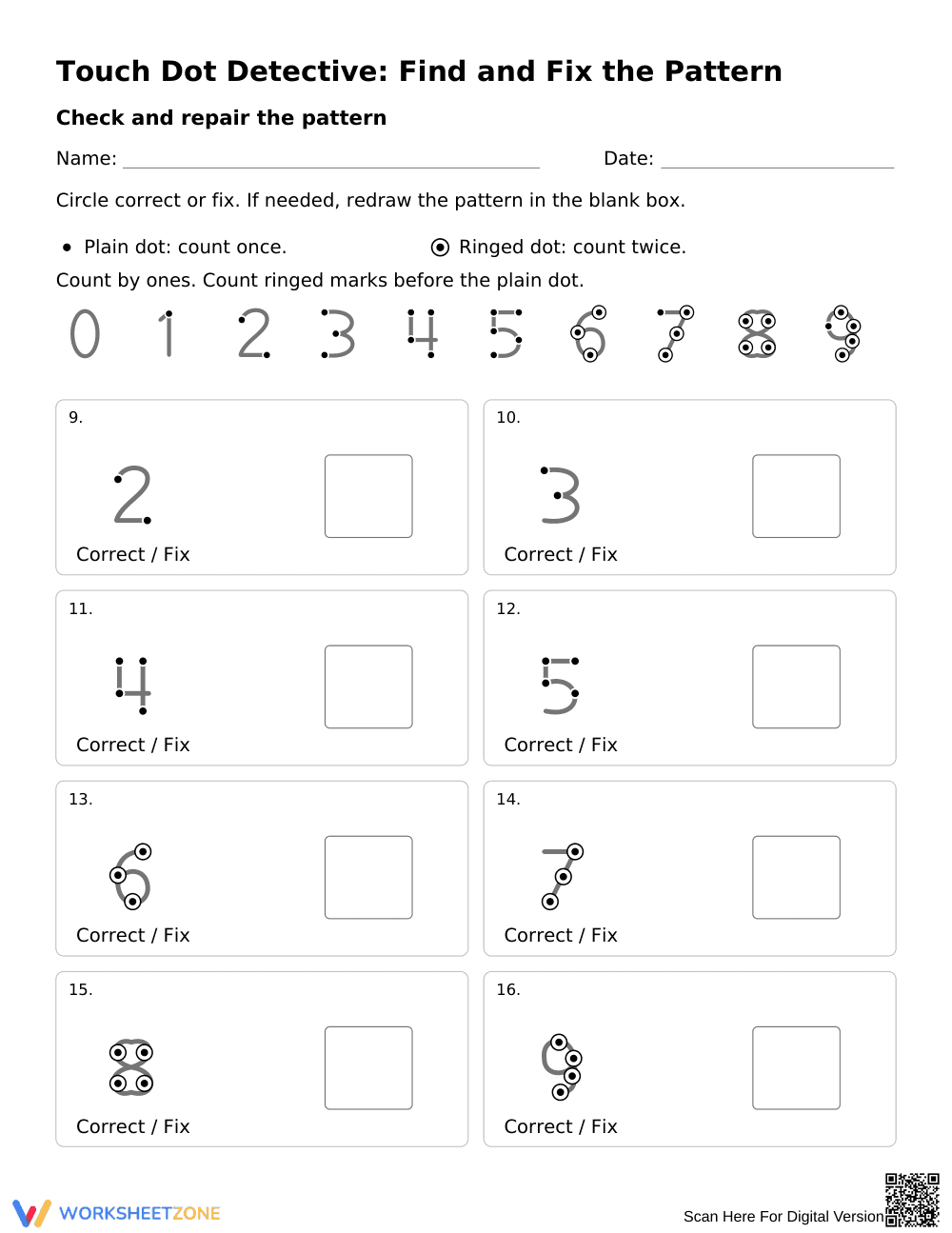
This Kindergarten touch math worksheet strengthens number sense by asking students to examine touch dot placements on the numbers 1 through 9, identify errors in each pattern, and draw the correct dots themselves. With 18 structured tasks spread across two pages, learners build the foundational counting skill that supports all later addition and subtraction with touch points.
At a Glance
- Grade: K · Subject: Math
- Standard:
CCSS.MATH.CONTENT.K.CC.B.5— Count objects to tell how many, connecting each number to its quantity- Skill Focus: Touch dot pattern recognition and correction
- Format: 2 pages · 18 problems · Answer key included · PDF
- Best For: Touch math introduction or reinforcement
- Time: 10–15 minutes
What's Inside
Each problem presents a large numeral with touch dots already placed on it. Some dots are positioned correctly; others are intentionally wrong. Students must circle the number that shows the correct dot pattern and then fix the incorrect version by drawing the dots in the right spots. The worksheet covers every single-digit number from 1 to 9, giving repeated exposure to the standard touch point locations. A complete answer key is provided so teachers or parents can check work quickly.
Skill Progression
- Guided practice (Problems 1–6): Students compare two versions of lower numbers (1–3) where dot placements are more visually distinct, building confidence with simpler quantities.
- Supported practice (Problems 7–12): Mid-range numbers (4–6) introduce double-touch points and more subtle misplacements, requiring closer inspection and stronger one-to-one correspondence.
- Independent practice (Problems 13–18): Higher numbers (7–9) demand that students recall multi-point patterns from memory and accurately reproduce them without a model.
This gradual-release structure mirrors the I Do, We Do, You Do framework, making the worksheet effective for whole-group modeling followed by independent seat work.
Standards Alignment
The primary standard is CCSS.MATH.CONTENT.K.CC.B.5. Touch dots translate abstract numerals into countable points, directly reinforcing this standard. A supporting standard, CCSS.MATH.CONTENT.K.CC.B.4, applies as students connect each dot to the counting sequence, practicing one-to-one correspondence.
How to Use It
Use this worksheet after direct instruction on touch point placement. During a small-group rotation, have students verbalize why a dot pattern is wrong before they fix it as a quick formative check. Alternatively, assign it as independent morning work once students have seen at least two modeled examples. Most Kindergarteners complete both pages in 10 to 15 minutes.
Who It's For
This resource suits Kindergarten students learning touch math for the first time or reviewing dot placements after an instructional break. It also supports students with IEP goals targeting number identification and counting accuracy. Pair it with a touch point anchor chart at student desks so learners can self-check before asking for help. With 18 problems, a built-in error-analysis component, and a full answer key, the resource offers structured practice that fits naturally into any touch math unit or intervention block.


