


























Views
Downloads

Daily Calendar Fun! Worksheet | Grade K-3 Essential
Paste this activity's link or code into your existing LMS (Google Classroom, Canvas, Teams, Schoology, Moodle, etc.).
Students can open and work on the activity right away, with no student login required.
You'll still be able to track student progress and results from your teacher account.
Establish a consistent and engaging morning routine with this comprehensive daily calendar worksheet. Designed to build temporal awareness, students practice identifying the day of the week, current month, and specific date while connecting their learning to the physical world through weather and seasonal observations. This resource transforms abstract time concepts into a concrete, repeatable success for early learners.
At a Glance
- Grade: K-3 · Subject: Math
- Standard:
CCSS.MATH.CONTENT.K.MD.B.3— Classify objects into categories and count the number of objects in each category.- Skill Focus: Calendar literacy and weather observation
- Format: 3 pages · 7 problems · Answer key included · PDF
- Best For: Morning meeting and daily warm-up routines
- Time: 5–10 minutes
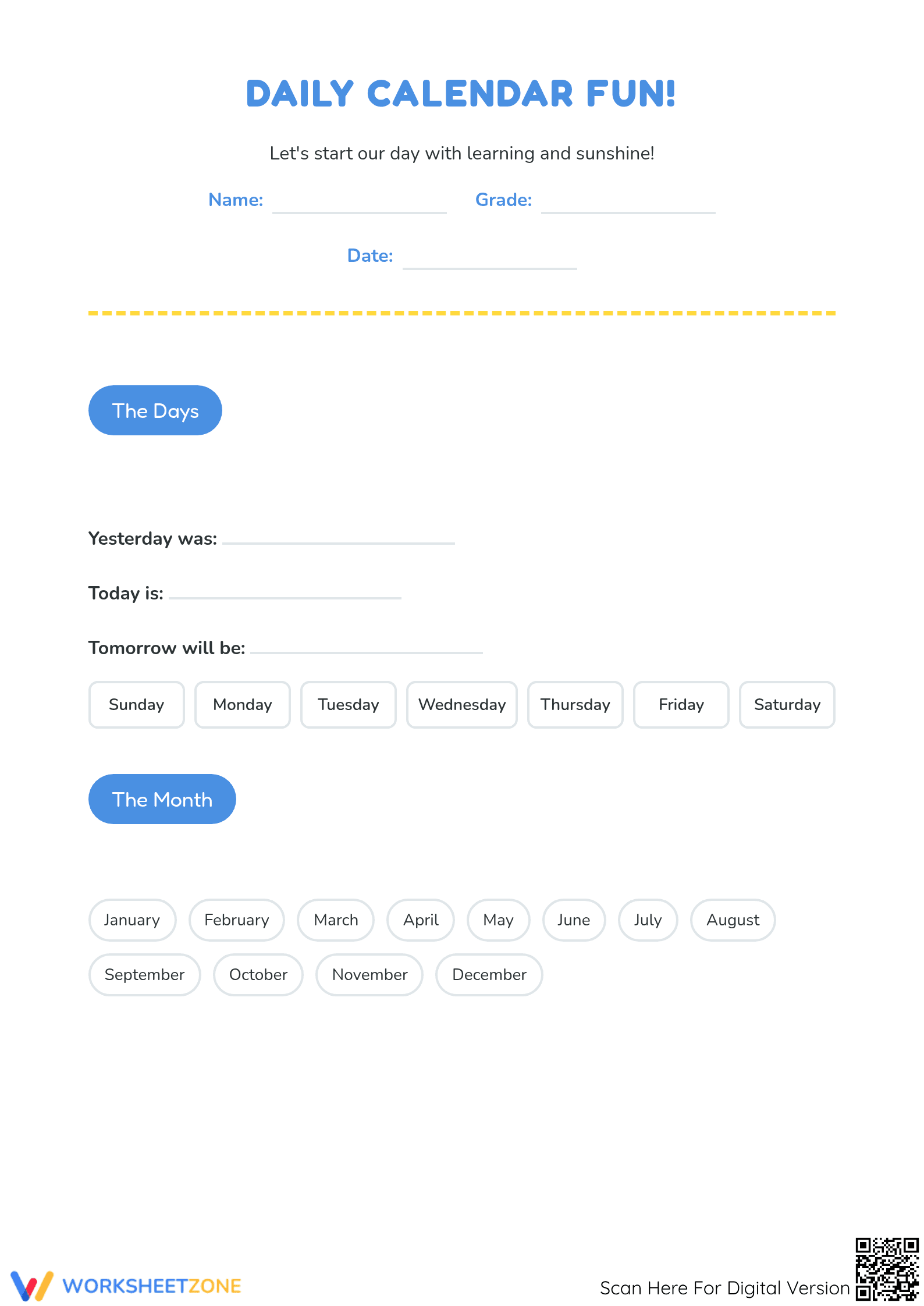
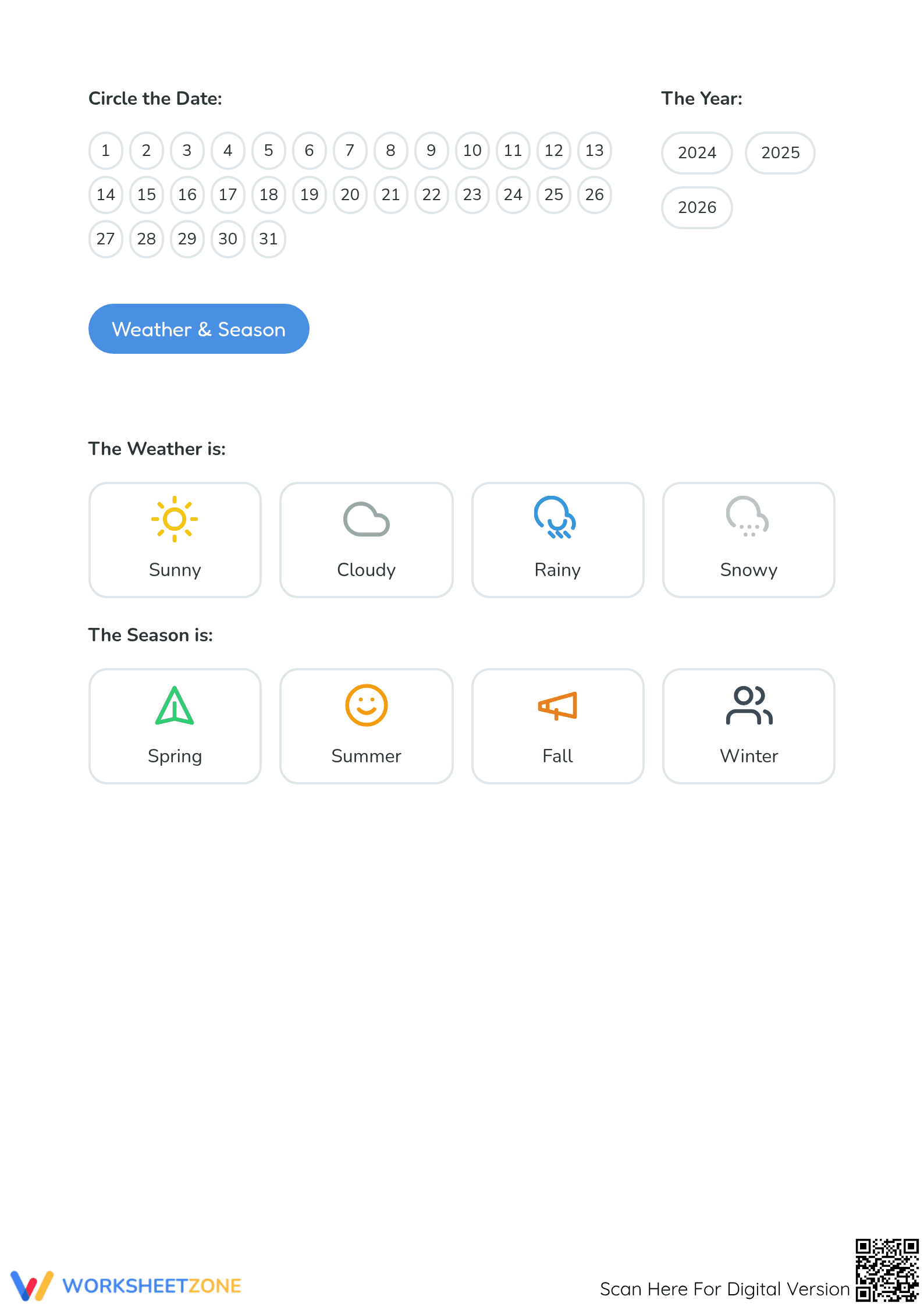
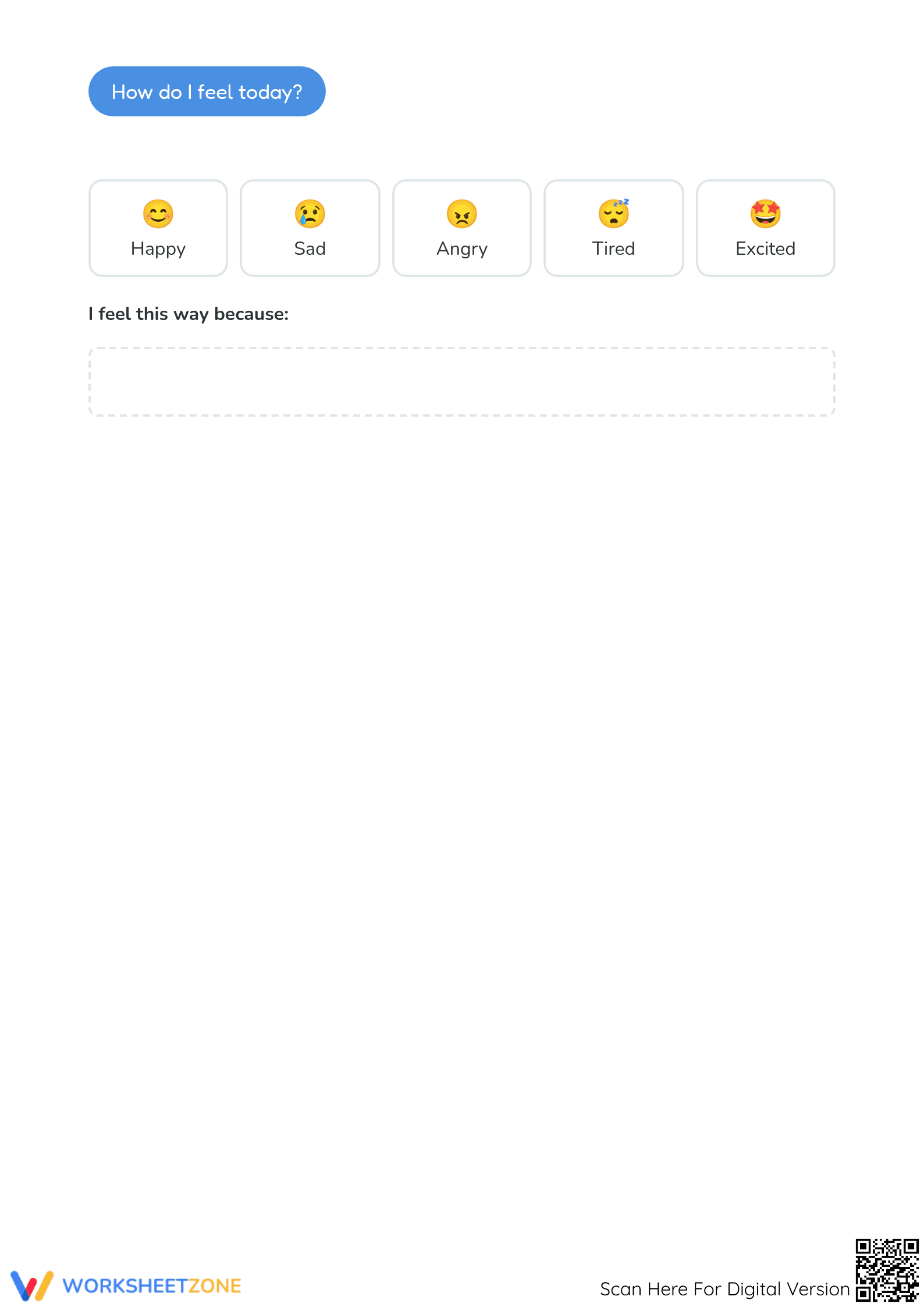
What’s Inside: This 3-page PDF provides a structured template for daily student reflection. The first page focuses on the sequence of days (Yesterday, Today, Tomorrow) and month identification. The second page features a numerical date grid for circling the day of the month, year selection, and visual icons for weather and seasons. The final page includes a Social-Emotional Learning (SEL) component where students identify their feelings and provide a brief written rationale, supporting both literacy and emotional regulation.
Zero-Prep Workflow
- Print (30 seconds): Select the specific page needed for the day or print the full 3-page packet for a week-long binder insert.
- Distribute (30 seconds): Hand out during the morning bell-ringer period or display on a smartboard for a whole-class guided activity.
- Review (1 minute): Use the included answer key or a classroom wall calendar to quickly verify student selections and facilitate a brief discussion.
This workflow ensures that teacher preparation stays under two minutes, making it an ideal choice for busy classrooms or emergency sub plans.
Standards Alignment: This resource primarily aligns with `CCSS.MATH.CONTENT.K.MD.B.3` by requiring students to categorize days, months, and weather patterns. It also supports `CCSS.ELA-LITERACY.L.2.2.A` through the practice of capitalizing holidays, product names, and geographic names, including months and days of the week. Both standard codes can be copied directly into lesson plans, IEP goals, or district curriculum mapping tools.
How to Use It: This worksheet is best utilized during the first ten minutes of the school day as a formative assessment tool. Teachers can observe how quickly students transition from identifying the day to predicting "tomorrow," which signals a developing grasp of linear time. It also serves as an excellent transition tool after recess to help students settle back into academic tasks through a familiar, low-stakes writing prompt.
Who It's For: This resource is specifically designed for Kindergarten through 3rd-grade students, including those in Special Education (SPED) settings who benefit from visual icons and predictable structures. It pairs naturally with a classroom weather station or a large-format wall calendar to provide a multi-sensory learning experience.
According to research by Fisher & Frey (2014), the use of predictable daily routines and scaffolds like this calendar worksheet significantly reduces cognitive load, allowing students to focus on higher-order temporal reasoning. By consistently engaging with the `CCSS.MATH.CONTENT.K.MD.B.3` standard through 7 distinct daily tasks, students move from simple identification to a deeper understanding of how time is categorized and measured. Data from the NAEP suggests that early exposure to these organizational structures correlates with improved mathematical fluency in later elementary years. This worksheet provides the necessary repetition for mastery while incorporating essential SEL check-ins that support the whole child. Educators can rely on this structured PDF to provide evidence of student progress in both language conventions and mathematical measurement categories throughout the academic year.


