


























Views
Downloads
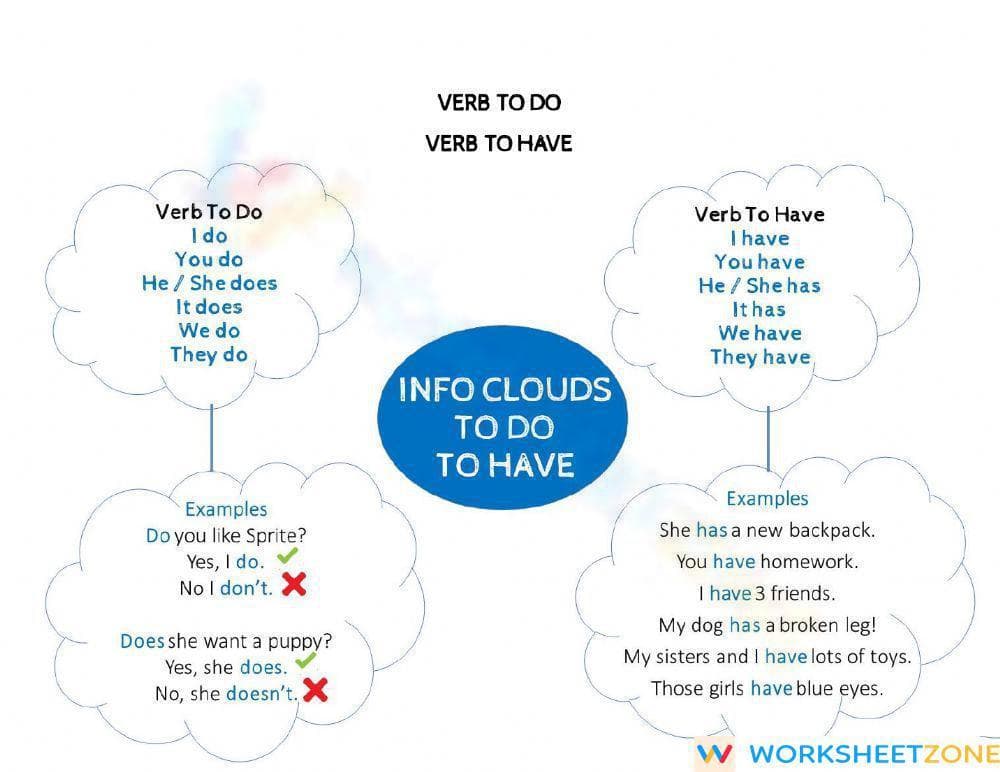


Essential To Do and To Have Verb Worksheet | Grades 1-4
Paste this activity's link or code into your existing LMS (Google Classroom, Canvas, Teams, Schoology, Moodle, etc.).
Students can open and work on the activity right away, with no student login required.
You'll still be able to track student progress and results from your teacher account.
This resource provides focused practice on verbs 'to do' and 'to have' for elementary students. Combining a visual reference guide with dialogue completion tasks, it ensures students navigate irregular conjugations. Students transition from modeled examples to applying verb forms in natural contexts, building essential fluency.
At a Glance
- Grade: 1–4 · Subject: ELA
- Standard:
CCSS.ELA-LITERACY.L.1.1.C— Use singular and plural nouns with matching verbs in basic sentences- Skill Focus: Verb to do and to have conjugation
- Format: 3 pages · 6 problems · Answer key included · PDF
- Best For: Zero-prep grammar practice and ELL support
- Time: 15–20 minutes
What's Inside
The package includes three pages for student engagement. The first page is a visual anchor with 'Info Clouds' showing conjugations for 'to do' and 'to have.' The next two pages feature a dialogue between John and Laura with six fill-in-the-blank opportunities. The layout includes illustrations and spacious lines for young writers.
Zero-Prep Workflow
This resource requires zero preparation. The workflow involves three steps: print the PDF in 30 seconds, distribute materials in 15 seconds, and use the reference clouds for a 1-minute review. Total prep time is under two minutes, making it ideal for substitute plans, bell-ringers, or formative assessments during grammar lessons.
Standards Alignment
Primary alignment is to `CCSS.ELA-LITERACY.L.1.1.C`, requiring students to use singular and plural nouns with matching verbs. This targets irregular 'do' and 'have' forms. Mastering these foundational verbs builds prerequisite skills for advanced tenses. Both standard codes can be copied directly into lesson plans, IEP goals, or district curriculum mapping tools.
How to Use It
Introduce this during the 'We Do' phase. Have students read the dialogue in pairs before filling blanks. This offers formative assessment; check if students identify subjects before choosing verb forms. Completion time is fifteen to twenty minutes, depending on familiarity and reading speed.
Who It's For
Designed for Grades 1-4, this supports students developing word class understanding. It is excellent for ELLs needing explicit modeling. The visual layout supports diverse learners with a constant reference. Pair this with a reading passage highlighting these verbs for a complete sequence.
According to the RAND AIRS 2024 analysis of primary literacy instructional materials, the use of visual anchor charts paired with conversational contexts significantly accelerates the acquisition of irregular verb forms in young learners. This worksheet utilizes this evidence-based strategy by providing students with an 'Info Cloud' reference system that explicitly models the conjugation of verbs 'to do' and 'to have' before requiring independent application. By embedding the practice within a relatable dialogue between characters, the resource ensures that Grade 1 through Grade 4 students understand the semantic utility of these verbs beyond rote memorization. The alignment to CCSS.ELA-LITERACY.L.1.1.C focuses on the core requirement of subject-verb agreement, a critical milestone for developing sentence-level fluency. Educators can rely on this self-contained resource to bridge the gap between recognizing word classes and applying them accurately in both spoken and written academic English, ensuring a robust foundation for more complex grammatical structures.


