




























Views
Downloads




Grade 2 Telling Time Worksheet | Essential Clock Practice

Paste this activity's link or code into your existing LMS (Google Classroom, Canvas, Teams, Schoology, Moodle, etc.).
Students can open and work on the activity right away, with no student login required.
You'll still be able to track student progress and results from your teacher account.
Mastering the Clock
Telling time is a pivotal Grade 2 skill connecting abstract numbers to daily life. This worksheet provides a multi-activity approach to ensure students read, write, and manipulate time on analog and digital clocks. Students will demonstrate proficiency in standard-aligned techniques while building the spatial-temporal reasoning necessary for future mathematical success.
At a Glance
At a Glance
- Grade: 2 · Subject: Math
- Standard:
2.MD.C.7— Tell and write time to the nearest five minutes using analog and digital clocks- Skill Focus: Telling time and elapsed time
- Format: 4 pages · 8 problems · Answer key included · PDF
- Best For: Independent practice and formative assessment
- Time: 20–30 minutes
What's Inside
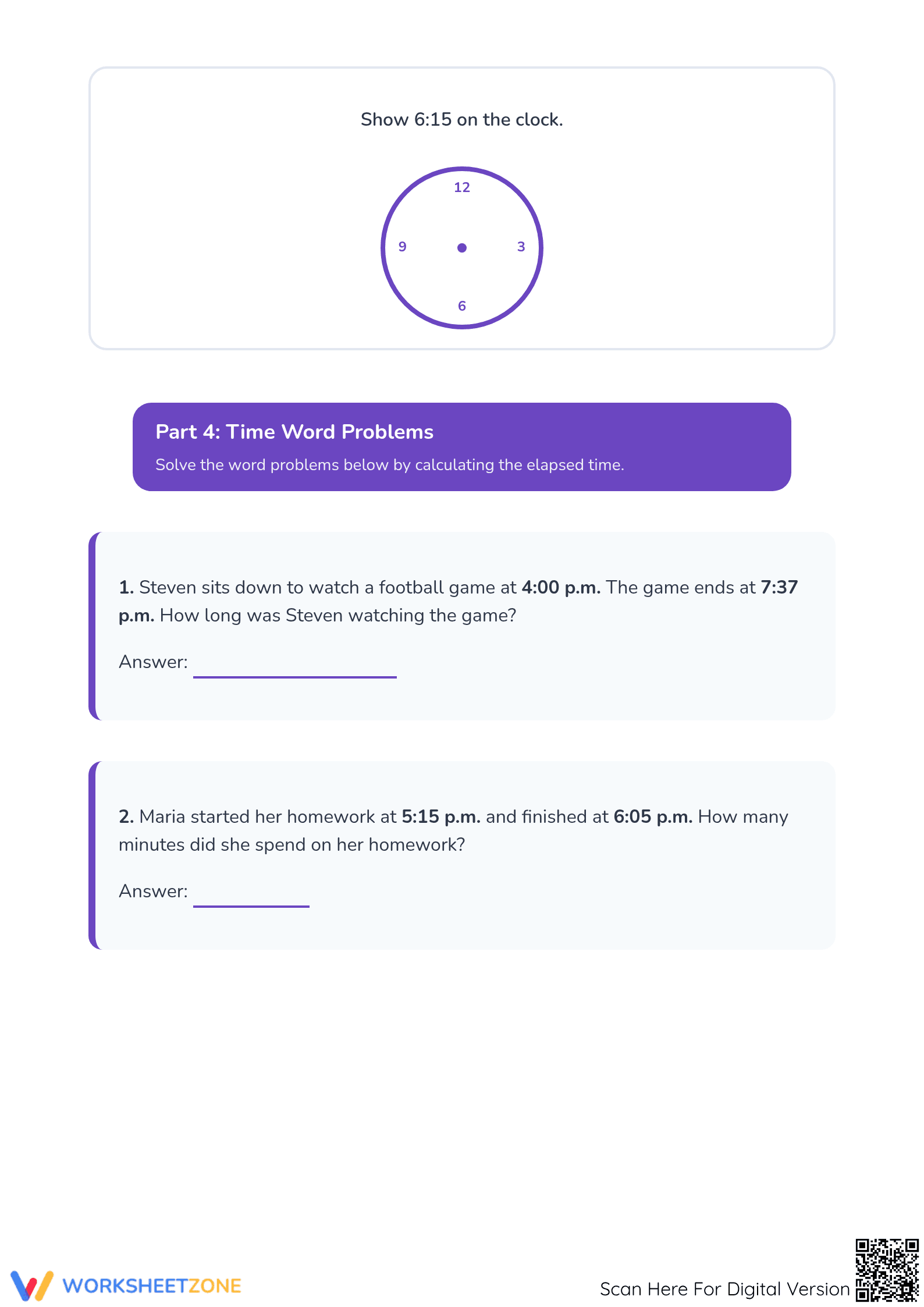
This 4-page PDF contains 8 rigorous tasks across four distinct parts. Students match digital prompts to analog faces, write digital times from clock images, and draw hands for specific times. The final section features two word problems calculating elapsed time in real-world contexts. A complete answer key is included for effortless grading and immediate feedback.
Skill Progression
- Guided Recognition: Students identify a digital time from a set of analog options to reinforce visual discrimination and recognize the clock face structure.
- Clock Construction: Students produce times by reading analog faces and drawing hands for specific prompts like 10:42, focusing on hand length differentiation.
- Analytical Application: Learners solve word problems involving intervals and start/end times to demonstrate functional mastery of time in context.
This sequence follows a gradual-release model, moving from basic identification to independent application of time-telling concepts.
Standards Alignment
Aligned to 2.MD.C.7, this resource targets telling time to the nearest five minutes using a.m. and p.m. designations. It addresses the complexity of five-minute intervals, a significant progression from first-grade benchmarks. This standard code can be copied directly into lesson plans, IEP goals, or district curriculum mapping tools to ensure instructional compliance.
How to Use It
Use this as independent practice or a formative assessment after direct instruction. Observe students drawing hands; a common pitfall is failing to distinguish between the short hour and long minute hands. For an extension, have students explain their logic for the elapsed time problems. This activity typically takes 20 to 30 minutes to complete.
Who It's For
Designed for Grade 2, this also serves as a review for Grade 3 or a challenge for advanced Grade 1 learners. It pairs well with physical analog clocks or classroom anchor charts. The structured layout supports students needing clear visual boundaries and consistent formatting to maintain focus during math rotations.
The CCSS.MATH.CONTENT.2.MD.C.7 standard requires Grade 2 students to tell and write time from analog and digital clocks to the nearest five minutes, utilizing a.m. and p.m. designations. This worksheet operationalizes this via a multimodal framework including identification, construction, and application. Research from the RAND AIRS 2024 report highlights that concrete representational models, like analog faces, are critical for internalizing the base-60 system and developing spatial-temporal reasoning. By transitioning from recognition to elapsed time calculation, this resource supports the cognitive shift toward mathematical fluency. The integration of digital-to-analog conversion ensures students remain proficient in traditional methods within a digital environment. This specific sequence provides the necessary repetition to move students toward mastery of standard-aligned benchmarks. It is an essential component for any second-grade curriculum, ensuring students are prepared for more complex interval calculations in subsequent grades.


