


























Views
Downloads
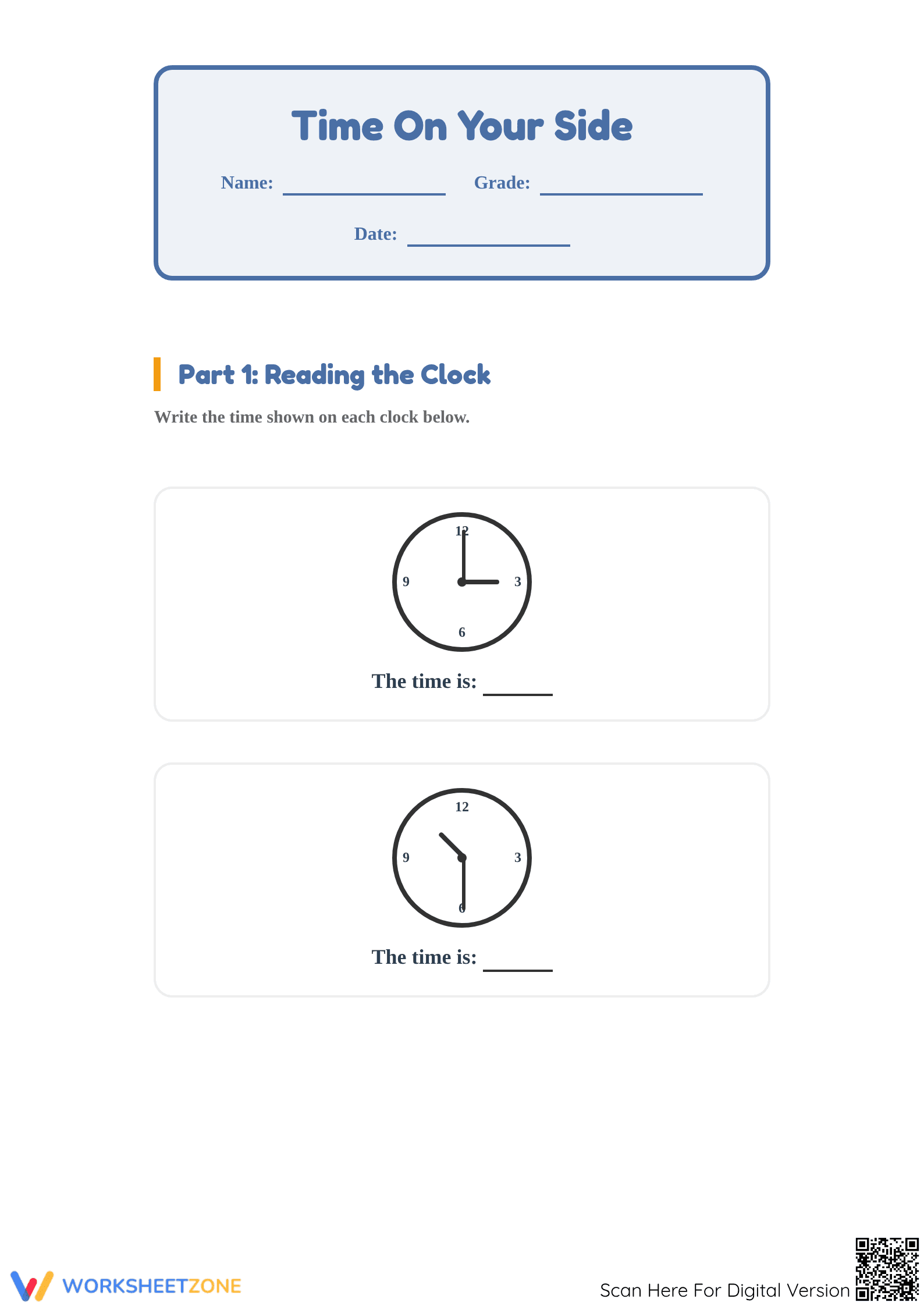


Grade 2 Telling Time — Printable No-Prep Worksheet
Paste this activity's link or code into your existing LMS (Google Classroom, Canvas, Teams, Schoology, Moodle, etc.).
Students can open and work on the activity right away, with no student login required.
You'll still be able to track student progress and results from your teacher account.
This printable Grade 2 math worksheet provides essential practice for telling time on analog clocks and solving basic elapsed time word problems. By working through visual clock-reading exercises and real-world time challenges, students build the foundational numeracy skills required to understand daily schedules and time intervals. It is designed for immediate classroom integration with zero preparation required.
At a Glance
- Grade: 2 · Subject: Math
- Standard:
2.MD.C.7— Tell and write time from analog and digital clocks to the nearest five minutes- Skill Focus: Analog clock reading and elapsed time
- Format: 2 pages · 7 problems · Answer key included · PDF
- Best For: Independent practice or quick formative assessment
- Time: 15–20 minutes
The worksheet is divided into two focused sections across two high-quality pages. Part 1 features four clear analog clock faces where students must identify and write the correct time. Part 2 presents three "Time Challenges" that require students to think critically about how time moves, including calculating time one hour into the future and 30 minutes into the past. A comprehensive answer key is included for rapid grading.
Implementing this resource into your math block is a streamlined three-step process. First, print the two-page PDF (10 seconds). Second, distribute copies for independent work during your "You Do" phase (1 minute). Third, use the answer key to review responses or grade papers (30 seconds). This efficiency makes it an ideal choice for substitute lesson plans or quick morning work.
This resource is strictly aligned to 2.MD.C.7, which requires students to tell and write time from analog and digital clocks to the nearest five minutes. The word problems also touch upon measurement concepts by introducing the logic of time intervals. This standard code can be copied directly into lesson plans, IEP goals, or district curriculum mapping tools to ensure instructional compliance.
Use this worksheet as a mid-unit formative assessment to gauge student comfort with analog clocks before moving to more complex elapsed time concepts. During the activity, observe if students are confusing the hour and minute hands—a common misconception at this grade level. It also serves as an excellent "Early Finisher" task or a focused homework assignment that parents can easily support.
The worksheet is tailored for second-grade students who are transitioning from telling time to the hour and half-hour to more precise increments. The clean layout and large clock faces support learners who need visual clarity, while the word problems provide a slight extension for on-grade-level thinkers. Pair this resource with classroom manipulative clocks for students who benefit from tactile reinforcement during problem-solving.
Effective math instruction for Grade 2 requires a balance of procedural fluency and conceptual understanding. According to Fisher & Frey (2014), the use of "gradual release" structures—moving from visual prompts to abstract problems—is critical for mastery. This worksheet implements that progression by starting with clock reading before challenging students to calculate elapsed intervals. The inclusion of 2.MD.C.7 alignment ensures that the complexity level remains appropriate for the developmental stage of seven- and eight-year-old learners. As noted in the NAEP framework, early competency with analog clocks correlates with better proportional reasoning and fractional understanding in later grades. By providing seven distinct opportunities for practice, this resource ensures that students move beyond rote memorization to a functional grasp of how time flows, supported by a clear answer key for feedback.


