


























Views
Downloads

Thinking BIG! Synonyms and Antonyms | Essential Grade 2
Paste this activity's link or code into your existing LMS (Google Classroom, Canvas, Teams, Schoology, Moodle, etc.).
Students can open and work on the activity right away, with no student login required.
You'll still be able to track student progress and results from your teacher account.
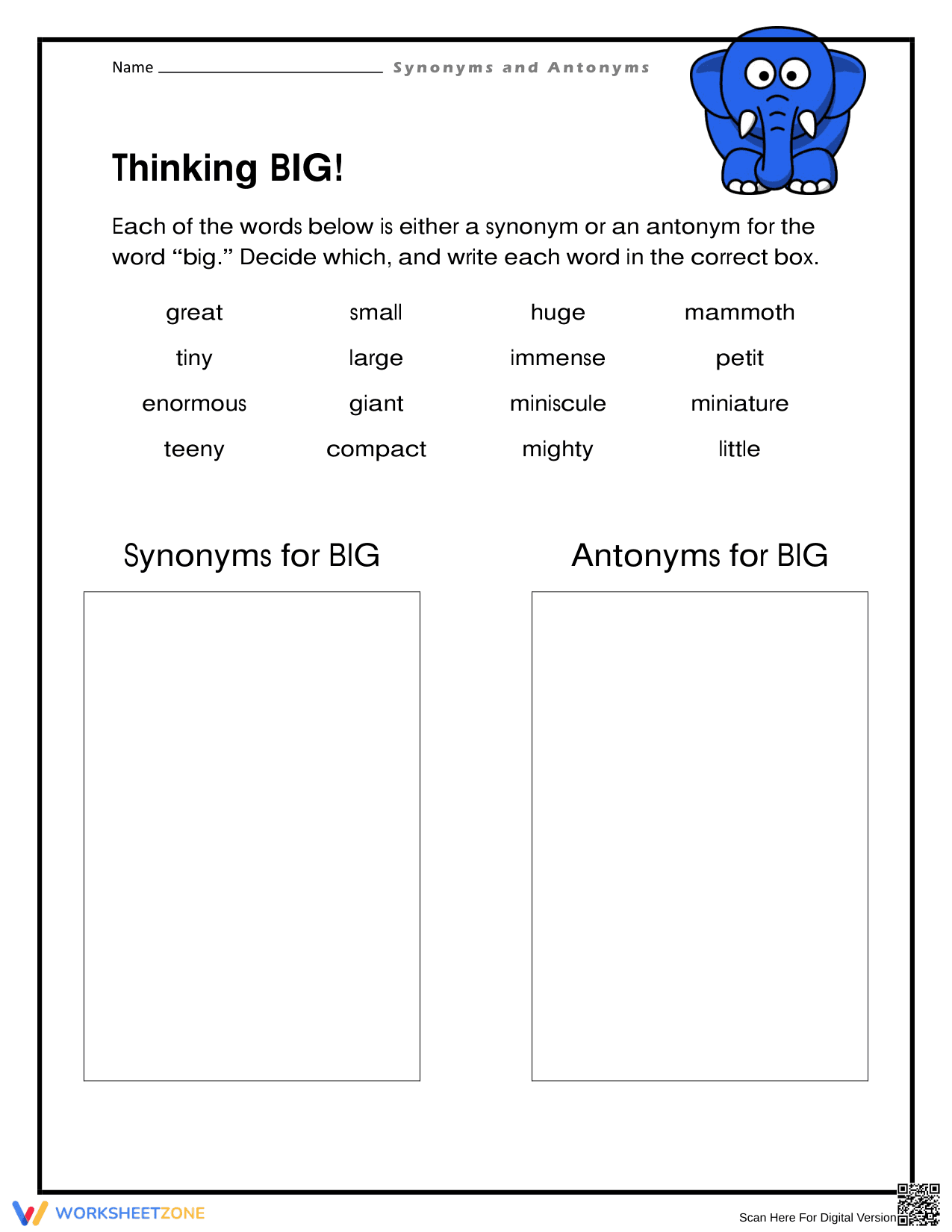
This Grade 2 Thinking BIG! worksheet helps students master the relationship between similar and opposite words by sorting vocabulary related to the concept of size. Students analyze 16 different terms to determine if they function as synonyms or antonyms for "big," strengthening their linguistic precision and expanding their descriptive writing toolkit.
At a Glance
- Grade: 2 · Subject: English Language Arts
- Standard:
CCSS.ELA-LITERACY.L.2.5— Identify real-life connections between words and their use and distinguish shades of meaning- Skill Focus: Synonyms and Antonyms
- Format: 1 page · 16 problems · Answer key included · PDF
- Best For: Literacy centers, independent seatwork, homework, or formative vocabulary assessment
- Time: 10–15 minutes
This focused one-page resource features a clear, student-friendly layout with a central word bank of 16 adjectives. The set includes common words like "huge" and "small" alongside more sophisticated vocabulary like "mammoth," "immense," and "miniscule." Two distinct sorting boxes provide an organized space for students to categorize their findings, supported by a fun elephant illustration that reinforces the "big" theme.
Zero-Prep Workflow: 1. Print: Generate copies for your entire class in less than 30 seconds. 2. Distribute: Hand out the worksheets as a transition activity or a focused center task after direct instruction; no teacher explanation is required as the instructions are self-contained. 3. Review: Use the included answer key to grade the 16 items in under a minute, providing immediate feedback on student comprehension. Total teacher prep time is under 2 minutes, making this ideal for sub plans.
Standards Alignment
This worksheet is aligned to CCSS.ELA-LITERACY.L.2.5, which requires students to demonstrate understanding of word relationships. By contrasting synonyms like "large" and "gigantic" against antonyms like "tiny" and "miniature," learners build a deeper conceptual map of how adjectives modify meaning. This standard code can be copied directly into lesson plans, IEP goals, or district curriculum mapping tools.
How to Use It
Use this worksheet as a formative assessment after introducing the concept of synonyms and antonyms. Observe how students handle nuanced words like "mighty" or "compact" to identify who needs additional vocabulary support. It also works perfectly as a quiet-time activity for early finishers or as a simple, effective addition to an emergency sub plan folder for Grade 2. Completion typically takes 10 to 15 minutes.
Who It's For
Designed primarily for second-grade students, this resource is also suitable for first-grade enrichment or third-grade review. It supports English Language Learners by providing a clear visual structure for word associations. Pair this worksheet with a descriptive writing lesson where students replace overused words with the more descriptive synonyms they have just categorized in their sorting boxes.
Research from Fisher & Frey (2014) highlights that word sorting is a high-leverage instructional strategy for building morphological awareness and lexical depth. By engaging in categorical thinking, students move beyond simple definitions to understand the structural relationships between words. This Grade 2 worksheet facilitates this process through 16 targeted tasks focused on synonyms and antonyms for the word "big," a foundational adjective in primary education. The activity aligns with CCSS.ELA-LITERACY.L.2.5, ensuring that student practice remains focused on established academic benchmarks. According to the NAEP framework, early mastery of word relationships is a significant predictor of long-term reading comprehension success. Teachers can use this tool to provide evidence of student progress toward specific language goals. This resource offers a structured, evidence-based approach to vocabulary acquisition that is ready for immediate classroom implementation, requiring zero teacher preparation time while delivering measurable learning outcomes.


