


























Views
Downloads


Grade 3 The Seasons — Printable No-Prep Worksheet
Paste this activity's link or code into your existing LMS (Google Classroom, Canvas, Teams, Schoology, Moodle, etc.).
Students can open and work on the activity right away, with no student login required.
You'll still be able to track student progress and results from your teacher account.
This printable Grade 3 reading comprehension worksheet provides a comprehensive exploration of Earth's four seasons. Students will engage with a detailed passage explaining the characteristics of spring, summer, autumn, and winter, as well as the scientific reason behind these cycles. This resource ensures students can identify key details and explain scientific relationships through evidence-based reading.
At a Glance
- Grade: 3 · Subject: ELA
- Standard:
CCSS.ELA-LITERACY.RI.3.1— Ask and answer questions to demonstrate understanding of a text by referring to facts.- Skill Focus: Informational Text Comprehension
- Format: 4 pages · 12 problems · Answer key included · PDF
- Best For: Independent reading practice and science integration
- Time: 25–35 minutes
What's Inside
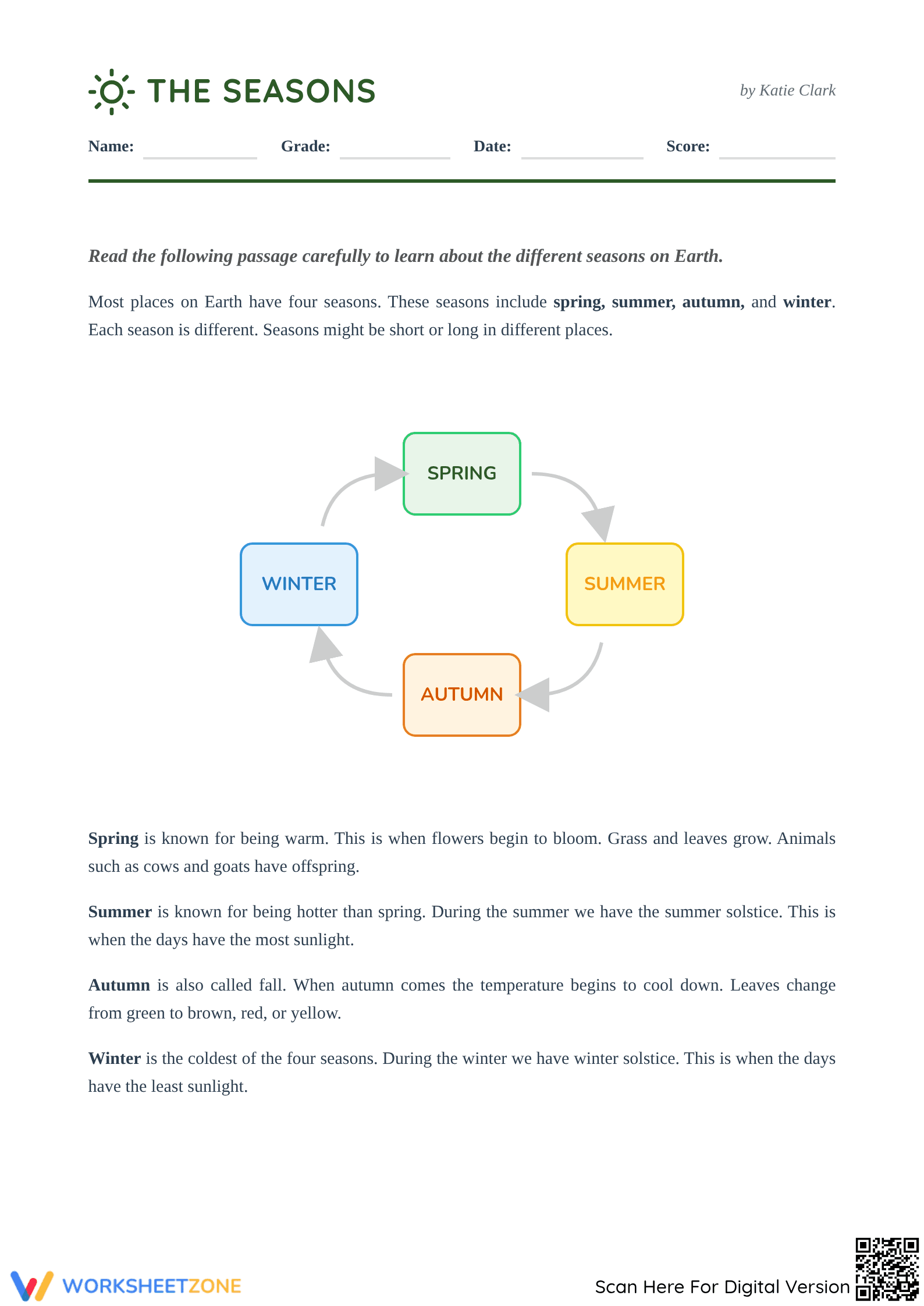
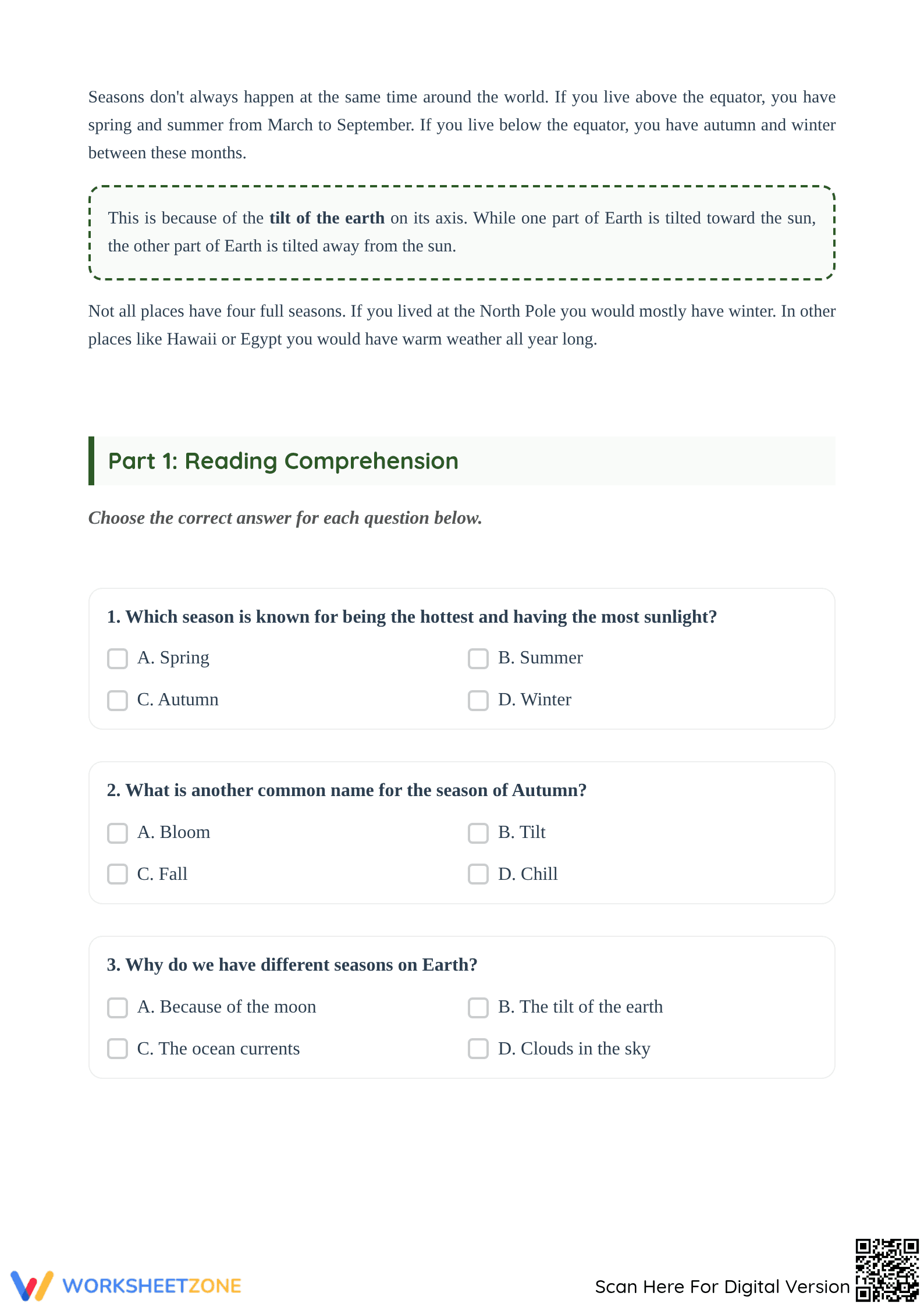
Inside this four-page packet, you will find a multi-part instructional sequence. The first page features an illustrated informational passage with a seasonal cycle diagram. Subsequent pages include three multiple-choice comprehension questions, three fill-in-the-blank sentences using text evidence, two short-answer prompts requiring complete sentences, and a final matching activity to reinforce the specific characteristics of each season.
Zero-Prep Workflow
This classroom-ready resource follows a streamlined zero-prep workflow designed for busy educators. Step 1: Print the four-page PDF in about thirty seconds. Step 2: Distribute to students for independent or small-group work sessions. Step 3: Use the included answer key for rapid grading or peer review. Total teacher preparation time is less than two minutes from download to delivery, making it ideal for sub plans.
Standards Alignment
This resource is explicitly aligned to the primary standard `CCSS.ELA-LITERACY.RI.3.1`. This standard requires students to ask and answer questions to demonstrate understanding of a text, referring explicitly to the text as the basis for the answers. Both standard codes can be copied directly into lesson plans, IEP goals, or district curriculum mapping tools for documentation and progress monitoring.
How to Use It
Use this worksheet during a unit on the seasons in either ELA or Science blocks. It works effectively as a post-instructional assessment after a lesson on Earth's tilt. For formative assessment, observe students as they complete the Short Answer section; specifically, check if they are quoting text evidence about the North Pole or Hawaii to justify their answers. Completion typically takes thirty minutes.
Who It's For
This worksheet is ideal for third-grade students developing informational reading skills. It provides enough scaffolding for struggling readers while offering extension through the short-answer contrast task. This resource pairs naturally with a weather-tracking anchor chart or a short video passage about the summer and winter solstices to deepen conceptual understanding and vocabulary acquisition.
Educational research underscores the importance of integrating content-area knowledge, such as Earth science, with literacy instruction to improve overall comprehension. According to Fisher & Frey (2014), engaging with complex informational texts through structured questioning allows students to build the necessary mental models for long-term retention of scientific concepts. This worksheet specifically addresses the `CCSS.ELA-LITERACY.RI.3.1` standard by requiring learners to extract specific details—such as the role of the Earth's tilt—and apply them to answer diverse question formats. By moving from multiple-choice recognition to short-answer production, the resource supports the gradual release of responsibility. The inclusion of the plain-English skill of answering text-based questions ensures that students remain focused on evidence-based reading. This structured approach is a proven method for bridging the gap between decoding and deep conceptual mastery in elementary ELA classrooms, making it an essential tool for evidence-based instruction.


