


























Views
Downloads
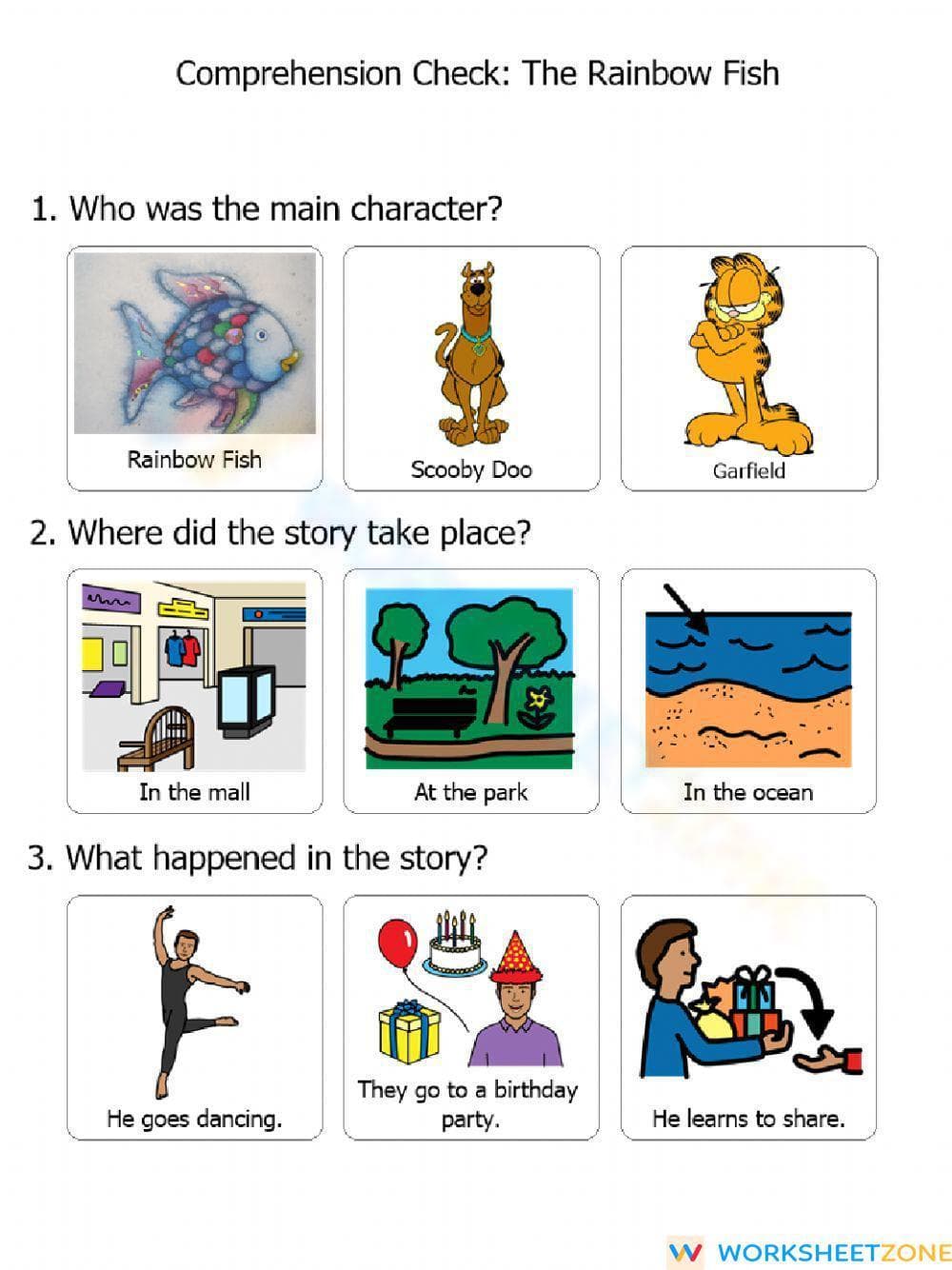

Rainbow Fish Comprehension Worksheet | Grade 1-3 Essential
Paste this activity's link or code into your existing LMS (Google Classroom, Canvas, Teams, Schoology, Moodle, etc.).
Students can open and work on the activity right away, with no student login required.
You'll still be able to track student progress and results from your teacher account.
This Rainbow Fish comprehension worksheet helps early readers identify key story elements including characters, setting, and plot events through accessible visual cues. Students demonstrate their understanding of the classic narrative by selecting correct illustrations for three core questions. This resource ensures immediate feedback and high engagement for Kindergarten through Grade 3 learners during literacy blocks.
At a Glance
- Grade: 1 · Subject: ELA
- Standard:
CCSS.ELA-LITERACY.RL.1.3— Describe characters, settings, and major events in a story using key details- Skill Focus: Story Elements & Comprehension
- Format: 1 page · 3 problems · Answer key included · PDF
- Best For: Independent reading centers and sub plans
- Time: 5–10 minutes
The worksheet features a streamlined, single-page layout designed for visual learners. It includes three multiple-choice questions focusing on the "who," "where," and "what" of the story. Each question is accompanied by three high-quality images with simple labels, allowing emerging readers to participate successfully. A clear answer key is included to facilitate rapid grading or student self-correction.
Implementing this resource requires minimal effort, perfect for busy classrooms. First, print the PDF in seconds. Second, distribute copies; since directions are self-explanatory, teacher introduction takes under one minute. Finally, review answers as a group or use the key for a quick check. Total preparation time is well under two minutes, making it an ideal sub plan.
Standards Alignment
The primary focus of this assessment is CCSS.ELA-LITERACY.RL.1.3, which requires students to "Describe characters, settings, and major events in a story, using key details." By isolating these three distinct elements, the worksheet provides a clear snapshot of a student's ability to recall specific narrative components. Both standard codes can be copied directly into lesson plans, IEP goals, or district curriculum mapping tools.
How to Use It
Use this worksheet as a formative "quick check" after a read-aloud of *The Rainbow Fish*. It serves as an excellent transition between direct instruction and independent work. While students work, observe whether they utilize the images or text labels to gauge their literacy independence. Most learners will complete the activity in under eight minutes.
Who It's For
This resource is designed for students in Kindergarten through Grade 3, with particular utility for English Language Learners (ELL) and students with IEPs who benefit from visual scaffolds. The pictorial options reduce the cognitive load of decoding, allowing the focus to remain strictly on comprehension. It pairs naturally with the original picture book by Marcus Pfister or a digital video reading of the text.
Effective comprehension instruction for early readers relies on visual support to bridge the gap between listening and analysis. According to the NAEP framework, identifying literal details like characters and setting forms the foundation for higher-order inferencing in later grades. This worksheet aligns with best practices identified in Fisher & Frey (2014) regarding scaffolds in early literacy. By providing clear visual choices, educators can accurately assess narrative recall without the interference of underdeveloped writing skills. The specific alignment to CCSS.ELA-LITERACY.RL.1.3 ensures practice remains focused on core requirements while maintaining student engagement. This printable PDF offers a reliable method for documenting progress toward mastery of key ideas and details in literary texts. This assessment tool is a valuable addition to any primary ELA curriculum.


