


























Views
Downloads

Printable St. Patrick's Day Maze | Grade 1 Logic
Paste this activity's link or code into your existing LMS (Google Classroom, Canvas, Teams, Schoology, Moodle, etc.).
Students can open and work on the activity right away, with no student login required.
You'll still be able to track student progress and results from your teacher account.
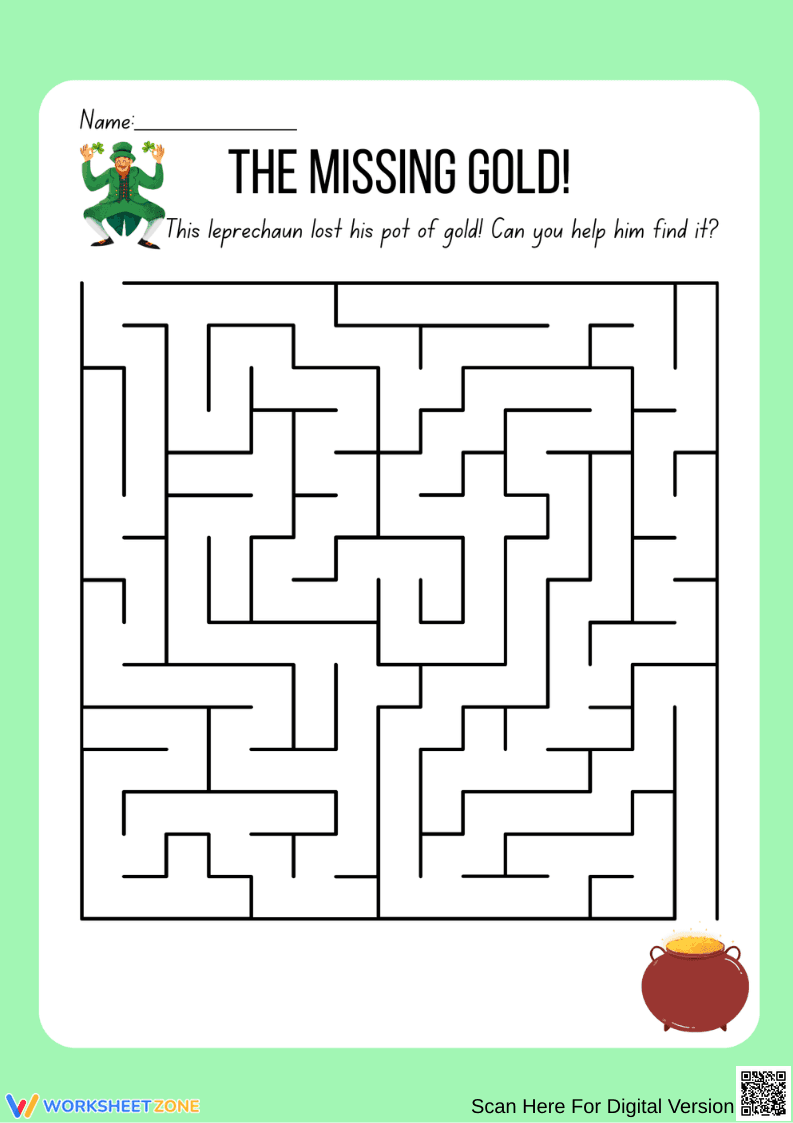
This engaging St. Patrick's Day maze worksheet challenges early learners to build spatial reasoning and problem-solving skills. Students help a leprechaun navigate a complex path to find his missing pot of gold. This single-page activity provides focused cognitive practice while celebrating the holiday with a fun, thematic puzzle.
At a Glance
- Grade: 1 · Subject: Logic
- Standard:
CCSS.MATH.PRACTICE.MP1— Persevere in solving complex spatial puzzles- Skill Focus: Spatial reasoning
- Format: 1 page · 1 problem · No answer key · PDF
- Best For: Morning work or early finishers
- Time: 10–15 minutes
Inside this resource is a single, full-page maze activity with a festive St. Patrick's Day theme. Students trace a continuous path from the leprechaun to the pot of gold. The maze features multiple dead ends designed to test visual tracking and fine motor control. The clean layout ensures students remain focused on the spatial challenge.
This print-and-go resource requires zero teacher preparation.
- Print (1 min): Download the PDF and print. The black-and-white lines ensure ink-saving reproduction.
- Distribute (1 min): Hand out with pencils. Instructions are self-explanatory, requiring no setup.
- Review (1 min): Students self-correct by retracing steps, minimizing teacher intervention.
With prep time under two minutes, this is suitable for sub plans or morning work.
This worksheet aligns with CCSS.MATH.PRACTICE.MP1: Make sense of problems and persevere in solving them. By navigating the maze, students practice sustained attention and strategic planning to reach a specific goal. It also supports early fine motor development necessary for handwriting. Both standard codes can be copied directly into lesson plans, IEP goals, or district curriculum mapping tools.
Use this puzzle as engaging morning work to activate cognitive skills at the start of the day. Alternatively, keep a stack in an early finisher folder for a quiet, productive challenge. While students work, observe their pencil grip and visual tracking as a formative assessment of fine motor development. Expect completion within a 10 to 15-minute timeframe.
This resource is primarily designed for Kindergarten through Grade 3 students developing their spatial awareness and problem-solving endurance. It serves as an excellent tool for occupational therapy sessions focusing on hand-eye coordination and pencil control. For differentiation, encourage students who struggle with fine motor skills to trace the path with their finger before using a pencil. Pair this activity with a St. Patrick's Day read-aloud or a thematic math lesson to create a cohesive holiday learning experience.
Developing spatial reasoning through activities like mazes is a critical component of early cognitive development. This worksheet aligns with CCSS.MATH.PRACTICE.MP1, requiring students to persevere in solving complex spatial puzzles. According to a comprehensive EdReports 2024 analysis, integrating visual-spatial tasks into early education significantly improves later mathematical achievement and logical reasoning capabilities. Mazes specifically train the brain to anticipate outcomes, plan routes, and execute precise motor movements. By engaging with this thematic puzzle, young learners practice sustained attention and self-correction in a low-stakes environment. The ability to navigate visual obstacles and maintain focus on a distant goal translates directly to more complex academic problem-solving tasks. This targeted practice ensures students build the foundational cognitive endurance necessary for advanced mathematical concepts and reading comprehension strategies in subsequent grade levels.


