




























Views
Downloads
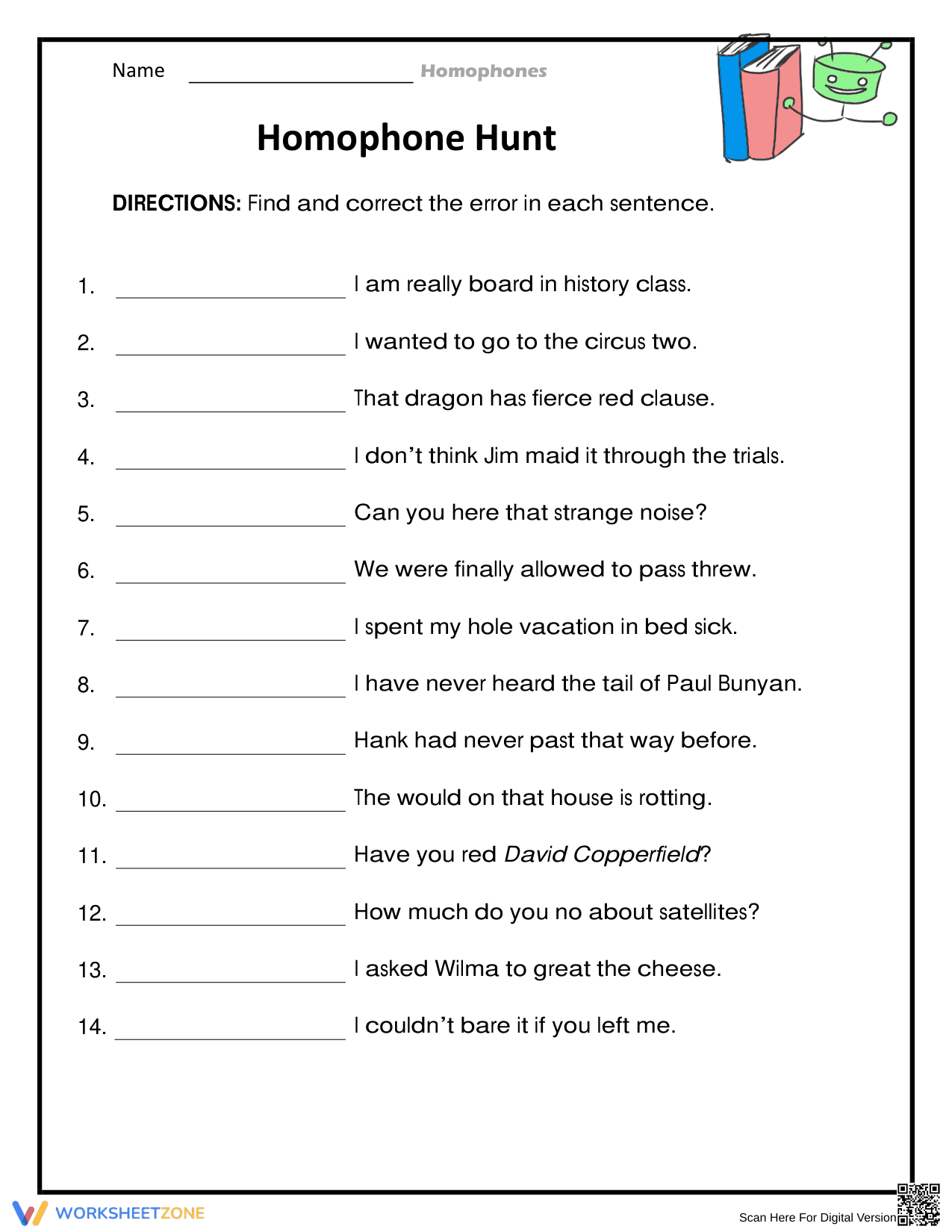

Printable Homophone Hunt Worksheet | Grade 2 English

Paste this activity's link or code into your existing LMS (Google Classroom, Canvas, Teams, Schoology, Moodle, etc.).
Students can open and work on the activity right away, with no student login required.
You'll still be able to track student progress and results from your teacher account.
Homophones can be quite tricky for young learners to master. This Grade 2 "Homophone Hunt" worksheet provides focused practice in identifying and correcting confused words within realistic sentences. Hunting for errors like "board" versus "bored" helps students significantly strengthen their spelling accuracy and reading comprehension skills through active engagement.
At a Glance
- Grade: 2 · Subject: ELA Grammar
- Standard:
CCSS.ELA-LITERACY.L.2.1— Use context clues to identify and correct frequently confused words in text- Skill Focus: Homophone identification and correction
- Format: 1 high-quality page · 14 unique problems · Full answer key included · PDF
- Best For: Independent practice, homework, or literacy center rotations
- Time: 15–20 minutes
What's Inside
This single-page PDF includes 14 carefully crafted sentences, each containing one intentional homophone error. Students must read the sentence, identify the incorrect word, and write the correct spelling on the provided line. The worksheet features common Grade 2 homophones such as too/two, hear/here, and whole/hole. A complete answer key is provided for efficient grading.
Skill Progression
The worksheet follows a structured skill progression to build student confidence. Guided practice begins with high-frequency homophones like "bored" and "too" to establish the task. Supported practice in the middle items introduces pairs such as "here/hear" and "threw/through." Independent practice concludes the set, challenging students with trickier words like "bare/bear" and "grate/great." This gradual-release approach ensures students master using context clues effectively.
Standards Alignment
This resource is aligned with `CCSS.ELA-LITERACY.L.2.1`, which requires students to demonstrate command of the conventions of standard English grammar and usage when writing. By focusing specifically on spelling and word choice in context, it also provides foundational support for later mastery of frequently confused words. Both standard codes can be copied directly into lesson plans, IEP goals, or district curriculum mapping tools.
How to Use It
Use this worksheet as a formative assessment after a direct instruction lesson on homophones. Have students complete the "hunt" independently, then trade papers to check their work using the provided answer key. This encourages peer-to-peer discussion about word meanings. Expect students to spend approximately 15 to 20 minutes on the task, making it an ideal choice for morning work or a literacy center rotation.
Who It's For
This resource is designed for Grade 2 students but is also highly suitable for Grade 1 enrichment or Grade 3 review. It works well for ELL students who need targeted practice with English sound-alike words. Pair this worksheet with a homophone anchor chart or a short reading passage to provide students with additional visual support during their "hunt."
Research by Fisher & Frey (2014) emphasizes the importance of focused vocabulary practice through context-rich sentences to improve long-term retention. The `CCSS.ELA-LITERACY.L.2.1` standard addresses the foundational need for students to recognize how word choice impacts writing clarity. By identifying homophone errors in a "hunt" format, learners engage in active cognitive retrieval, which is more effective than passive rote memorization. This Grade 2 ELA worksheet provides exactly this type of structured engagement, offering 14 opportunities for students to apply their knowledge of frequently confused words. Studies from RAND AIRS 2024 indicate that interactive, printable resources help bridge the gap between abstract grammar rules and practical application. Using these targeted exercises allows educators to identify specific spelling misconceptions early, ensuring that students develop the essential conventions required for higher-level literacy tasks and academic success across all subjects.


