


























Views
Plays

The Boy Who Cried Wolf Worksheet | Grade 1 Ready
Paste this activity's link or code into your existing LMS (Google Classroom, Canvas, Teams, Schoology, Moodle, etc.).
Students can open and work on the activity right away, with no student login required.
You'll still be able to track student progress and results from your teacher account.
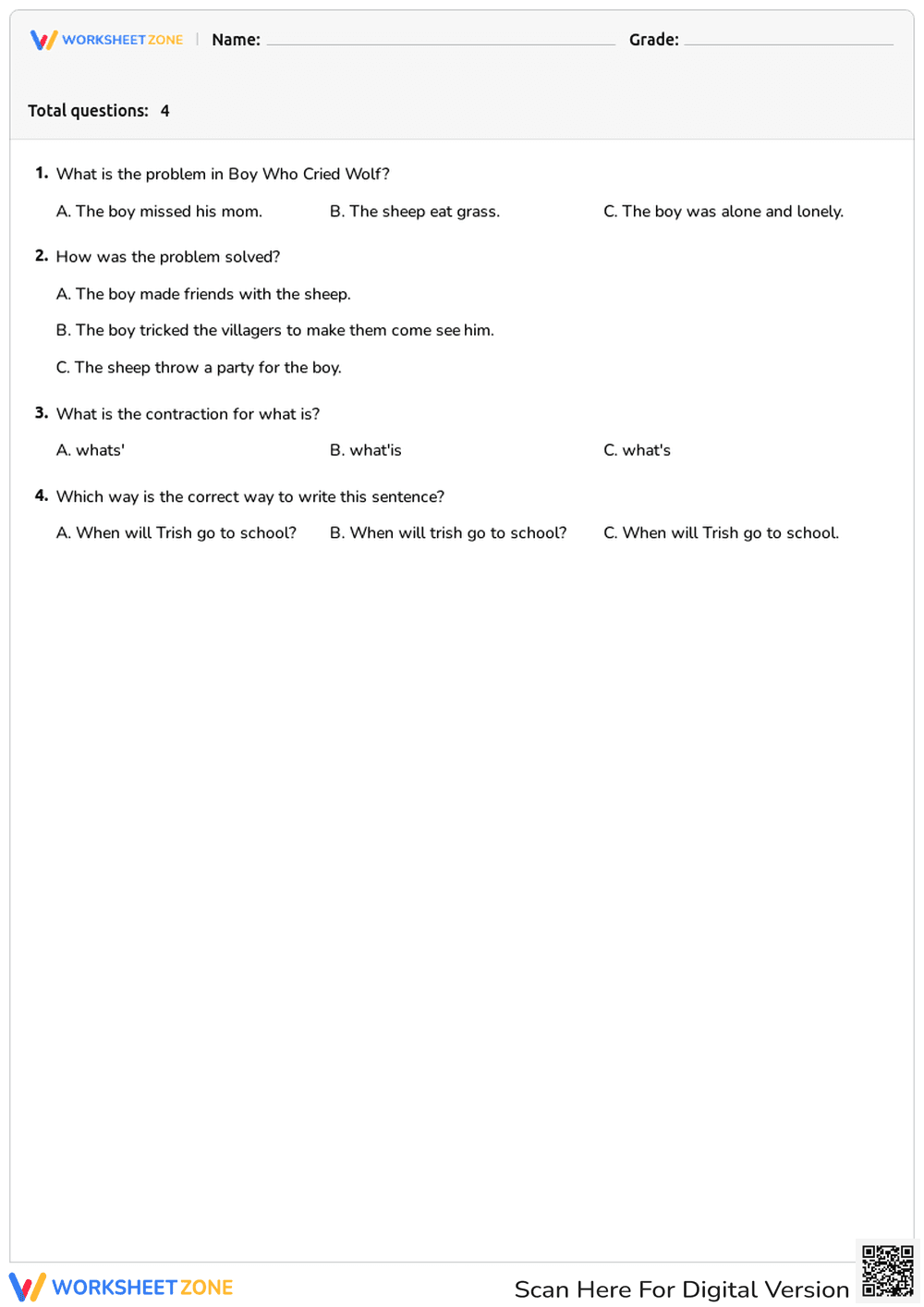
This Grade 1 reading comprehension worksheet helps students identify the central message and key story elements of the classic fable, The Boy Who Cried Wolf. By analyzing the problem and solution within the narrative, learners build foundational literacy skills while practicing essential grammar mechanics like contractions and capitalization.
At a Glance
- Grade: 1 · Subject: ELA
- Standard:
CCSS.ELA-LITERACY.RL.1.2— Retell stories and demonstrate understanding of their central message or lesson- Skill Focus: Story elements and grammar mechanics
- Format: 1 page · 4 problems · Answer key included · PDF
- Best For: Quick formative assessment or sub plans
- Time: 10–15 minutes
What's Inside
This single-page resource features four targeted multiple-choice questions. The first half focuses on reading comprehension, specifically identifying the protagonist's conflict and resolution. The second half transitions into language mechanics, requiring students to identify contractions and select properly punctuated sentences. The clean layout is ideal for students who require visual organization.
Zero-Prep Workflow
- Print: Generate the single-page PDF in under 30 seconds.
- Distribute: Hand out as a "ticket out the door" or independent practice task.
- Review: Discuss the four answers as a group to address misconceptions regarding story structure.
Total teacher preparation time is under two minutes, making this an ideal resource for busy mornings or unexpected substitute teacher needs.
Standards Alignment
The primary focus is `CCSS.ELA-LITERACY.RL.1.2`, which requires students to retell stories and demonstrate understanding of their central message. By asking students to identify the specific problem and solution, the worksheet provides evidence of their ability to track narrative arcs. Additionally, the resource supports `CCSS.ELA-LITERACY.L.1.2` by assessing capitalization and punctuation proficiency. Both standard codes can be copied directly into lesson plans, IEP goals, or district curriculum mapping tools.
How to Use It
Assign this worksheet following a shared reading of the fable. It serves as a formative assessment to gauge understanding of the boy's motivation. Observe if students distinguish between character feelings and plot actions. This task takes 10 to 15 minutes and works well as a transition activity between reading and writing blocks.
Who It's For
This resource is tailored for Grade 1 and Grade 2 students. It is also effective for Kindergarteners ready for text-based questions and English Language Learners due to the concise language. Pair this with a visual anchor chart or a direct instruction lesson on the purpose of contractions.
Effective reading instruction in the early grades necessitates a balance between narrative comprehension and foundational language skills. According to the RAND AIRS 2024 report, integrating grammar practice within the context of familiar stories enhances retention and application of linguistic rules. This worksheet addresses CCSS.ELA-LITERACY.RL.1.2 by requiring students to isolate the central conflict and resolution of a fable, a critical step toward mastering theme identification. By combining these comprehension tasks with mechanics like contractions and sentence structure, the resource aligns with research suggesting that multi-component literacy tasks improve overall reading proficiency. Educators can use the four-question format to quickly identify students who struggle with literal comprehension versus those who lack mastery of conventions.


