




























Views
Downloads
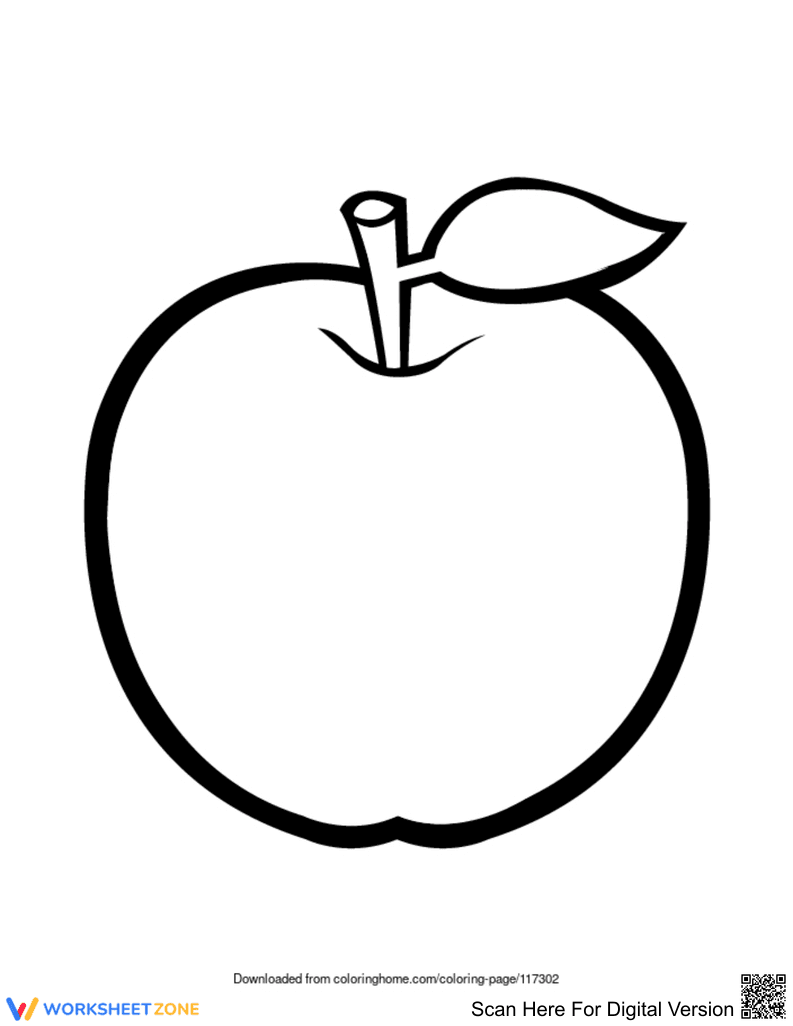

Apple Coloring Page | Essential Kindergarten Printable

Paste this activity's link or code into your existing LMS (Google Classroom, Canvas, Teams, Schoology, Moodle, etc.).
Students can open and work on the activity right away, with no student login required.
You'll still be able to track student progress and results from your teacher account.
This Kindergarten apple coloring worksheet provides a simple, high-contrast outline for young learners to practice fine motor control and color recognition. By engaging with a familiar fruit, students develop the hand-eye coordination necessary for early writing while exploring artistic expression. It serves as a foundational tool for early childhood classrooms and home learning environments.
At a Glance
- Grade: Kindergarten · Subject: English
- Standard:
CCSS.ELA-LITERACY.L.K.5.A— Sort common objects into categories to gain sense of word meanings- Skill Focus: Fine Motor Skills
- Format: 1 page · 1 task · No answer key · PDF
- Best For: Morning work or early finishers
- Time: 10–15 minutes
What's Inside
Inside this resource, you will find a single-page PDF featuring a large, clear illustration of an apple. The design includes a thick outer border to help students stay within the lines, a sturdy stem, and a single leaf. There are no complex patterns, making it ideal for toddlers, preschoolers, and kindergarteners who are just beginning to master crayon or marker control. The minimalist layout ensures that the focus remains entirely on the coloring task.
Zero-Prep Workflow
The zero-prep workflow for this worksheet is designed for maximum efficiency. First, print the single-page PDF (30 seconds). Second, distribute the sheets along with a variety of red, green, and yellow coloring tools (1 minute). Finally, review the completed work by asking students to name the fruit and identify its color (30 seconds). Total teacher preparation time is under 2 minutes, making it an excellent choice for emergency sub plans or transition periods between lessons.
Standards Alignment
This worksheet aligns with `CCSS.ELA-LITERACY.L.K.5.A`, which encourages students to sort common objects into categories. By identifying the apple as a fruit and discussing its characteristics, students build vocabulary and conceptual understanding. This standard code can be copied directly into lesson plans, IEP goals, or district curriculum mapping tools to document creative and categorical learning in the early elementary years.
How to Use It
Use this worksheet during a "Healthy Eating" unit or as a quiet morning arrival activity. It works well after a direct instruction lesson about the letter 'A' or the autumn season. For a formative assessment, observe how students grip their coloring tools and their ability to follow the boundary of the image. Expect students to spend approximately 10 to 15 minutes completing the task depending on their developmental stage.
Who It's For
This resource is primarily for Kindergarten and Grade 1 students, including those requiring fine motor intervention or English Language Learners building basic vocabulary. It pairs naturally with a "Parts of a Fruit" anchor chart or a read-aloud book about orchards. The simplicity ensures that all students can achieve success independently, fostering confidence in their artistic and academic abilities.
Research from RAND AIRS 2024 emphasizes that integrating simple artistic tasks like coloring into early childhood education supports the development of intrinsic motivation and executive function. This worksheet, focused on the `CCSS.ELA-LITERACY.L.K.5.A` standard, allows students to engage in the plain-English skill of identifying and categorizing common objects through visual representation. According to the NAEP frameworks, early exposure to structured creative tasks correlates with improved spatial reasoning and readiness for formal writing instruction. By providing a low-stakes environment for practicing grip and pressure, this resource bridges the gap between play and academic skill-building. Educators can utilize this tool to reinforce vocabulary related to nature and nutrition while monitoring developmental milestones in motor control. The standalone nature of the task ensures it can be integrated into various instructional models without additional overhead, supporting a balanced approach to early literacy and fine motor development.


