


























Views
Downloads

That Monster on the Block Worksheet | Grade 1-3 Essential
Paste this activity's link or code into your existing LMS (Google Classroom, Canvas, Teams, Schoology, Moodle, etc.).
Students can open and work on the activity right away, with no student login required.
You'll still be able to track student progress and results from your teacher account.
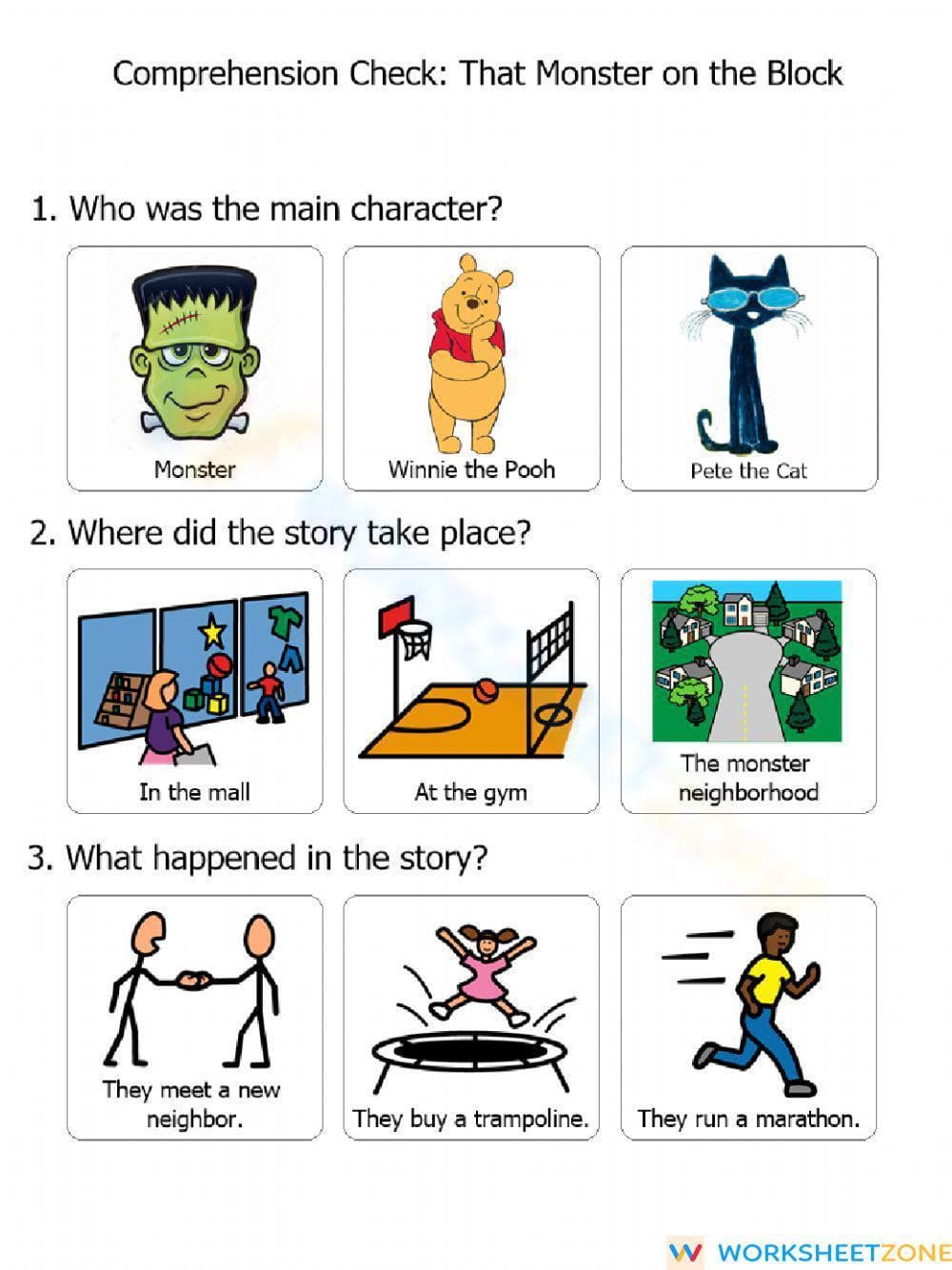
This That Monster on the Block comprehension check helps early learners master key story elements through structured visual identification. Students demonstrate understanding by selecting correct characters, settings, and major plot events immediately after reading or listening to the text. This essential practice builds foundational literacy skills and ensures young readers grasp the core narrative arc effectively.
At a Glance
- Grade: 1 · Subject: ELA
- Standard:
CCSS.ELA-LITERACY.RL.1.3— Describe characters, settings, and major events in a story using key details- Skill Focus: Narrative comprehension
- Format: 1 page · 3 problems · Answer key included · PDF
- Best For: Post-reading quick checks and literacy centers
- Time: 5–10 minutes
What's Inside
This high-quality resource features a single-page layout designed specifically for Kindergarten through Grade 3 students. It includes three targeted multiple-choice questions, each supported by clear, colorful illustrations to aid decoding and comprehension. The worksheet focuses on the three pillars of narrative structure: identifying the main character, recognizing the specific setting, and recalling a pivotal event from the story.
Zero-Prep Workflow
This resource is designed for efficiency. First, print the single-page PDF, which takes 30 seconds for a full class set. Second, distribute the worksheets to students immediately following a read-aloud, a process requiring only 1 minute. Third, review the answers as a group using the included key in under 2 minutes. Its straightforward design makes it an ideal choice for emergency sub plans or quick classroom transitions.
Standards Alignment
The primary focus of this assessment is `CCSS.ELA-LITERACY.RL.1.3`, which requires students to describe characters, settings, and major events in a story using key details. By providing visual choices, the worksheet scaffolds the cognitive load, allowing students to focus on identification. This standard code can be copied directly into lesson plans, IEP goals, or district curriculum mapping tools to track student progress.
How to Use It
Use this worksheet as a formative assessment following a shared reading of "That Monster on the Block." During the activity, observe if students rely on the text or illustrations to make selections; this provides a valuable tip for identifying which learners may need support with visual cues. Completion typically ranges from five to ten minutes, making it a perfect exit ticket for a literature block.
Who It's For
This worksheet is primarily designed for K-2 students and Grade 3 learners who benefit from visual scaffolding. It serves as an excellent pairing resource for the original picture book or a direct instruction lesson on story elements. Teachers can read questions aloud to emergent readers or use the illustrations to prompt verbal discussions about the monster's neighborhood and motivations.
The That Monster on the Block comprehension check utilizes visual scaffolding to bridge the gap between listening and independent reading, a method supported by Fisher & Frey (2014) in their research on gradual release of responsibility. By targeting CCSS.ELA-LITERACY.RL.1.3, the worksheet focuses on the critical ability to identify characters, settings, and events, which is a foundational requirement for later narrative analysis. Research from the NAEP consistently highlights that early mastery of these core story elements is a strong predictor of future reading proficiency and academic success. This resource provides three targeted tasks that minimize decoding barriers while maximizing cognitive engagement with the narrative. Each task is strategically designed to provide immediate feedback on student comprehension levels. The inclusion of clear visual distractors ensures students actively process story content, making it a reliable tool for classroom teachers.


