




























Views
Downloads
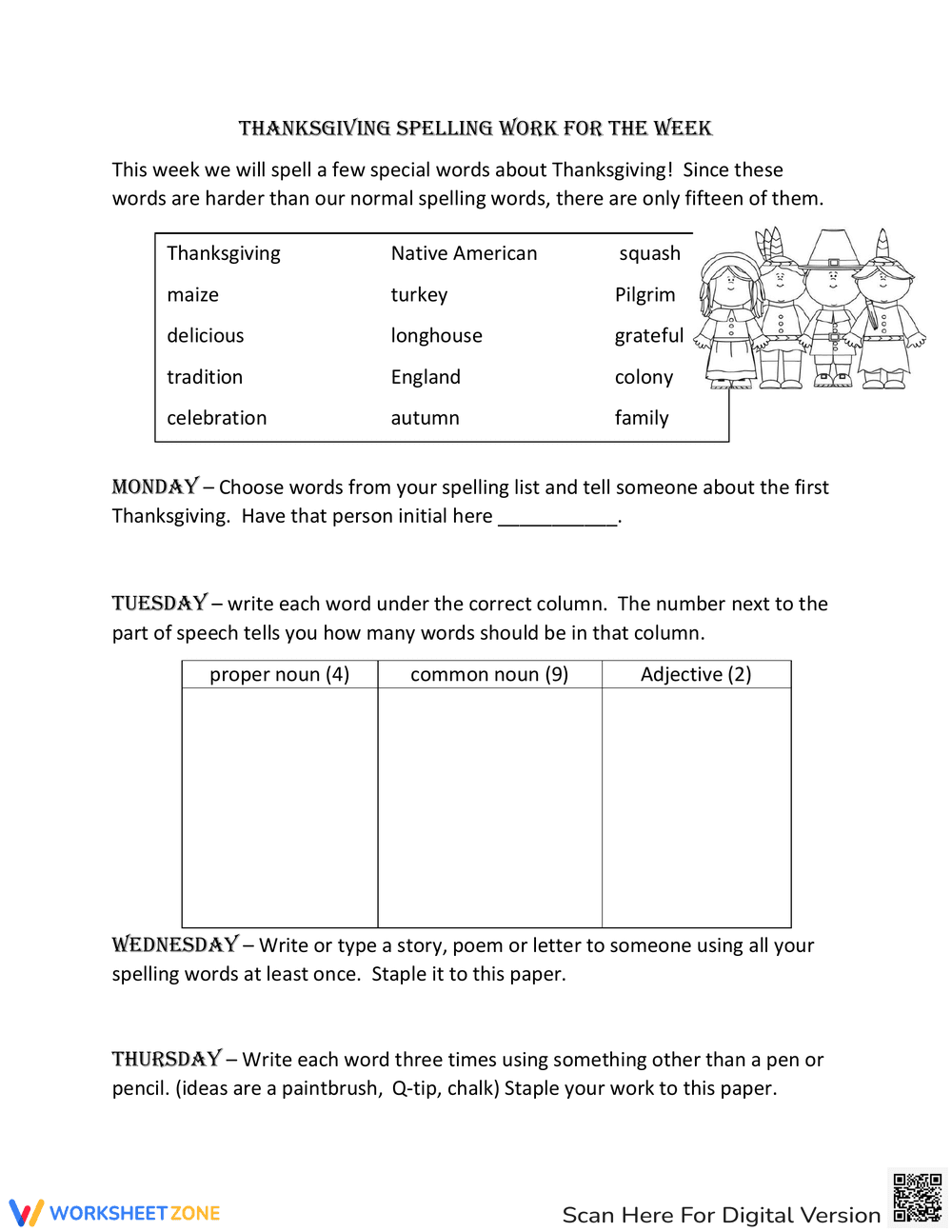

Thanksgiving Spelling Worksheet | Grade 3-6 Essential

Paste this activity's link or code into your existing LMS (Google Classroom, Canvas, Teams, Schoology, Moodle, etc.).
Students can open and work on the activity right away, with no student login required.
You'll still be able to track student progress and results from your teacher account.
This Thanksgiving spelling worksheet provides a comprehensive four-day literacy plan centered on 15 holiday-themed vocabulary words. Students engage in multi-sensory practice, grammatical categorization, and creative application to ensure long-term retention of complex terms like longhouse and tradition. It transforms standard rote memorization into a meaningful exploration of seasonal history and language mechanics.
At a Glance
- Grade: 3-6 · Subject: ELA
- Standard:
CCSS.ELA-LITERACY.L.3.2.F— Use spelling patterns and generalizations in writing words- Skill Focus: Spelling, Parts of Speech, Creative Writing
- Format: 1 page · 4 tasks · No-prep · PDF
- Best For: Holiday-themed morning work or homework
- Time: 15–20 minutes daily
What's Inside: The resource features a curated list of 15 spelling words ranging from historical nouns to descriptive adjectives. The layout is organized by day, including an oral retelling prompt for Monday, a parts-of-speech sorting table for Tuesday, a creative writing assignment for Wednesday, and a multi-sensory writing task for Thursday. This single-page PDF acts as a complete weekly packet.
Zero-Prep Workflow: This resource is designed for immediate classroom implementation with a total teacher prep time of under 2 minutes. First, print the single-page PDF for your class. Second, distribute the sheet on Monday morning and explain the 15-word list. Third, review the sorting table and creative writing pieces at the end of the week. Its self-explanatory nature makes it an ideal sub-plan during the busy holiday season.
Standards Alignment: The primary focus is `CCSS.ELA-LITERACY.L.3.2.F`, which requires students to use spelling patterns and generalizations. Additionally, the Tuesday sorting task supports `CCSS.ELA-LITERACY.L.3.1.A` by requiring students to explain the function of nouns and adjectives within the context of the holiday list. Both standard codes can be copied directly into lesson plans, IEP goals, or district curriculum mapping tools.
How to Use It: Assign this as a bell-ringer activity where students complete one section each morning as they arrive. Alternatively, use it as a thematic homework packet to keep students engaged during the short Thanksgiving week. For a formative assessment, observe students during the Tuesday sorting task to identify misconceptions regarding proper versus common nouns. Completion typically takes 15 to 20 minutes per day.
Who It's For: This worksheet is tailored for students in grades 3 through 6, with vocabulary that challenges younger learners while remaining relevant for upper elementary review. It is particularly effective for inclusive classrooms where students benefit from structured, predictable daily routines. Pair this with a non-fiction passage about the first Thanksgiving to provide additional context for the spelling words.
According to Fisher & Frey (2014), the gradual release of responsibility is most effective when students move from word recognition to contextual application. This worksheet mirrors that research by transitioning students from simple list reading to grammatical sorting and finally to independent creative writing. By integrating the `CCSS.ELA-LITERACY.L.3.2.F` standard into a thematic unit, educators leverage seasonal interest to increase student engagement and orthographic awareness. Research indicates that multi-sensory writing tasks, such as the Thursday prompt, significantly improve the encoding of irregular spelling patterns in elementary learners. This structured approach ensures that the 15 target words are not just memorized for a test but are integrated into the student's active writing vocabulary. The inclusion of oral retelling and parts-of-speech analysis provides a holistic literacy experience that exceeds traditional drill-and-kill spelling methods.


