




























Views
Downloads
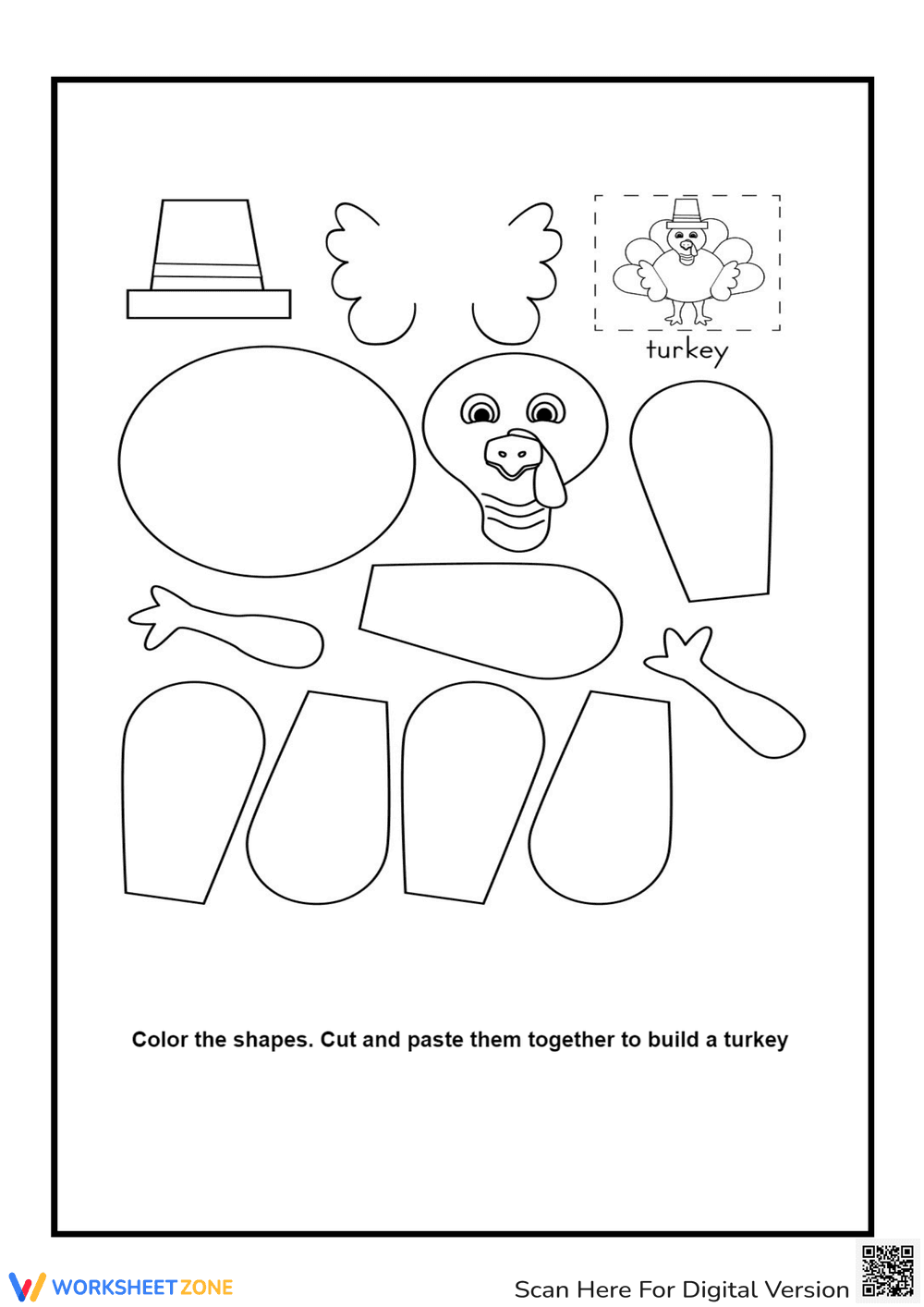

Printable Thanksgiving Turkey Craft | Grade K-2 Activity

Paste this activity's link or code into your existing LMS (Google Classroom, Canvas, Teams, Schoology, Moodle, etc.).
Students can open and work on the activity right away, with no student login required.
You'll still be able to track student progress and results from your teacher account.
This Grade K-2 Thanksgiving turkey craft provides a hands-on way for students to develop essential fine motor skills while celebrating the holiday season. By engaging in the multi-step process of coloring, cutting, and assembling, learners practice spatial awareness and precision. This activity results in a complete seasonal decoration that students can take home or display.
At a Glance
- Grade: K-2 · Subject: Arts & Crafts
- Standard:
K.G.B.5— Model shapes in the world by building shapes from components- Skill Focus: Fine Motor (Cutting & Pasting)
- Format: 1 page · 10+ pieces · No answer key needed · PDF
- Best For: Seasonal morning work or centers
- Time: 20–30 minutes
What's Inside
This single-page PDF features a comprehensive set of turkey components, including the body, head, wings, feathers, legs, and a pilgrim hat. The worksheet includes a small visual reference of the finished turkey to guide student assembly. The clear black-and-white outlines are designed for easy coloring with crayons or markers before the cutting phase begins.
Zero-Prep Workflow
- Print: Select the number of copies needed and print on standard letter paper or cardstock for extra durability (30 seconds).
- Distribute: Provide each student with the worksheet, scissors, glue, and coloring supplies (1 minute).
- Review: Briefly point out the reference image and the dashed lines to guide the cutting process (30 seconds).
Total teacher preparation time is under 2 minutes, making this an ideal resource for substitute folders or last-minute holiday programming.
Standards Alignment
The primary alignment for this activity is `CCSS.MATH.CONTENT.K.G.B.5`, which asks students to model shapes in the world by building shapes from components. While primarily an artistic task, the assembly of the turkey requires students to understand how individual geometric and organic shapes combine to form a recognizable whole. This standard code can be copied directly into lesson plans, IEP goals, or district curriculum mapping tools.
How to Use It
This worksheet is best used during the week leading up to Thanksgiving as a calming morning work activity or a dedicated fine motor center. Teachers should observe students during the cutting phase to provide formative feedback on scissor grip and paper manipulation. Expect most Kindergarten students to take approximately 30 minutes, while second graders may finish in 20 minutes.
Who It's For
This resource is designed for Kindergarten, Grade 1, and Grade 2 students. It is particularly effective for students receiving occupational therapy services who need engaging ways to practice bilateral coordination. It pairs naturally with a read-aloud about Thanksgiving or a lesson on the parts of a bird.
According to Fisher & Frey (2014), the gradual release of responsibility begins with clear modeling of multi-step tasks, such as the color, cut, and paste sequence found in this Thanksgiving Turkey Cut Out Craft. This Grade K-2 resource targets the K.G.B.5 standard by requiring students to model real-world objects—in this case, a turkey—by assembling individual components into a composite whole. Research indicates that integrating seasonal themes into fine motor practice increases student engagement and task persistence. By manipulating small paper parts, learners strengthen the intrinsic muscles of the hand, which is a critical precursor to fluent handwriting and tool use. This activity provides a structured environment for students to practice spatial reasoning and following complex directions. The inclusion of a visual reference model ensures that the task remains accessible while still challenging the student's ability to organize and sequence the assembly process effectively.


