


























Views
Downloads

Thanksgiving Gratitude Challenge | Essential Grade 3
Paste this activity's link or code into your existing LMS (Google Classroom, Canvas, Teams, Schoology, Moodle, etc.).
Students can open and work on the activity right away, with no student login required.
You'll still be able to track student progress and results from your teacher account.
This Thanksgiving Gratitude Challenge worksheet helps Grade 3 students develop social-emotional awareness and writing stamina by brainstorming 100 specific things they appreciate. By providing structured categories, the activity moves beyond generic responses to help children recognize the value in their physical abilities, nature, and modern inventions. It is a perfect seasonal bridge between ELA and character education.
At a Glance
- Grade: 3 · Subject: ELA & SEL
- Standard:
CCSS.ELA-LITERACY.W.3.4— Produce writing where development and organization are appropriate to the task- Skill Focus: Categorized brainstorming and gratitude
- Format: 2 pages · 100 problems · Answer key included · PDF
- Best For: Thanksgiving week bell-ringers or SEL
- Time: 30–45 minutes
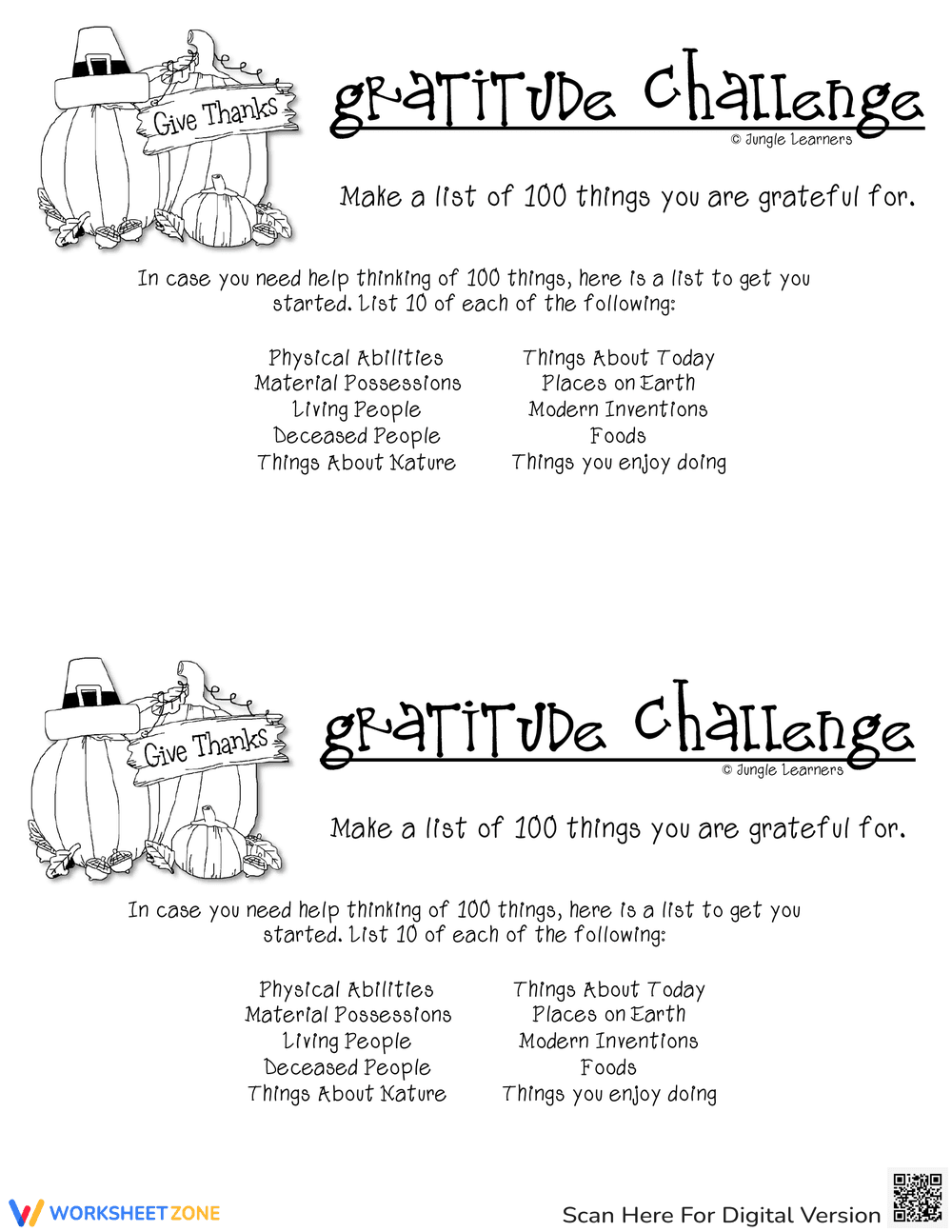
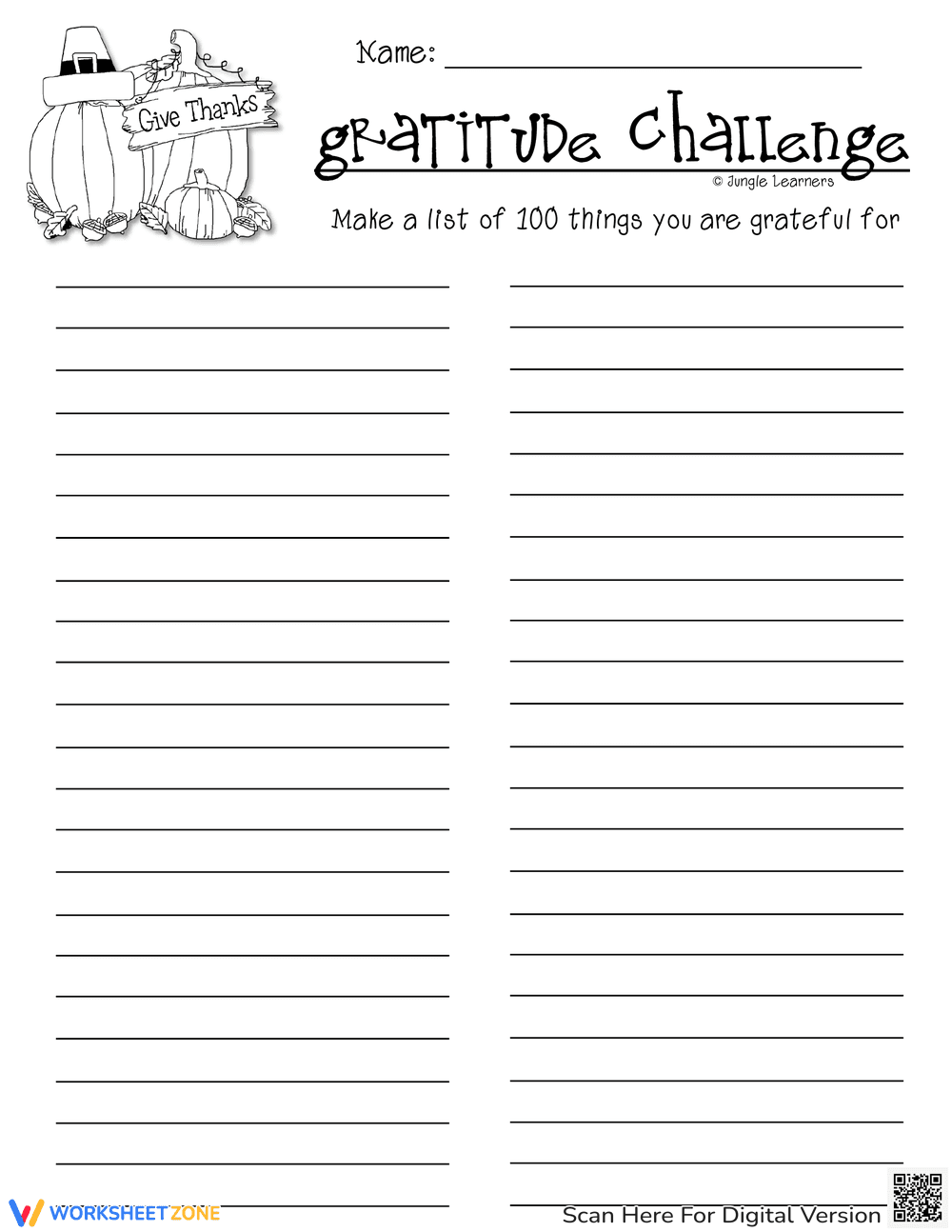
The resource includes a comprehensive instruction sheet and a dedicated lined writing page. The instruction sheet breaks the daunting task of finding 100 items into ten manageable categories, such as "Modern Inventions," "Physical Abilities," and "Living People." This structural support ensures students remain engaged without feeling overwhelmed by the blank page, providing a clear roadmap for their reflections.
The zero-prep workflow is designed for busy holiday schedules. First, print the two-page PDF (30 seconds). Second, distribute the instruction sheet and writing template to students (1 minute). Third, facilitate a brief 2-minute brainstorming session to model one example from a category like "Places on Earth." Total teacher preparation time is under 2 minutes, making this an ideal sub plan or transition activity during the short holiday week.
This worksheet aligns with CCSS.ELA-LITERACY.W.3.4, requiring students to produce writing that is organized and appropriate to the specific task of a 100-item challenge. It also supports vocabulary development and categorization skills as students sort their thoughts into the provided domains. Both standard codes can be copied directly into lesson plans, IEP goals, or district curriculum mapping tools.
Use this as a "Slow-Burn" activity throughout Thanksgiving week. Students can add 20 items per day to their list during morning meetings or early finisher time. Alternatively, use it as a formative assessment for writing stamina; observe which students struggle to move between categories and provide verbal prompts. Completion usually takes 30 to 45 minutes of focused work if done in one sitting.
This is designed for Grade 3 students but is easily adaptable for Grades 1-4. It serves as an excellent resource for general education classrooms, counseling groups, or homeschool settings. Pair this worksheet with a mentor text about thankfulness or a classroom anchor chart listing "Gratitude Verbs" to further support student writing and vocabulary expansion.
According to the RAND AIRS 2024 report on social-emotional learning, structured gratitude practices in elementary settings significantly improve classroom climate and student focus. This Thanksgiving Gratitude Challenge utilizes a categorized brainstorming framework to meet CCSS.ELA-LITERACY.W.3.4 requirements for task-appropriate writing. By requiring 100 unique entries across ten distinct domains, the worksheet pushes students beyond surface-level responses, fostering deeper cognitive engagement with the concept of appreciation. Research from Fisher & Frey (2014) suggests that providing such organizational scaffolds—like the ten categories included here—allows students to demonstrate higher levels of writing stamina and categorical thinking. This resource provides a measurable way to track student participation in SEL initiatives while simultaneously reinforcing ELA standards. Educators can utilize the resulting lists as a baseline for future descriptive writing assignments or as a reflective tool during parent-teacher conferences to highlight a student's personal growth and perspective.


