































Thanksgiving Coordinate Grid Review Quiz | Grade 3

Paste this activity's link or code into your existing LMS (Google Classroom, Canvas, Teams, Schoology, Moodle, etc.).
Students can open and work on the activity right away, with no student login required.
You'll still be able to track student progress and results from your teacher account.
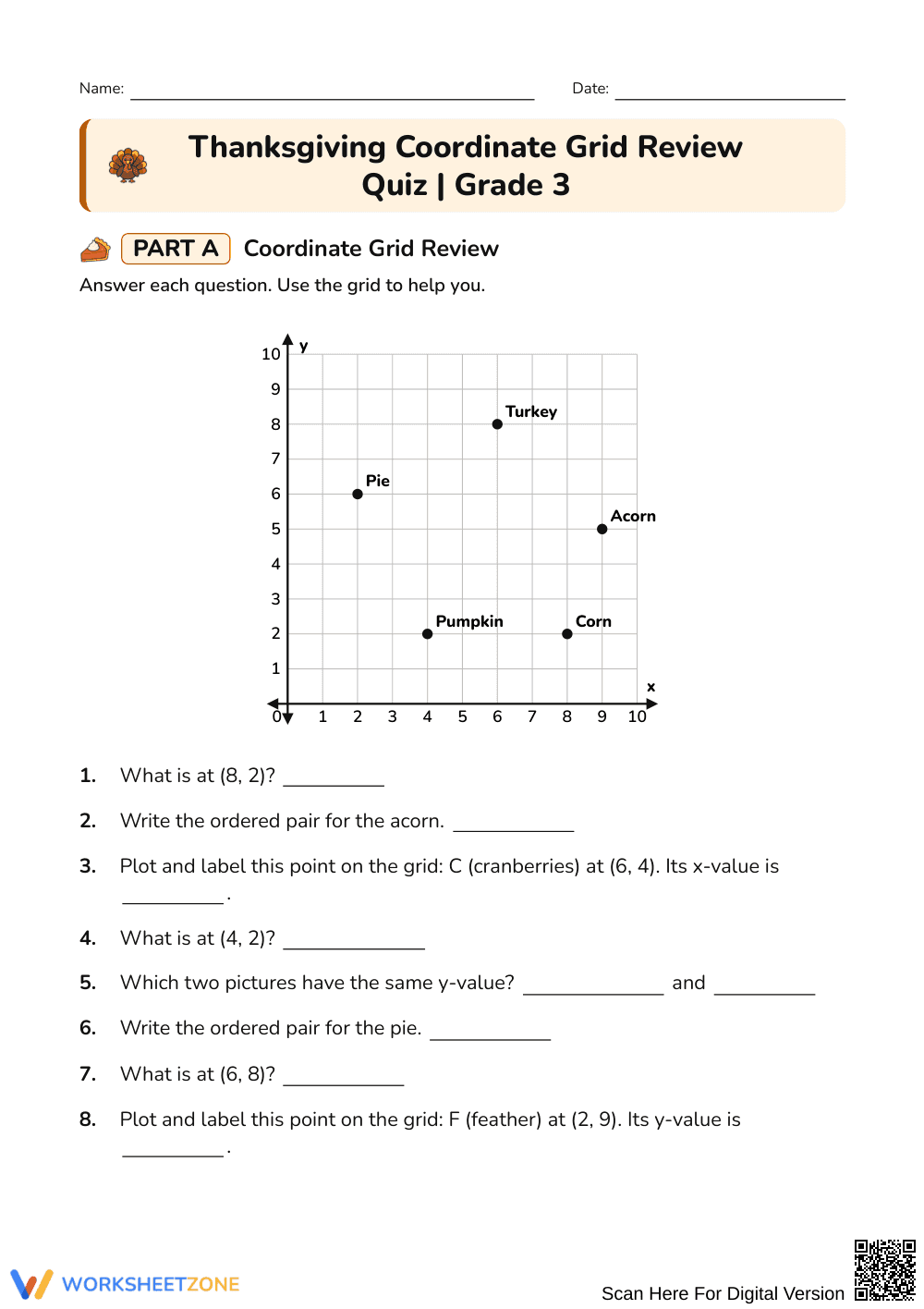
This Grade 3 coordinate grid worksheet strengthens foundational spatial reasoning by guiding students to locate, plot, and record ordered pairs in quadrant one. Through 11 engaging Thanksgiving-themed problems, learners read coordinates, graph new seasonal points, and analyze common coordinate reversal errors to build lasting mathematical fluency and precision.
At a Glance
- Grade: 3 · Subject: Math
- Standard: Spatial Reasoning — Locate, identify, and plot positive coordinate pairs on a first quadrant grid
- Skill Focus: Reading, plotting, and writing ordered pairs (x, y)
- Format: 2 pages · 11 problems · Full answer key included · Printable PDF
- Best For: Seasonal review, spiral practice, and quick assessment
- Time: 20–30 minutes
What's Inside
The 2-page student worksheet features an organized 0-to-10 quadrant-one grid populated with recognizable Thanksgiving graphics, including turkeys, acorns, and pies. Students solve 11 varied tasks that progress from identifying objects at specified coordinates to writing coordinate pairs and plotting new icons. The resource also contains a dedicated error-analysis prompt and a complete 2-page answer key with step-by-step solutions.
Skill Progression
- Guided practice (Problems 1–4): Students read labeled coordinates directly off the grid to identify seasonal pictures and locate initial points with provided x-axis scaffolds.
- Supported practice (Problems 5–8): Learners compare shared y-coordinates across symbols, plot cranberries and feathers, and transcribe ordered pairs into standard (x, y) notation.
- Independent practice (Problems 9–11): Students independently record coordinate values and complete an error-analysis task explaining coordinate transposition.
This structured progression follows the gradual-release framework, smoothly guiding learners from visual identification to independent mathematical reasoning.
Standards Alignment
This resource focuses on foundational elementary geometry standards by teaching students to define coordinate systems with perpendicular axes and locate points using ordered pairs. Supporting standards emphasize spatial measurement and data interpretation. Both standard codes can be copied directly into lesson plans, IEP goals, or district curriculum mapping tools.
How to Use It
Deploy this review quiz immediately after direct instruction on the coordinate plane to gauge individual student understanding before Thanksgiving break. Alternatively, use it as a mid-unit checkpoint or partner activity during math stations. While students work, watch for learners reversing the horizontal and vertical directions. Expect typical completion times between 20 and 30 minutes.
Who It's For
This worksheet is ideal for third-grade math classrooms, intervention groups, and multi-tier support environments seeking seasonal practice. It supports visual learners through clear icon markers and extends thinking through error correction. Pair this activity with a whole-group anchor chart modeling the rule of moving right along the x-axis before moving up the y-axis.
According to Fisher & Frey (2014), purposeful instructional sequences that transition from teacher modeling to collaborative visual checks and independent error analysis significantly enhance student retention of spatial concepts. Graphing on a coordinate plane requires students to coordinate two distinct spatial dimensions simultaneously, an abstract cognitive shift for elementary learners. By combining recognizable visual markers with structured prompts to identify, plot, and write ordered pairs, this coordinate grid practice worksheet reinforces precise mathematical communication. When third-grade students evaluate misconceptions, such as swapping horizontal and vertical coordinates, they construct durable conceptual models that directly prevent common algebraic errors in upper elementary grades. Systematic formative assessments that incorporate explicit error-correction tasks allow educators to identify directional confusion early, ensuring all learners develop confident spatial fluency and accurate coordinate plane navigation skills across foundational geometric curricula.


