


























Views
Downloads
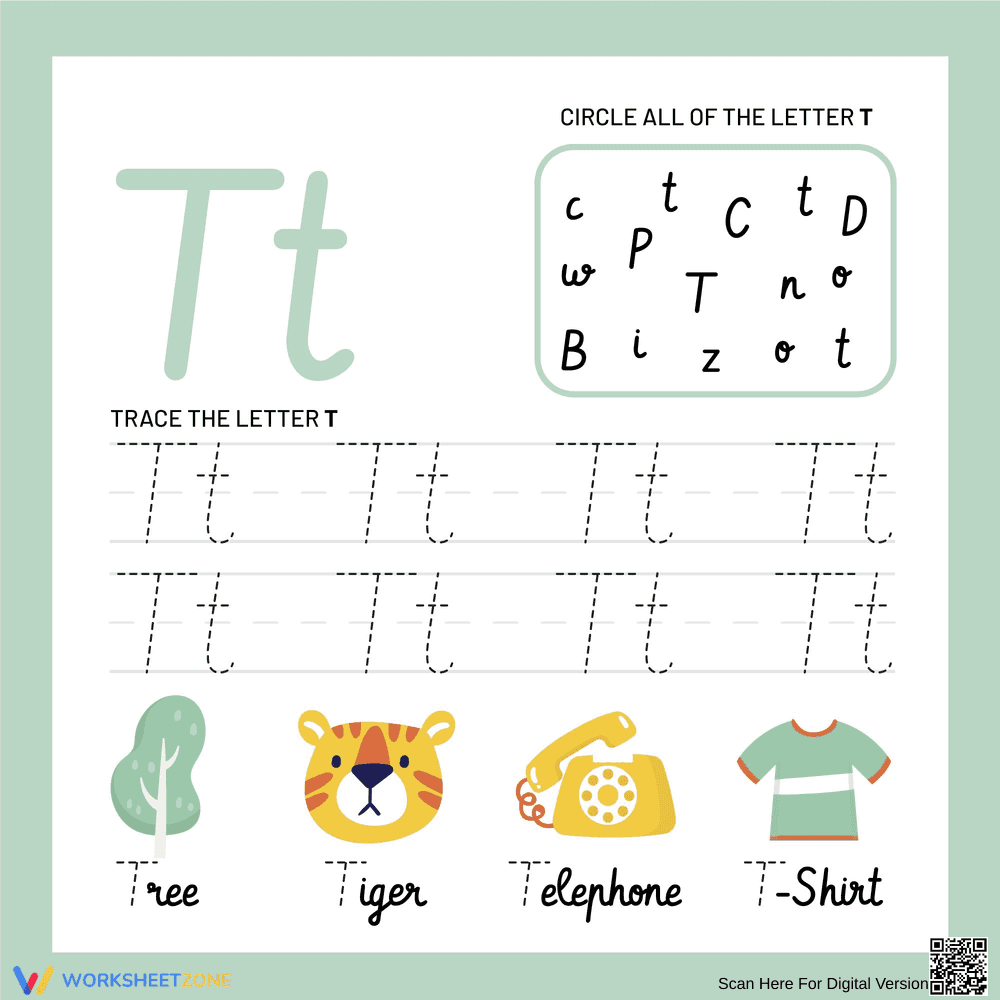

Printable Cursive Letter T Worksheet | Grade 1
Paste this activity's link or code into your existing LMS (Google Classroom, Canvas, Teams, Schoology, Moodle, etc.).
Students can open and work on the activity right away, with no student login required.
You'll still be able to track student progress and results from your teacher account.
This printable cursive letter T worksheet helps early learners master letter formation and recognition before moving to complex words. Students practice tracing uppercase and lowercase letters, identifying the target letter among distractors, and tracing initial-sound vocabulary words. This targeted practice builds essential fine motor skills and handwriting fluency.
At a Glance
- Grade: K-1 · Subject: English
- Standard:
CCSS.ELA-LITERACY.L.K.1.A— Print many upper- and lowercase letters- Skill Focus: Cursive Letter Tracing
- Format: 1 page · 3 task types · No answer key needed · PDF
- Best For: Independent handwriting practice
- Time: 10–15 minutes
This single-page resource features three activity zones to reinforce letter familiarity. The top right section includes a visual discrimination task where students circle the target letter. The middle section provides eight guided tracing pairs for uppercase and lowercase cursive T, with directional dashed lines. The bottom section connects the letter to vocabulary with four illustrated words—tree, tiger, telephone, and t-shirt—for tracing.
This resource follows a zero-prep workflow for educators:
- Print (30 seconds): Generate the PDF and send to the copier. No special formatting required.
- Distribute (30 seconds): Hand out during morning work. Visual instructions make tasks clear to early readers.
- Review (1 minute): Scan completed sheets to check stroke direction and accuracy.
Total teacher prep time is under two minutes, making this ideal for sub plans.
This worksheet aligns directly with CCSS.ELA-LITERACY.L.K.1.A: Print many upper- and lowercase letters. While the standard focuses on print, this resource adapts the foundational motor skill requirement for early cursive or pre-cursive introduction. A supporting standard, CCSS.ELA-LITERACY.RF.K.3.A, is addressed as students connect the initial letter sound to the provided vocabulary words. Both standard codes can be copied directly into lesson plans, IEP goals, or district curriculum mapping tools.
Deploy this worksheet during morning work to establish a focused routine before direct instruction. Alternatively, use it as an independent station during literacy centers. As a formative assessment observation tip, watch students trace the first few letters to ensure they start at the correct point and follow dashed lines continuously. Expected completion time ranges from 10 to 15 minutes.
This resource is designed for Kindergarten and first-grade students developing their handwriting and fine motor capabilities. It serves as an excellent intervention tool for occupational therapy students who need structured, dashed-line boundaries to control their pencil strokes. For differentiation, provide a textured surface underneath the paper for tactile feedback for struggling learners. Pair this worksheet with a tactile sand-tray tracing activity to reinforce the motor pathway before moving to paper.
Developing automaticity in letter formation is a critical precursor to expressive writing and reading fluency. When students practice printing many upper- and lowercase letters, as outlined in CCSS.ELA-LITERACY.L.K.1.A, they reduce the cognitive load required for basic transcription. This allows young learners to allocate more working memory to idea generation and phonics application. According to Fisher & Frey (2014), explicit handwriting instruction combined with guided, repetitive practice significantly improves both letter legibility and overall writing volume in early elementary grades. By integrating visual discrimination tasks with guided motor practice, this resource supports the dual coding of letter shapes and sounds. Consistent engagement with targeted tracing activities builds the muscle memory necessary for efficient, legible handwriting throughout a student's academic career. Establishing these foundational motor pathways early prevents the development of improper grip and inefficient stroke habits that are difficult to correct later.


