




























Views
Downloads



Essential Temperature Conversion Worksheet: High School Science

Paste this activity's link or code into your existing LMS (Google Classroom, Canvas, Teams, Schoology, Moodle, etc.).
Students can open and work on the activity right away, with no student login required.
You'll still be able to track student progress and results from your teacher account.
Understanding how to navigate different temperature scales is a fundamental skill for any student of physics or chemistry. This comprehensive worksheet provides students with the tools and practice needed to convert between Fahrenheit, Celsius, and Kelvin. By working through structured exercises, learners develop a practical grasp of thermal energy concepts and measurement precision in scientific environments.
At a Glance
- Grade: High School · Subject: Science
- Standard:
HS-PS3-4— Solve problems involving the transfer of thermal energy and temperature scale measurement- Skill Focus: Multi-scale temperature conversion
- Format: 4 pages · 21 problems · Answer key included · PDF
- Best For: Unit practice and mastery assessment
- Time: 20–30 minutes
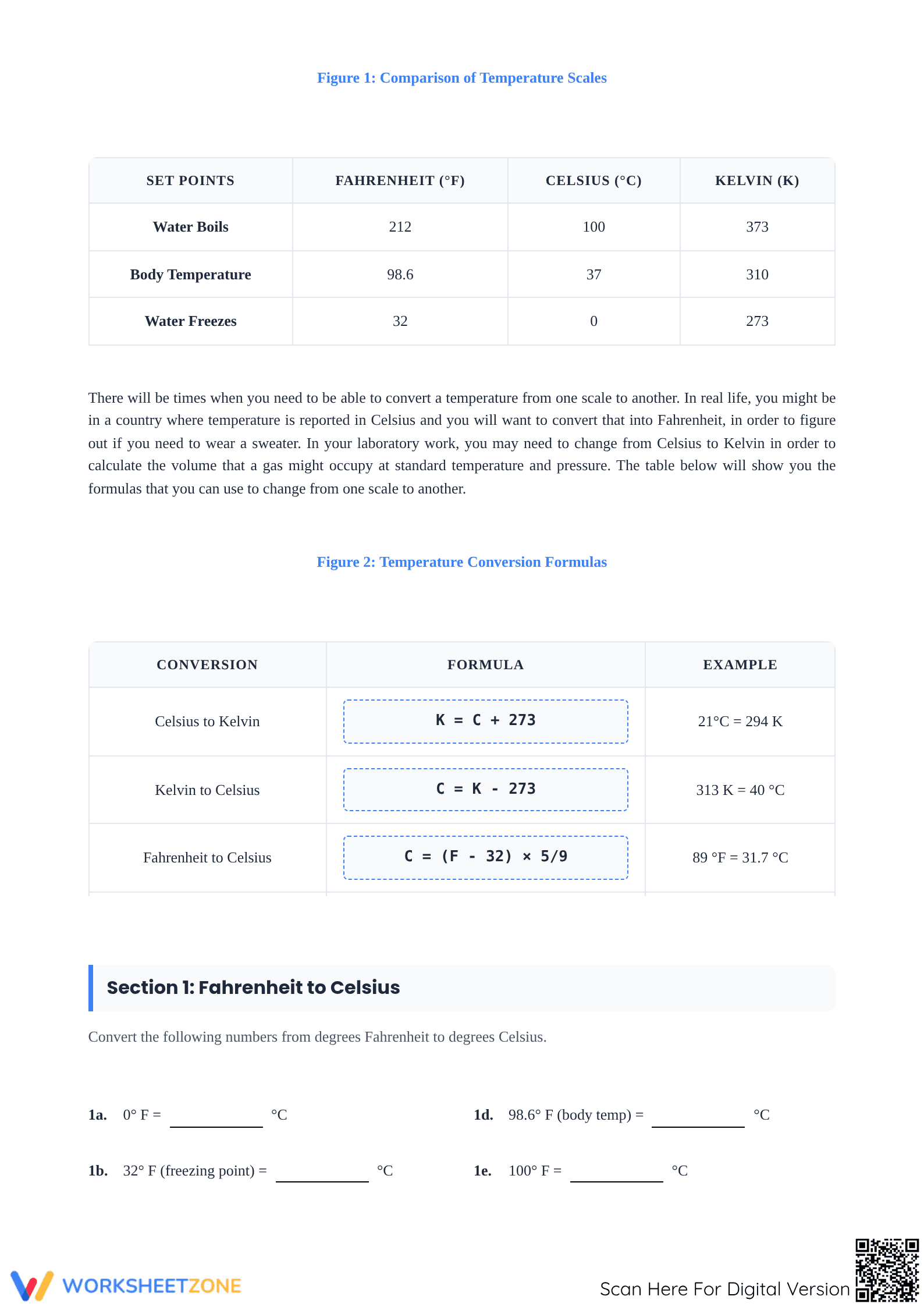
This 4-page resource includes detailed background reading on the Fahrenheit, Celsius, and Kelvin scales, providing conceptual context before calculations begin. Students will find reference tables for set points like boiling and freezing, along with clear formula charts for every conversion type. The worksheet includes 21 specific tasks, ranging from basic numerical conversions to contextual word problems, accompanied by a complete answer key for immediate feedback.
Skill Progression
- Guided Practice: Students begin by reviewing formula charts and set-point comparison tables to understand the mathematical relationships between scales (6 introductory tasks).
- Supported Practice: Learners apply specific formulas to convert freezing points, boiling points, and room temperatures across three different sections (12 structured problems).
- Independent Practice: The final section requires contextual analysis, where students identify the scale used in real-world scenarios and perform multi-step conversions independently (3 high-order problems).
This sequence follows a gradual-release model, ensuring students master the arithmetic before applying it to complex scientific data.
Standards Alignment
This resource aligns with HS-PS3-4, requiring students to understand the transfer of thermal energy and the scales used to measure it. It also supports mathematics standards related to algebraic substitution and multi-step equations. Both standard codes can be copied directly into lesson plans, IEP goals, or district curriculum mapping tools.
How to Use It
This worksheet is ideal for use during a unit on thermal energy or as an introductory lab skill activity in Chemistry. Assign it after a direct instruction lesson on temperature scales to serve as a formative assessment. Teachers should observe students during Section 3 to ensure they are correctly applying the fractional components of the Fahrenheit-to-Celsius formula. Expected completion time is 25 minutes.
Who It's For
This resource is designed for high school students in Physical Science, Physics, or Chemistry courses. It provides necessary scaffolding for students who struggle with multi-step algebra while offering enough rigor for advanced learners. It pairs naturally with an introductory reading on the kinetic molecular theory or a lab investigation into specific heat capacity.
According to the RAND AIRS 2024 report on secondary science instructional materials, structured practice in unit conversion is fundamental for developing computational literacy in STEM disciplines. This worksheet specifically targets standard HS-PS3-4, requiring students to translate between Fahrenheit, Celsius, and Kelvin scales to understand thermal energy dynamics. By applying mathematical formulas to physical measurements, students move from rote memorization to conceptual application. Research by Fisher & Frey (2014) highlights the importance of instructional scaffolding, which this resource provides through its introductory text and formula reference charts. Mastery of these conversions is a prerequisite for advanced work in thermodynamics, gas laws, and stoichiometry. Educational data from NAEP suggests that students who engage in multi-step conversion tasks demonstrate higher proficiency in problem-solving and data analysis. This comprehensive 4-page resource ensures that learners can confidently navigate various scientific contexts where different temperature units are utilized for measurement and calculation.


