


























Views
Downloads

Printable Telling Time Worksheet | Grade 2-4 Math
Paste this activity's link or code into your existing LMS (Google Classroom, Canvas, Teams, Schoology, Moodle, etc.).
Students can open and work on the activity right away, with no student login required.
You'll still be able to track student progress and results from your teacher account.
Mastering the concept of time is a pivotal milestone for elementary students. This comprehensive telling time worksheet enables children in grades 2 through 4 to practice converting analog clock faces into digital formats while correctly identifying AM and PM periods. By completing these exercises, learners develop a concrete understanding of daily schedules and temporal awareness.
At a Glance
- Grade: 2–4 · Subject: Math
- Standard:
CCSS.MATH.CONTENT.2.MD.C.7— Tell and write time from analog and digital clocks to the nearest five minutes- Skill Focus: Analog to Digital Time Conversion
- Format: 4 pages · 20 problems · Answer key included · PDF
- Best For: Homework, math centers, or quick formative assessment
- Time: 30–45 minutes
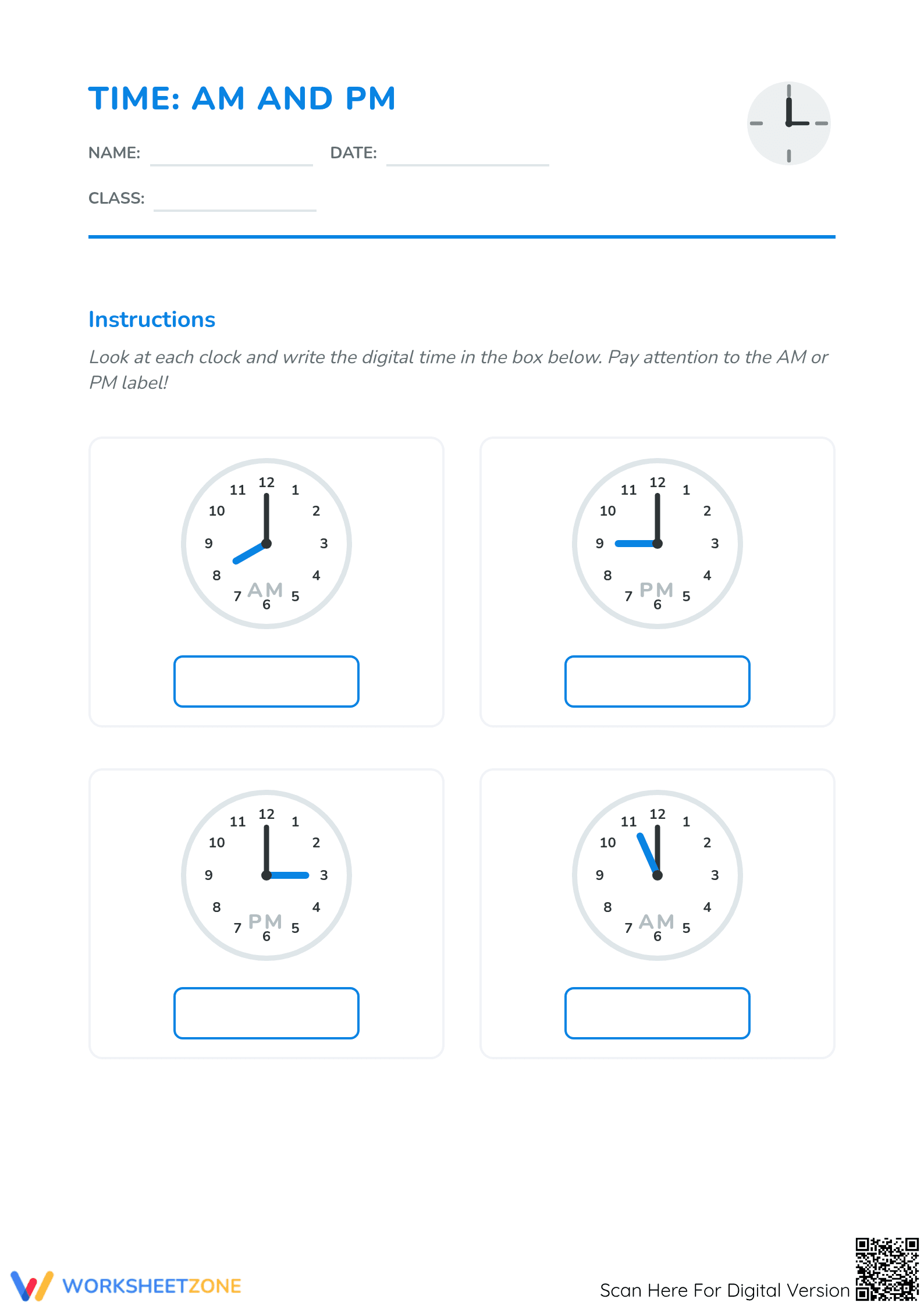
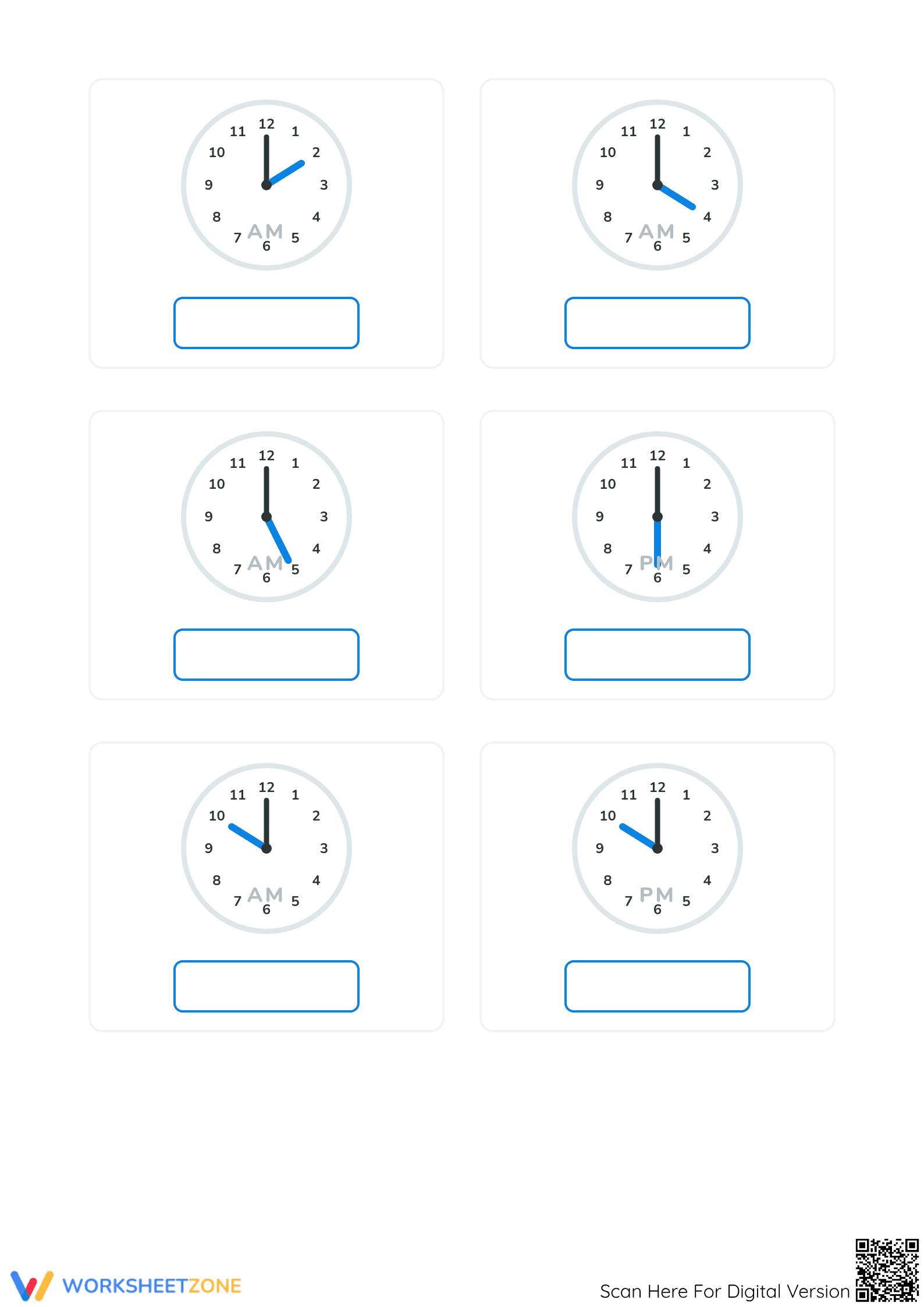
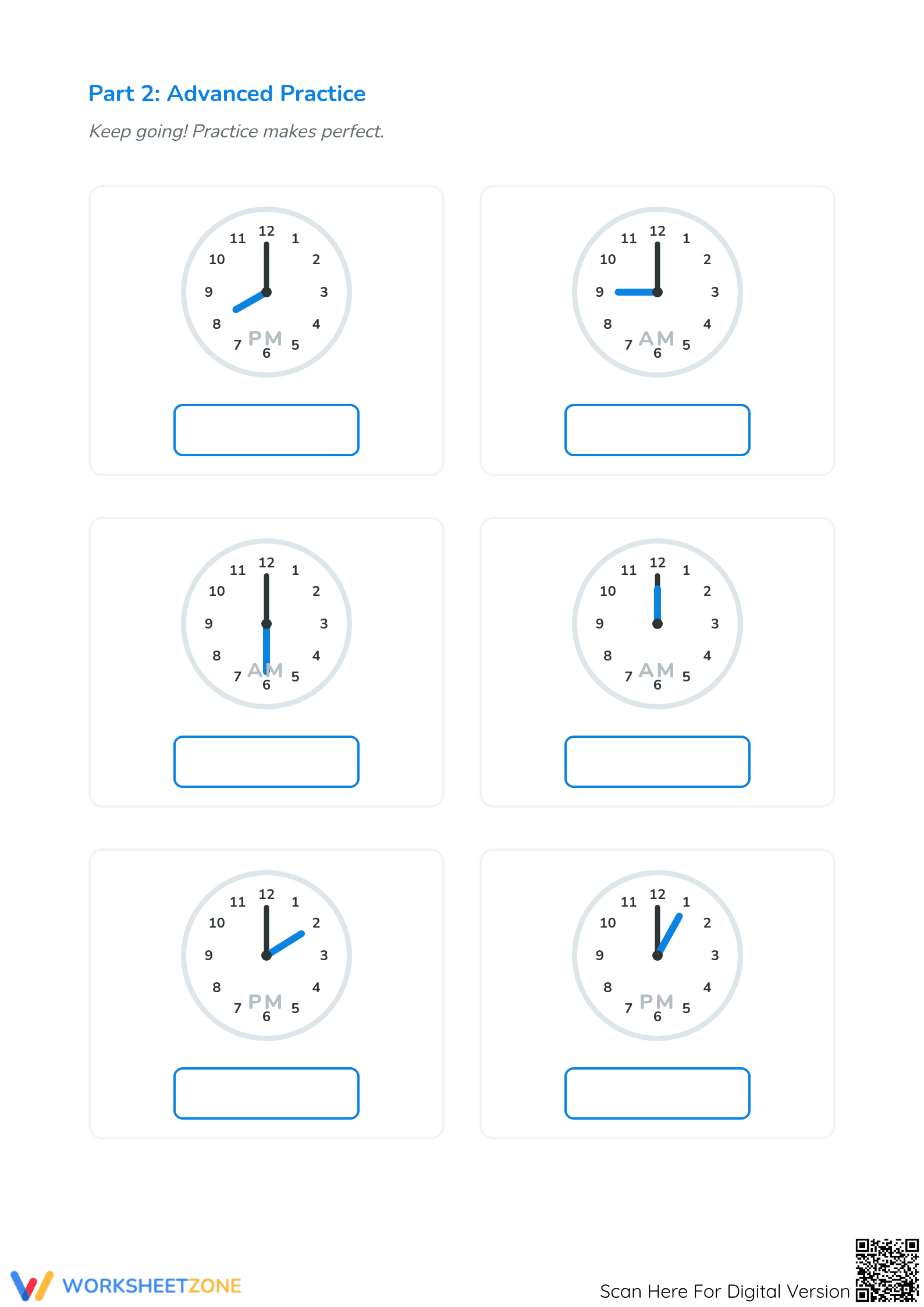
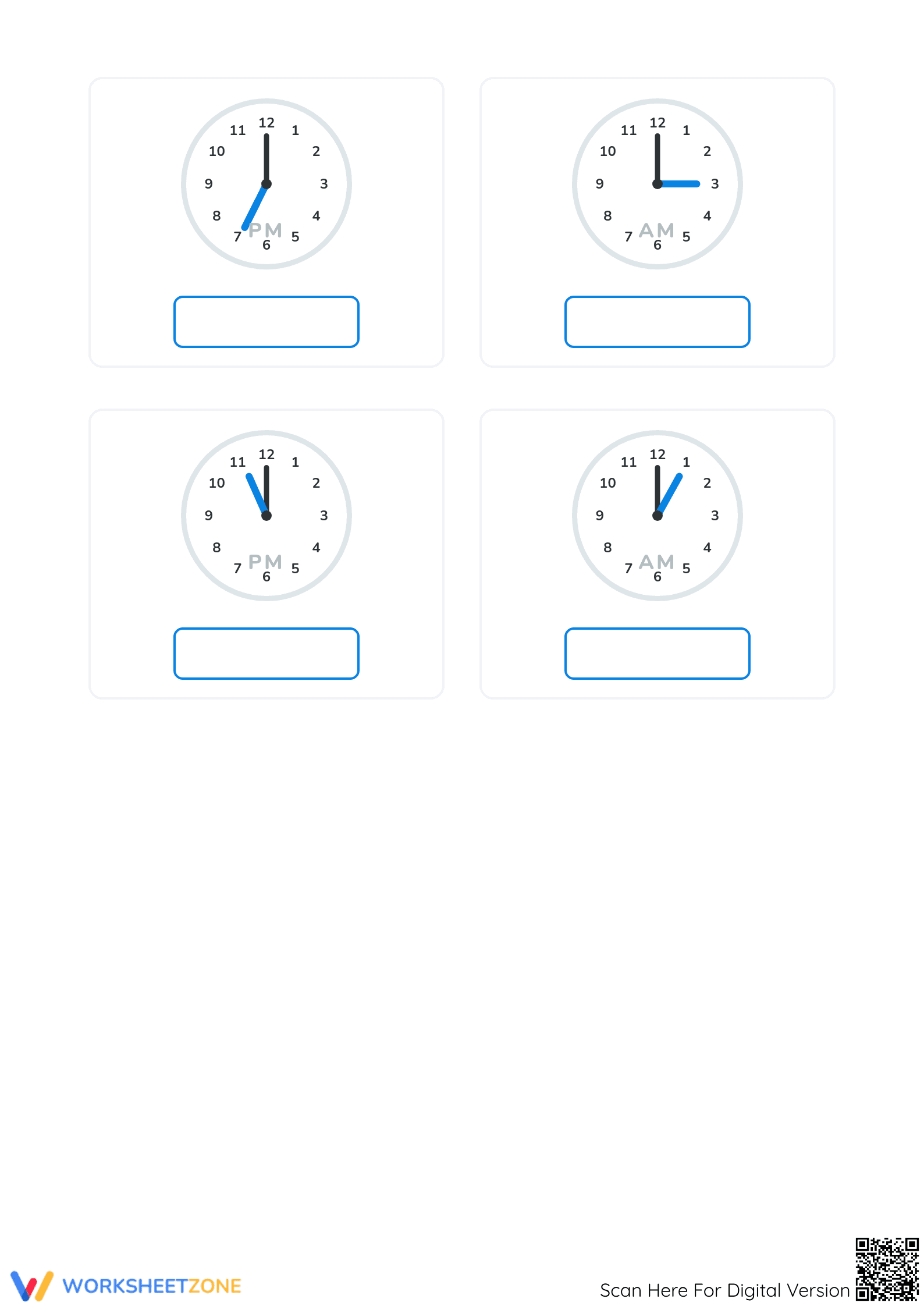
This resource features 20 analog clock illustrations distributed across four pages. Each clock includes a clear AM or PM label to challenge students' understanding of the 24-hour cycle. The layout provides ample space for students to write the exact digital time in dedicated boxes. A complete answer key is provided for every page, ensuring easy grading and efficient self-correction.
Skill Progression
- Guided Practice: The first page introduces foundational clock faces with whole and half-hour increments to build confidence and establish the digital-writing pattern.
- Supported Practice: Pages two and three present 12 problems featuring 15-minute and 5-minute intervals, requiring students to carefully analyze hand positions.
- Independent Practice: The final page provides 4 "Advanced Practice" problems where students must integrate all previously practiced skills independently.
This gradual-release model moves students from simple recognition to mastery of complex time concepts.
Standards Alignment
This resource is directly aligned with CCSS.MATH.CONTENT.2.MD.C.7. The standard requires that students tell and write time from analog and digital clocks to the nearest five minutes, using a.m. and p.m. Additionally, the worksheet supports development of temporal logic across the primary grades. Both standard codes can be copied directly into lesson plans, IEP goals, or district curriculum mapping tools.
How to Use It
Use this worksheet during a Math Workshop session as a rotating center activity. After a direct instruction lesson on the 24-hour clock, assign page 1 to verify that students can distinguish between morning and afternoon periods. Alternatively, use the final page as a Quick Check exit ticket to identify students who struggle with 15-minute increments. Observe if students confuse the hour hand's position when it approaches the next hour.
Who It's For
Designed primarily for second, third, and fourth-grade students, this resource is ideal for general education classrooms, special education small groups, or ESL/ELL students. It pairs naturally with a physical classroom clock or a digital time-telling passage to reinforce the connection between abstract numbers and the physical passage of time throughout the school day.
The instruction of time-telling via analog clocks remains a fundamental component of the primary mathematics curriculum, as emphasized by NAEP. This resource focuses on CCSS.MATH.CONTENT.2.MD.C.7, requiring students to accurately translate analog representations into digital notation while distinguishing between ante-meridiem and post-meridiem designations. According to a ScienceDirect TpT Analysis, structured practice with varied time intervals is critical for developing fluency in temporal reasoning. By providing 20 unique problems, this worksheet ensures students encounter a diverse range of hour and minute hand configurations, reinforcing the proportional relationship between clock hands. Research by Fisher & Frey (2014) supports the use of such scaffolded instructional materials to facilitate the gradual release of responsibility. This worksheet provides a clear path for students to move from basic hour recognition to the nuances of five-minute precision, serving as an essential tool for elementary mathematical literacy and daily life competency.


