


























Views
Downloads
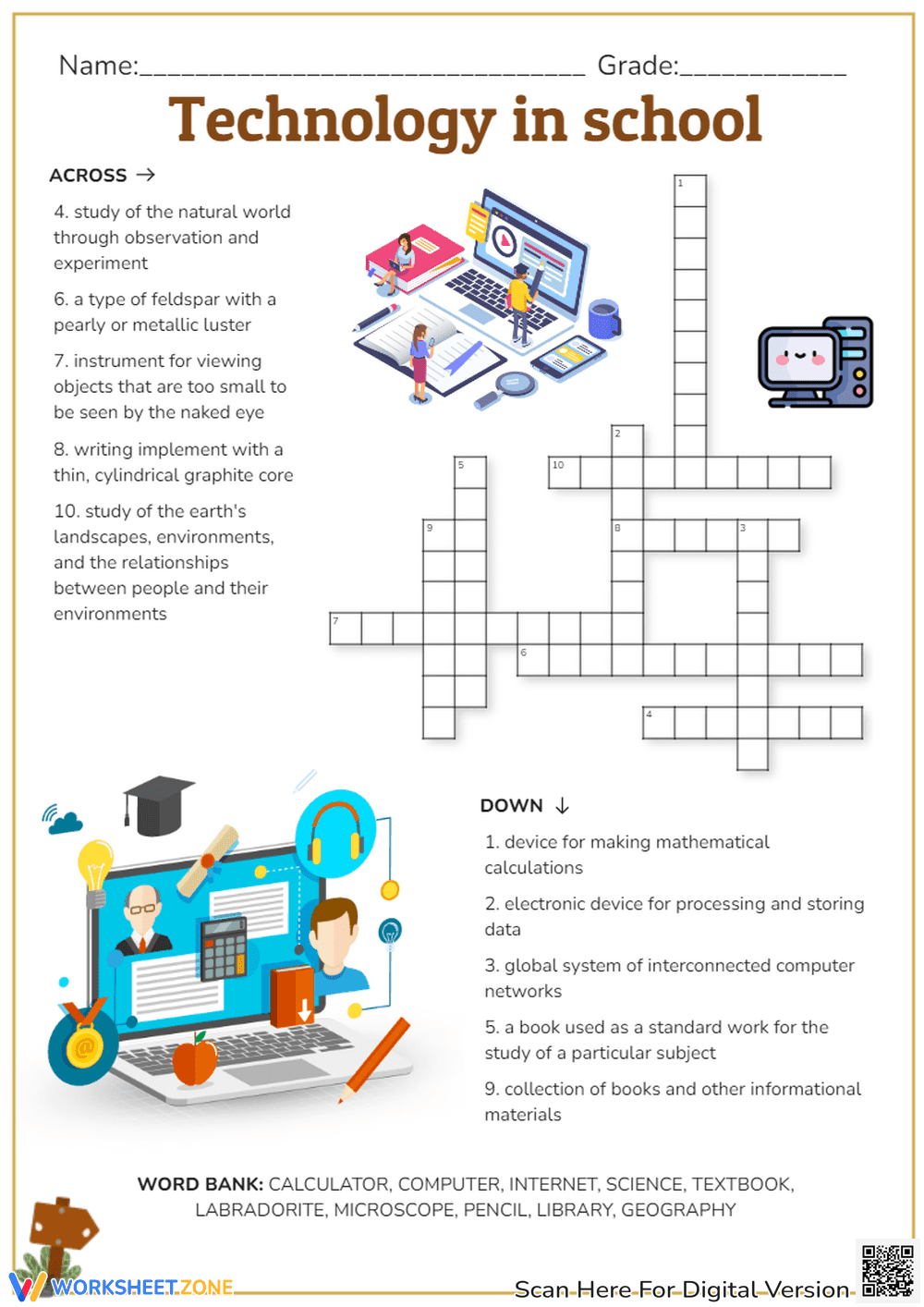

Technology in School Crossword | Essential Grade 3-4
Paste this activity's link or code into your existing LMS (Google Classroom, Canvas, Teams, Schoology, Moodle, etc.).
Students can open and work on the activity right away, with no student login required.
You'll still be able to track student progress and results from your teacher account.
This Technology in School Crossword worksheet helps elementary students master essential academic vocabulary through a fun, puzzle-based format. By matching definitions to specific terms like "calculator" and "geography," students strengthen their reading comprehension and spelling skills. This printable resource ensures students can identify the tools and subjects they encounter daily in a modern classroom setting.
At a Glance
- Grade: 1-4 · Subject: ELA / Vocabulary
- Standard:
CCSS.ELA-LITERACY.L.3.6— Acquire and use accurately grade-appropriate general academic and domain-specific words- Skill Focus: School technology and subject vocabulary
- Format: 1 page · 10 problems · Answer key included · PDF
- Best For: Morning work or early finisher activity
- Time: 15–20 minutes
The worksheet features a single-page layout containing 10 crossword clues divided into "Across" and "Down" sections. It includes a helpful word bank at the bottom to support spelling and provide scaffolding for younger learners or those struggling with word retrieval. The clues cover a range of topics from science equipment to digital infrastructure, ensuring a broad exposure to school-related terminology.
This resource is designed for immediate classroom implementation with a total teacher prep time of under 2 minutes. First, print the single-page PDF for your class. Second, distribute the sheets as a quiet morning activity or a transition task between subjects. Finally, review the answers as a whole group to reinforce the definitions and correct any spelling errors, providing instant feedback to students.
Aligned to CCSS.ELA-LITERACY.L.3.6, which requires students to acquire and use accurately grade-appropriate general academic and domain-specific words. By engaging with terms like "textbook" and "microscope," students build the foundational vocabulary necessary for success in ELA and content-area subjects. This standard code can be copied directly into lesson plans, IEP goals, or district curriculum mapping tools.
Use this crossword as a formative assessment during the first week of school to gauge familiarity with classroom resources. It serves as an excellent "early finisher" option for students who complete assignments ahead of schedule. Observe if students rely on the word bank or solve clues independently to identify those needing vocabulary support. Completion typically takes 15 to 20 minutes.
This worksheet is ideal for students in Grades 1 through 4, with the word bank providing differentiation for younger readers. It pairs naturally with a "Back to School" lesson or a unit on technology. It is also a reliable option for emergency substitute plans because it requires no teacher setup and is entirely self-explanatory for students.
Vocabulary acquisition in the elementary years is a critical predictor of long-term reading comprehension and academic success. This Technology in School Crossword aligns with CCSS.ELA-LITERACY.L.3.6 by requiring students to identify and spell domain-specific terms like "microscope" and "internet" using contextual definitions. According to Fisher & Frey (2014), word-solving strategies—such as using a word bank to bridge the gap between a definition and a specific term—strengthen the neural pathways associated with lexical retrieval. By engaging with 10 targeted academic terms in a gamified format, students transition from passive recognition to active recall. This worksheet provides the necessary scaffolding for diverse learners to master school-related terminology within a structured, low-stakes environment. Research from the RAND AIRS 2024 report suggests that frequent, brief exposures to academic vocabulary across multiple domains significantly improve a student's ability to synthesize complex informational texts in later grades.


