


























Views
Downloads

"Teacher for a Day" Worksheet | Grade 4 Essential
Paste this activity's link or code into your existing LMS (Google Classroom, Canvas, Teams, Schoology, Moodle, etc.).
Students can open and work on the activity right away, with no student login required.
You'll still be able to track student progress and results from your teacher account.
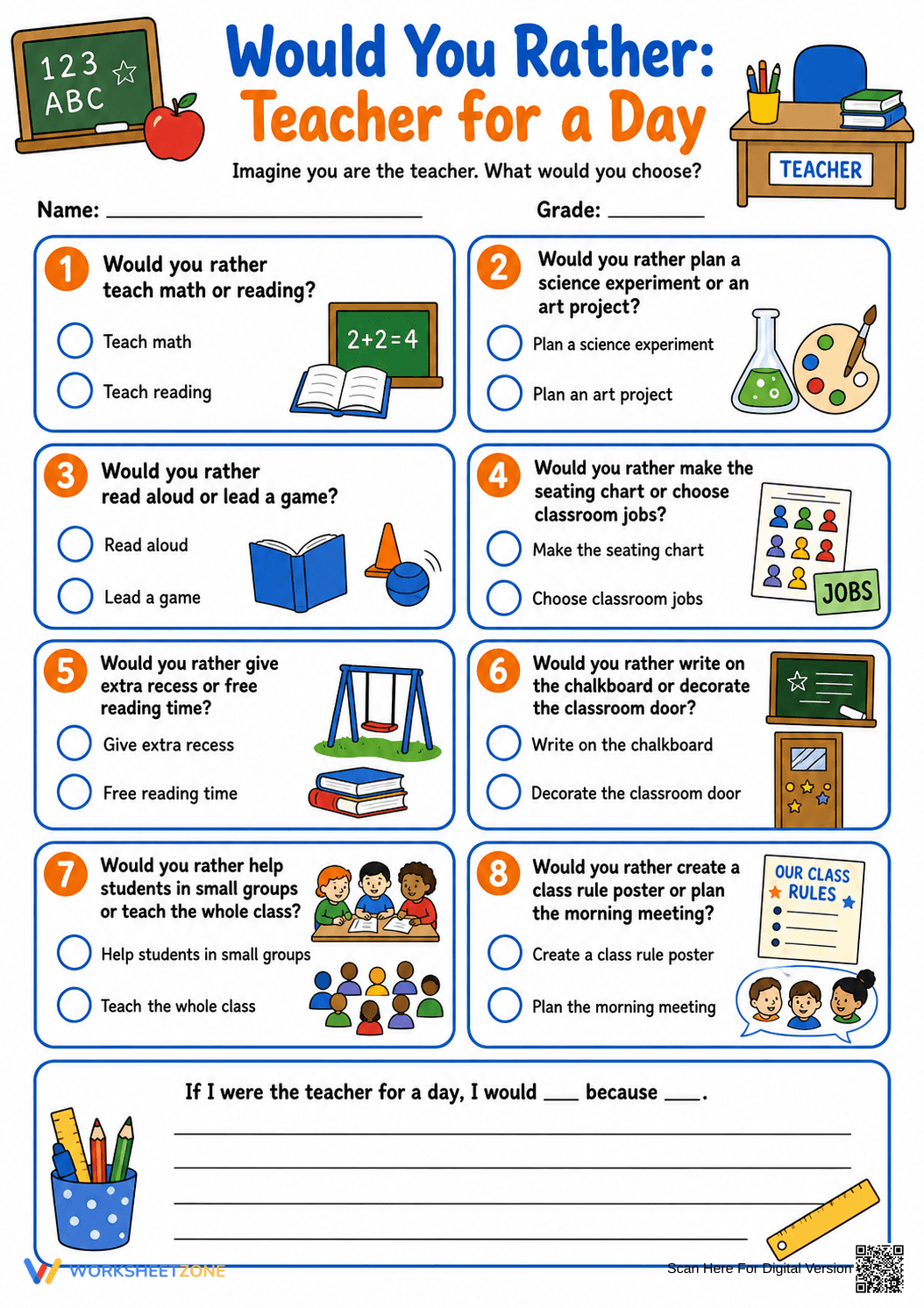
This Grade 4 ELA worksheet engages students in creative decision-making and opinion writing by asking them to step into a leadership role. Students evaluate eight distinct classroom scenarios, choosing between teaching styles and administrative tasks. This activity builds critical thinking and helps students articulate their reasoning through a structured writing prompt.
At a Glance
- Grade: 4 · Subject: ELA
- Standard:
CCSS.ELA-LITERACY.W.4.1— Write opinion pieces on topics or texts, supporting a point of view- Skill Focus: Opinion Writing & Creative Thinking
- Format: 1 page · 9 problems · Answer key not applicable · PDF
- Best For: Morning work or creative writing warm-ups
- Time: 15–20 minutes
The worksheet features a vibrant, school-themed layout with eight choice boxes. Each box includes a specific teacher-related dilemma, such as choosing between teaching math or reading, and planning experiments versus art projects. The final section provides a multi-line writing prompt where students must complete the sentence "If I were the teacher for a day, I would... because..." to practice evidence-based reasoning.
Zero-Prep Workflow
- Print: Select the single-page PDF and print enough copies for your class (30 seconds).
- Distribute: Hand out the worksheets as students enter the room or during a writing block (1 minute).
- Review: Facilitate a quick class discussion where students share their favorite choices and justifications (5 minutes).
Total teacher preparation time is under 2 minutes, making this an ideal resource for substitute folders or unexpected schedule changes.
Standards Alignment
The primary standard addressed is `CCSS.ELA-LITERACY.W.4.1`, which requires students to write opinion pieces on topics, supporting a point of view with reasons and information. By selecting a preference and providing a "because" statement, students practice the foundational skills of argumentative writing. This standard code can be copied directly into lesson plans, IEP goals, or district curriculum mapping tools.
How to Use It
Use this worksheet during the "hook" phase of a writing lesson to spark interest in persuasive techniques. It also serves as a formative assessment tool; observe how students justify their choices in the writing section to gauge their ability to link opinions with logical reasons. Completion typically takes 15 to 20 minutes depending on the depth of the final response.
Who It's For
This resource is designed for general education students in Grades 3–6, but it is particularly effective for English Language Learners (ELLs) due to the visual cues and binary choice format. It pairs naturally with an anchor chart on transition words like "because," "therefore," and "for instance" to help students expand their written responses.
According to the RAND AIRS 2024 report, engaging students in choice-based writing activities significantly increases intrinsic motivation and task persistence in elementary ELA settings. This worksheet leverages the "Would You Rather" format to address CCSS.ELA-LITERACY.W.4.1, focusing on the plain-English skill of stating an opinion and providing a logical reason for that preference. Research from Fisher & Frey (2014) suggests that providing students with low-stakes opportunities to practice argumentative structures—such as choosing between two classroom activities—builds the cognitive scaffolding necessary for more complex persuasive essays. By integrating visual icons with text-based choices, the resource supports diverse learners in developing the ability to articulate their reasoning clearly. This structured approach ensures that students are not just making random selections but are actively participating in the foundational steps of evidence-based writing and classroom leadership reflection.


