


























Views
Downloads

Essential Synonyms Worksheet | Grade 2 Printable ELA
Paste this activity's link or code into your existing LMS (Google Classroom, Canvas, Teams, Schoology, Moodle, etc.).
Students can open and work on the activity right away, with no student login required.
You'll still be able to track student progress and results from your teacher account.
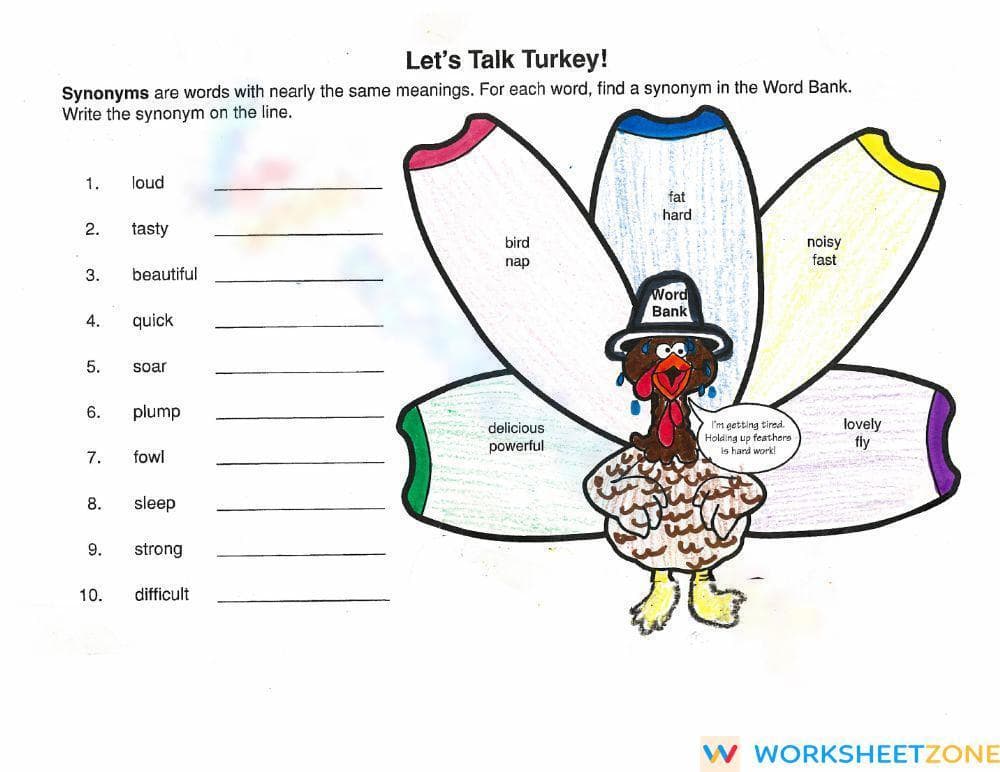
Mastering synonyms is a fundamental step in building a robust vocabulary and improving writing precision. This Grade 2 ELA worksheet provides targeted practice for identifying words with similar meanings. By connecting common adjectives and verbs to their synonyms, students enhance their lexical flexibility and learn to choose more descriptive language for their own creative compositions and narratives.
At a Glance
- Grade: 2 · Subject: ELA
- Standard:
CCSS.ELA-LITERACY.L.2.5— Demonstrate understanding of word relationships and nuances in word meanings- Skill Focus: Synonyms Identification
- Format: 1 page · 10 problems · Answer key included · PDF
- Best For: Vocabulary centers and independent practice
- Time: 15–20 minutes
This "Let’s Talk Turkey!" themed worksheet features 10 vocabulary matching tasks. On the left, students find a list of common words such as "loud," "tasty," and "beautiful." On the right, a visually engaging turkey illustration holds a Word Bank containing synonymous pairs like "noisy," "delicious," and "lovely." The clear layout and thematic graphics make it an inviting resource for primary learners.
The worksheet follows a clear skill progression designed to build student confidence. Using a gradual-release approach, it begins with guided practice through a Word Bank, providing a closed set of options that reduces cognitive load while students familiarize themselves with the synonym pairs. Students then move to supported practice by matching 10 distinct words, requiring them to evaluate nuances between similar terms like "quick" and "fast" or "soar" and "fly." Finally, learners transition to independent practice as they write the correct synonym on the provided lines, reinforcing spelling and handwriting alongside vocabulary acquisition.
This resource is primary aligned to CCSS.ELA-LITERACY.L.2.5, which requires students to demonstrate understanding of word relationships and nuances in word meanings. It also supports CCSS.ELA-LITERACY.L.3.5 for third-grade students working on similar vocabulary goals. Both standard codes can be copied directly into lesson plans, IEP goals, or district curriculum mapping tools.
Incorporate this worksheet during the independent practice phase of a vocabulary lesson. It works exceptionally well as a quick formative assessment to check for understanding after a direct instruction session on word relationships. Expect most students to complete the 10 tasks within 15 to 20 minutes, making it a perfect fit for literacy rotations or morning work.
This resource is designed for Grade 2 and 3 students, though it can serve as an enrichment activity for advanced Grade 1 learners or as a remedial tool for older students needing vocabulary support. It pairs naturally with a classroom anchor chart displaying common synonyms or a short reading passage where students can search for these vocabulary words in context.
According to research from Fisher & Frey (2014) on the gradual release of responsibility, structured vocabulary tasks like this one are essential for moving students toward independent word usage. The use of a word bank provides the necessary scaffolding to bridge the gap between receptive and productive vocabulary. By focusing on CCSS.ELA-LITERACY.L.2.5, this worksheet addresses the specific need for Grade 2 students to distinguish shades of meaning among closely related adjectives and verbs. Explicit synonym instruction has been shown in NAEP reports to correlate significantly with improved reading comprehension scores across the primary grades. This printable resource offers a high-utility, research-backed method for reinforcing lexical depth without overwhelming young learners with complex sentence structures, allowing the focus to remain entirely on the targeted word relationships.


