


























Views
Plays

Rhyming and Syllables Worksheet | Essential Grade K-1
Paste this activity's link or code into your existing LMS (Google Classroom, Canvas, Teams, Schoology, Moodle, etc.).
Students can open and work on the activity right away, with no student login required.
You'll still be able to track student progress and results from your teacher account.
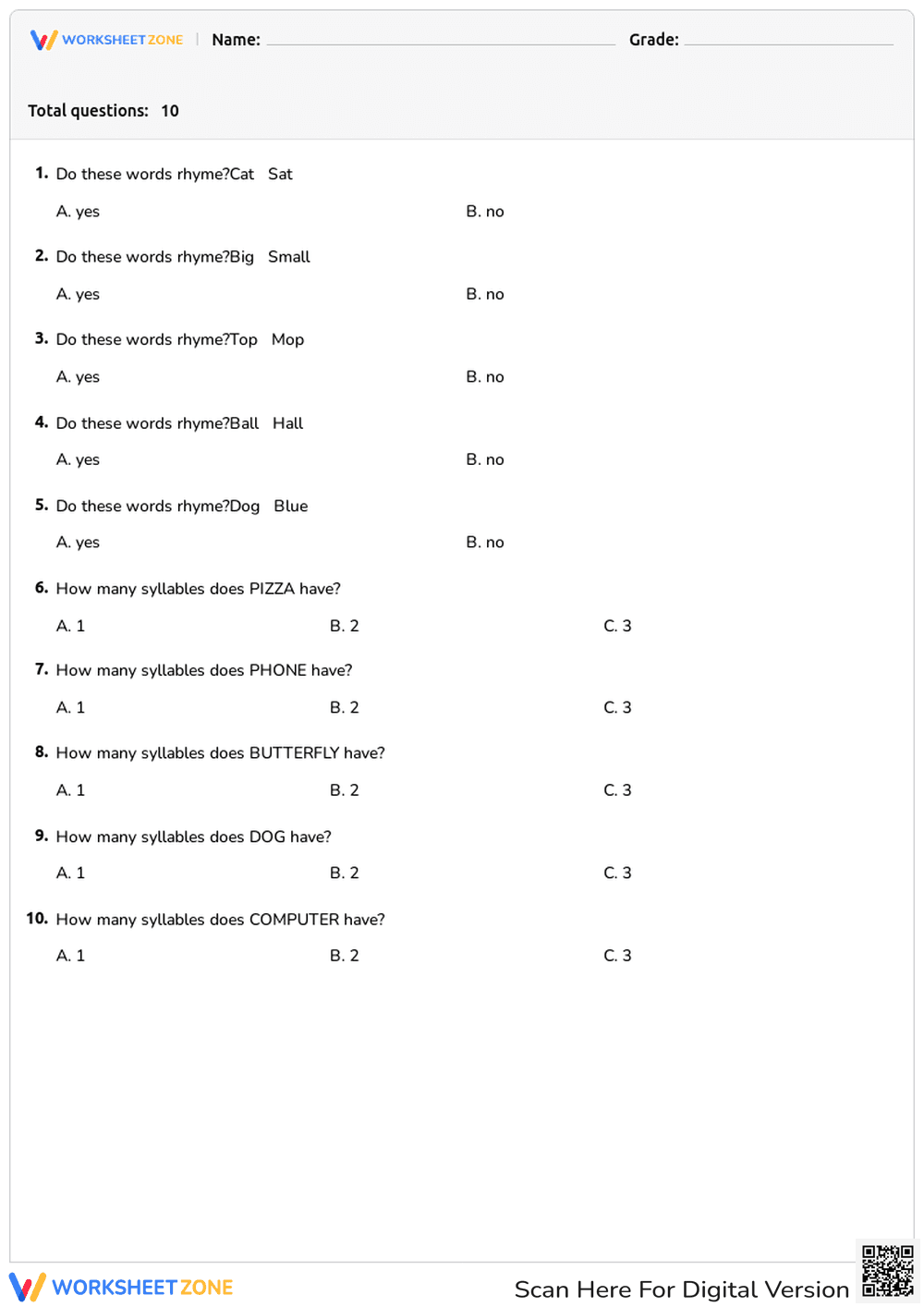
This Grade K-1 phonological awareness worksheet provides students with 10 targeted exercises to master rhyming and syllable counting. By identifying word endings and segmenting sounds, learners build the foundational literacy skills necessary for fluent reading. This resource ensures students can distinguish between similar sounds and understand word structure effectively.
At a Glance
- Grade: Kindergarten · Subject: ELA
- Standard:
CCSS.ELA-LITERACY.RF.K.2— Demonstrate understanding of spoken words, syllables, and sounds (phonemes)- Skill Focus: Rhyming and Syllable Counting
- Format: 1 page · 10 problems · Answer key included · PDF
- Best For: Quick formative assessment or morning work
- Time: 10–15 minutes
The worksheet features a clean, distraction-free layout containing 10 multiple-choice questions. The first five tasks require students to determine if word pairs like "Cat" and "Sat" rhyme, using a simple yes/no format. The remaining five tasks challenge students to count syllables in common words such as "Pizza" and "Computer," choosing from three numerical options. A full answer key is provided for rapid grading.
This resource is designed for a zero-prep classroom environment. Teachers can print the single-page PDF in under 30 seconds, distribute it to the class in 1 minute, and review the answers collectively in less than 5 minutes. The total teacher preparation time is under 2 minutes, making it an ideal choice for emergency sub plans or transition periods.
This activity is directly aligned with `CCSS.ELA-LITERACY.RF.K.2`, which requires students to demonstrate an understanding of spoken words, syllables, and sounds. Specifically, it addresses sub-standards RF.K.2.A (recognizing and producing rhyming words) and RF.K.2.B (counting, pronouncing, blending, and segmenting syllables). Both standard codes can be copied directly into lesson plans, IEP goals, or district curriculum mapping tools.
Use this worksheet as a formative assessment after a direct instruction lesson on phonemes. It works exceptionally well as an exit ticket to gauge student mastery before moving to complex blending. Teachers should observe if students are using "chin drops" or clapping to count syllables, providing a quick check on their physical engagement with the phonological tasks. Completion typically takes 10 to 15 minutes.
This resource is tailored for Kindergarten and Grade 1 students, as well as English Language Learners (ELL) who need focused practice with English phonology. It pairs naturally with a rhyming picture book or a syllable anchor chart. The clear font and simple structure support students with diverse learning needs who require minimal visual clutter.
Research from RAND AIRS 2024 emphasizes that phonological awareness, specifically the ability to recognize rhymes and segment syllables, is one of the strongest predictors of later reading success in early childhood education. This worksheet implements these findings by providing structured, repetitive practice that reinforces the auditory discrimination of word parts. By isolating these two specific skills—rhyming and syllable counting—the resource allows educators to identify specific gaps in a student's phonemic awareness before they impact decoding and fluency. Systematic practice with these 10 tasks aligns with evidence-based instructional routines that move students from oral language proficiency to print literacy. The use of familiar vocabulary ensures that the cognitive load remains focused on the phonological task rather than word recognition, supporting the gradual release of responsibility in a Grade K-1 setting.


