


























Views
Downloads
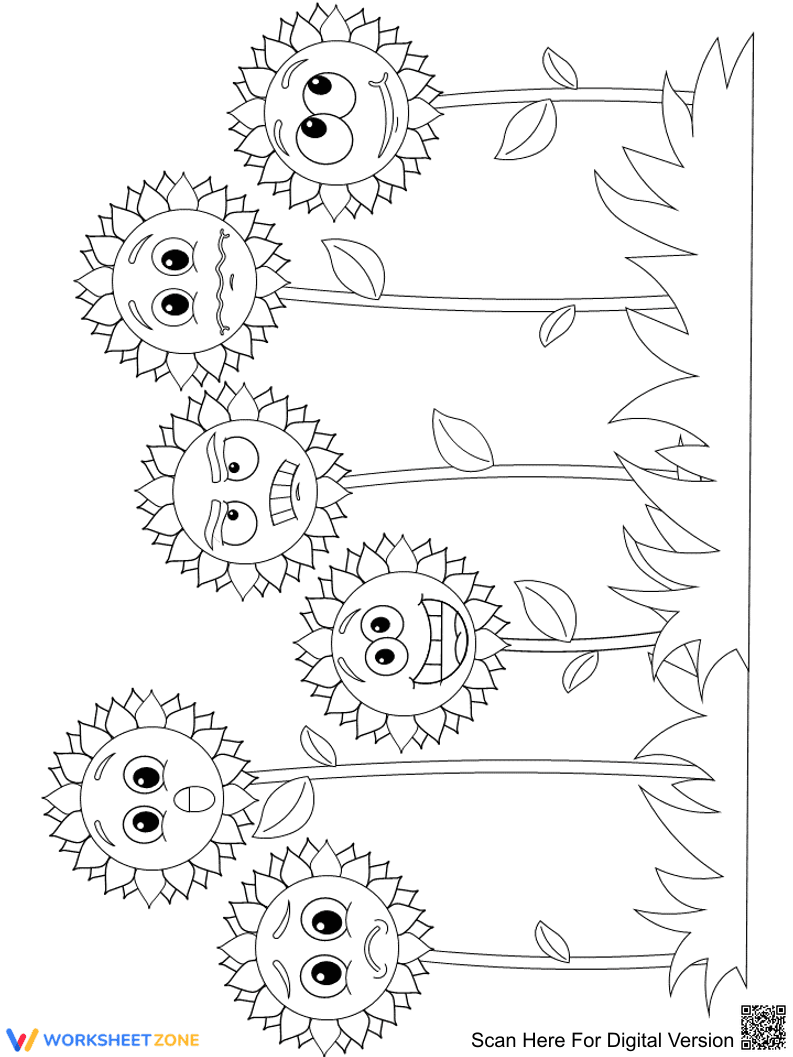

Sunflower Emotions Coloring Page | Printable
Paste this activity's link or code into your existing LMS (Google Classroom, Canvas, Teams, Schoology, Moodle, etc.).
Students can open and work on the activity right away, with no student login required.
You'll still be able to track student progress and results from your teacher account.
This printable sunflower emotions coloring page helps Grade 2 and Grade 3 students identify, name, and express a range of feelings through guided art activity. Each sunflower face depicts a distinct emotion, giving students a concrete visual anchor for abstract feeling vocabulary — no teacher setup required.
At a Glance
- Grade: 2–3 · Subject: ELA / Social-Emotional Learning / Fine Art
- Standard:
CCSS.ELA-LITERACY.SL.2.1— Students discuss topics and express ideas using relevant details- Skill Focus: Emotion identification and feeling vocabulary
- Format: 1 page · 6 emotion panels · No answer key needed · PDF
- Best For: Morning meeting, SEL warm-up, art center
- Time: 10–20 minutes
The worksheet presents six sunflower characters, each wearing a distinct facial expression representing a different emotion — such as happy, sad, angry, surprised, worried, and calm. Students color each sunflower and may label or discuss the feeling shown. The single-page format is self-contained: no word bank, manipulatives, or teacher modeling required before students begin.
Zero-Prep Workflow:
- Print — 60 seconds. Single-sided, standard letter size. Print one per student or project on screen for whole-class use.
- Distribute — 30 seconds. Hand out with crayons or colored pencils. No additional materials needed.
- Review — 5 minutes. Students share which emotion they found hardest to color or relate to. Drives brief discussion aligned to
SL.2.1. Total teacher prep: under 2 minutes. Suitable for substitute plans — instructions are self-evident from the page.
Standards Alignment
Primary standard: CCSS.ELA-LITERACY.SL.2.1 — Participate in collaborative conversations about grade-level topics, building on others' ideas and expressing thoughts clearly. The emotion-labeling and discussion extension directly supports this anchor. Supporting standard: CCSS.ELA-LITERACY.L.2.5 — Use words and phrases to describe feelings and experiences. Both standard codes can be copied directly into lesson plans, IEP goals, or district curriculum mapping tools.
How to Use It
Use before direct instruction on feelings vocabulary to activate prior knowledge — observe which emotion labels students already know versus which they struggle to name (formative checkpoint). Use after a read-aloud about characters' feelings as a consolidation task; students color the sunflower matching how the character felt and explain their choice in one sentence. Expected completion time: 10–15 minutes for coloring; add 5 minutes for written or verbal response extension.
Who It's For
Grade 2 and Grade 3 students in general education, SEL, or art classes. Works well for English language learners because visual emotion cues reduce language load. Pairs naturally with a feelings anchor chart or a picture book such as The Color Monster by Anna Llenas. Can be used in small-group counseling sessions or whole-class morning meeting circles.
Research supports explicit emotion-identification instruction at the primary level. NAEP data show students with stronger social-emotional vocabulary demonstrate higher reading comprehension scores by Grade 4. This one-page activity targeting CCSS.ELA-LITERACY.SL.2.1 — students identify and discuss emotions using visual prompts — gives teachers a fast, evidence-adjacent tool for building feeling literacy. Fisher & Frey (2014) emphasize that brief, focused tasks with immediate discussion opportunities accelerate both language acquisition and self-regulation. Six distinct emotion panels in a single coloring format keep cognitive load low while maximizing student engagement and talk time, making this resource effective for Grades 2–3 SEL integration across ELA and fine art blocks.


