




























Views
Downloads
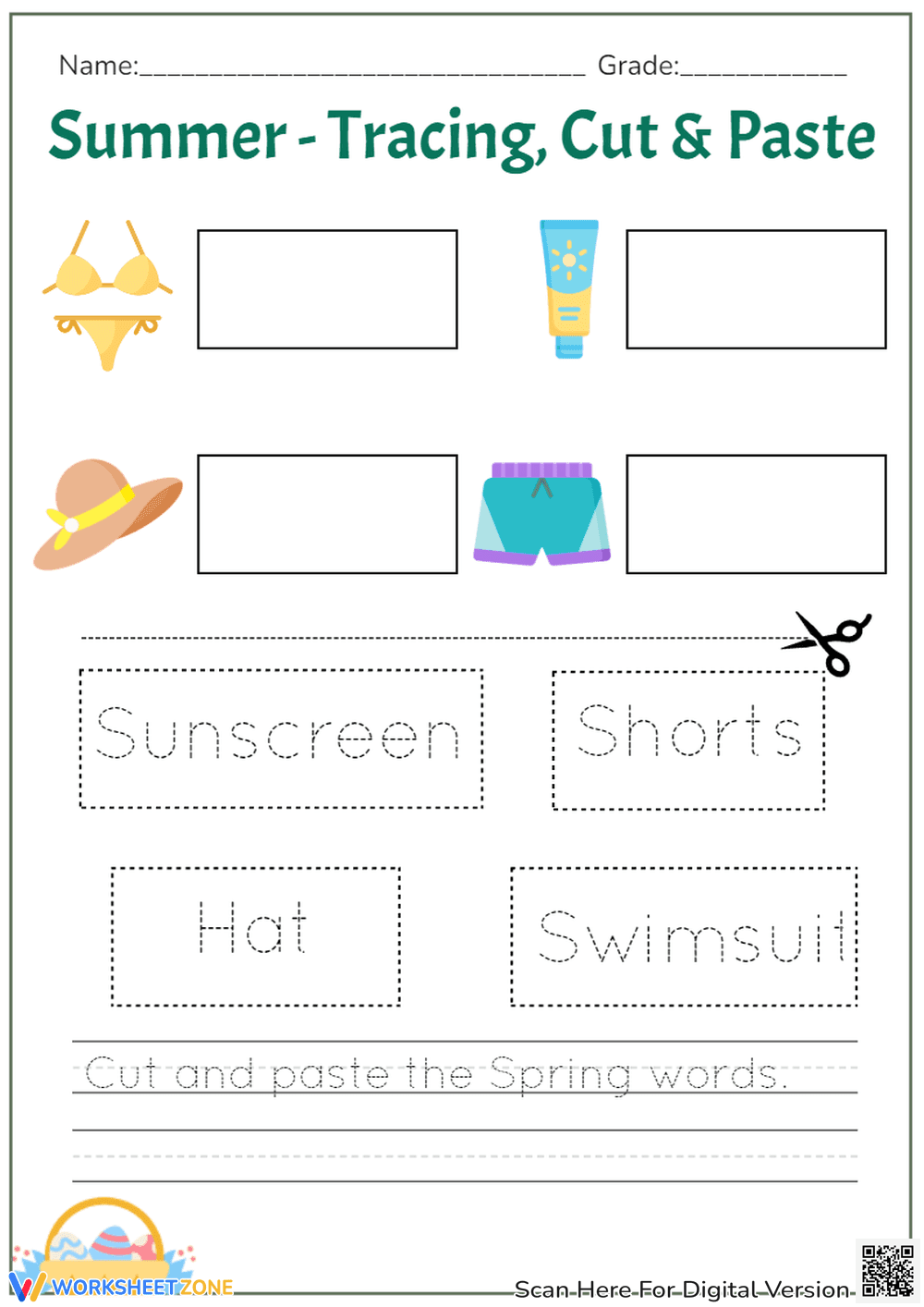

Summer Tracing & Cut and Paste | Essential Grade K-1

Paste this activity's link or code into your existing LMS (Google Classroom, Canvas, Teams, Schoology, Moodle, etc.).
Students can open and work on the activity right away, with no student login required.
You'll still be able to track student progress and results from your teacher account.
This Grade K-1 handwriting worksheet provides a multi-sensory approach to learning summer vocabulary through tracing and fine motor practice. Students develop essential penmanship skills while engaging with seasonal themes, ensuring that foundational literacy remains fun and accessible. By combining cutting, pasting, and tracing, this resource supports comprehensive early childhood development.
At a Glance
- Grade: Kindergarten & Grade 1 · Subject: Handwriting & ELA
- Standard:
CCSS.ELA-LITERACY.L.K.1.A— Print many upper- and lowercase letters while building fine motor control and letter recognition.- Skill Focus: Handwriting and Scissor Skills
- Format: 1 page · 9 tasks · Answer key included · PDF
- Best For: Morning work, literacy centers, or occupational therapy sessions.
- Time: 15–20 minutes
What's Inside
The worksheet features four distinct summer-themed vocabulary words: Sunscreen, Shorts, Hat, and Swimsuit. Each word is presented in a clear, dotted-line format for tracing, paired with a corresponding image for cut-and-paste matching. Additionally, a concluding sentence at the bottom of the page allows students to practice word spacing and sentence structure in a structured environment.
Zero-Prep Workflow
This resource is designed for a zero-prep classroom environment, allowing teachers to implement it in under two minutes. First, print the single-page PDF for each student (30 seconds). Next, distribute the sheets along with scissors and glue sticks (30 seconds). Finally, review the completed work to assess letter formation and fine motor accuracy (1 minute). It is an ideal solution for emergency sub plans or morning work.
Standards Alignment
This activity aligns directly with `CCSS.ELA-LITERACY.L.K.1.A`, which requires students to print many upper- and lowercase letters. It also supports `CCSS.ELA-LITERACY.RF.K.1.B` by helping students recognize that spoken words are represented in written language. Both standard codes can be copied directly into lesson plans, IEP goals, or district curriculum mapping tools.
How to Use It
Use this worksheet during your morning routine to settle students into a productive task immediately upon arrival. It also functions perfectly as a station in a literacy center rotation. While students work, observe their scissor grip and pencil pressure to identify those needing additional support. Expect most students to complete the entire page, including the cutting and pasting, within 15 to 20 minutes.
Who It's For
This resource is tailored for Kindergarten and Grade 1 students who are developing their fine motor skills and letter formation. It is also highly effective for occupational therapy sessions focusing on hand-eye coordination. For a complete lesson, pair this worksheet with a summer-themed picture book or an anchor chart featuring seasonal vocabulary words.
According to the RAND AIRS 2024 report, the integration of tactile activities like cutting and pasting with orthographic tasks such as tracing significantly improves letter recognition and retention in early childhood education. This worksheet targets CCSS.ELA-LITERACY.L.K.1.A by requiring students to produce legible letter forms within a thematic context. By engaging multiple sensory pathways, the activity supports the development of the 'writing circuit' in the brain, which is foundational for later reading fluency. Research indicates that students who master fine motor control early in their academic careers demonstrate higher levels of achievement in both literacy and mathematics by the third grade. This resource provides the structured practice necessary to bridge the gap between simple recognition and active production of written language. Educators can use this tool to provide evidence of student progress toward foundational ELA standards while maintaining high levels of student engagement through seasonal themes.


