


























Views
Downloads
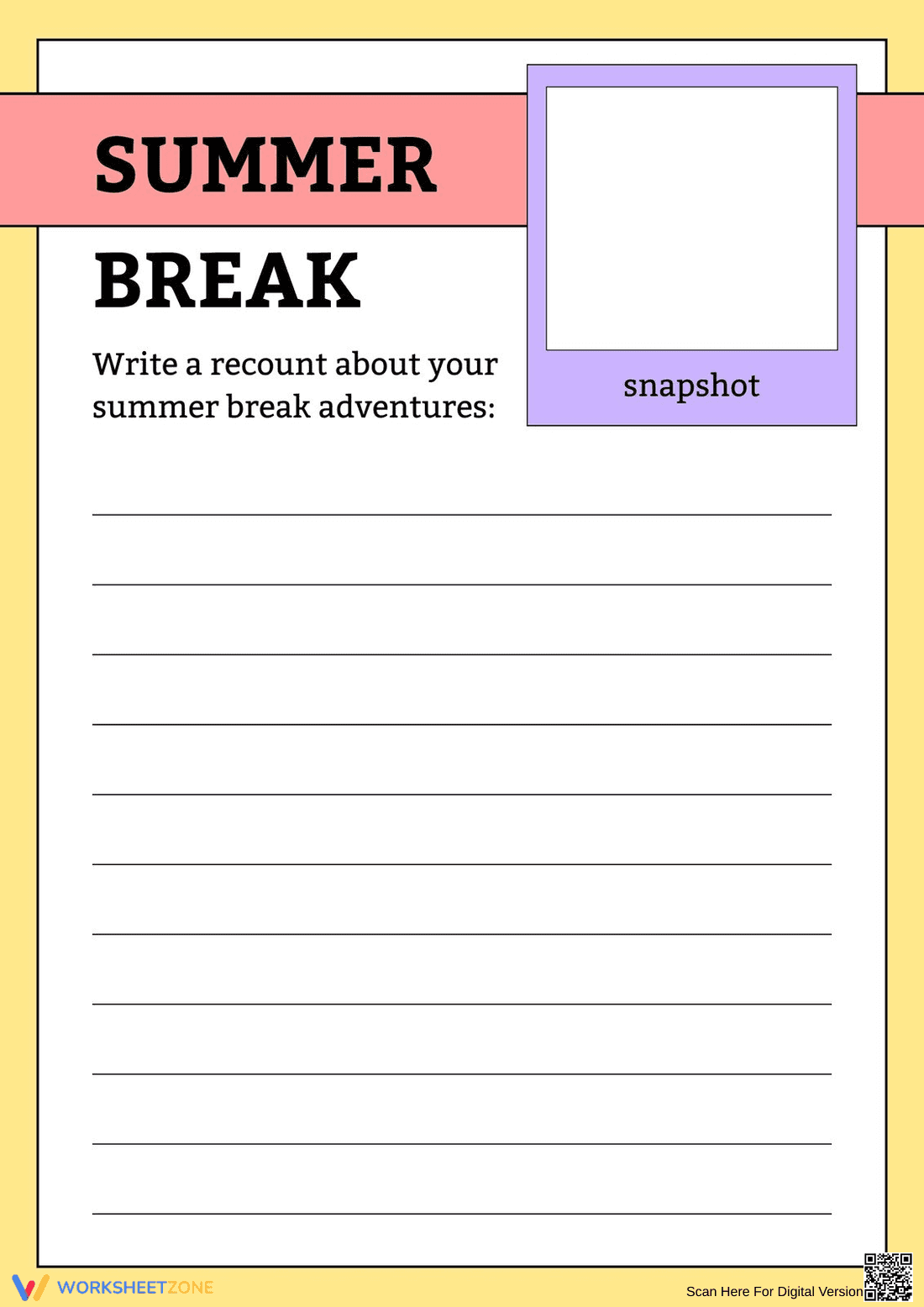

Summer Break Recount Writing | Grade 2 Printable
Paste this activity's link or code into your existing LMS (Google Classroom, Canvas, Teams, Schoology, Moodle, etc.).
Students can open and work on the activity right away, with no student login required.
You'll still be able to track student progress and results from your teacher account.
This Grade 2 narrative writing worksheet prompts students to recount their summer break adventures. By combining a visual snapshot box with structured writing lines, the resource helps young learners organize their thoughts and practice sequencing events. It provides an immediate, engaging entry point for back-to-school literacy instruction.
At a Glance
- Grade: 2 · Subject: ELA
- Standard:
CCSS.ELA-LITERACY.W.2.3— Write narratives recounting a well-elaborated event- Skill Focus: Narrative writing and sequencing
- Format: 1 page · 1 writing task · No answer key · PDF
- Best For: Back-to-school morning work
- Time: 15–20 minutes
This single-page printable features a clear, student-friendly layout designed for early elementary writers. The top section includes a designated "snapshot" box where students can illustrate a key moment from their summer vacation, serving as a visual brainstorm. Below the drawing space, ten wide-ruled lines provide ample room for students to draft their narrative recount, encouraging them to apply temporal words and descriptive details.
This resource is designed for immediate classroom implementation with a streamlined zero-prep workflow:
- Print (1 minute): Generate enough copies for your class directly from the PDF file. No special formatting or color ink is required.
- Distribute (1 minute): Hand out the sheets during morning arrival or as a transition activity. The instructions are self-explanatory.
- Review (3 minutes): Briefly model how to use the snapshot box to plan the writing before students begin working independently.
Total teacher preparation time is under two minutes, making this an ideal option for emergency sub plans.
This worksheet is directly aligned to CCSS.ELA-LITERACY.W.2.3, requiring students to write narratives in which they recount a well-elaborated event or short sequence of events. It also supports foundational language skills by encouraging the use of descriptive details and clear event order. Both standard codes can be copied directly into lesson plans, IEP goals, or district curriculum mapping tools.
Deploy this worksheet as morning work during the first week of school to ease students into routines. Alternatively, use it as an independent center activity after a read-aloud. As students work, use this as a formative assessment to observe baseline handwriting and sentence structure. Expected completion time is 15 to 20 minutes.
This resource is primarily designed for second-grade students, though it serves as excellent review for early third graders or an extension for advanced first graders. The inclusion of the drawing box provides a crucial scaffold for visual learners and English Language Learners who benefit from illustrating their ideas before translating them into text. Pair this worksheet with an anchor chart on transition words to maximize student success.
Effective narrative writing instruction in early elementary grades relies heavily on connecting academic tasks to students' personal experiences. By utilizing CCSS.ELA-LITERACY.W.2.3 to write narratives recounting a well-elaborated event, educators can foster greater engagement and writing stamina. According to Fisher & Frey (2014), providing structured opportunities for students to draw and then write significantly lowers the affective filter, allowing young learners to process their thoughts visually before tackling the cognitive demands of text generation. This summer break recount worksheet leverages that exact pedagogical framework. The integrated snapshot box acts as a graphic organizer, reducing working memory load so students can focus on sequencing and descriptive language. Regular practice with these scaffolded, personal narrative prompts builds essential foundational literacy skills while giving teachers valuable insight into baseline writing proficiencies at the start of the academic year.


