


























Views
Plays

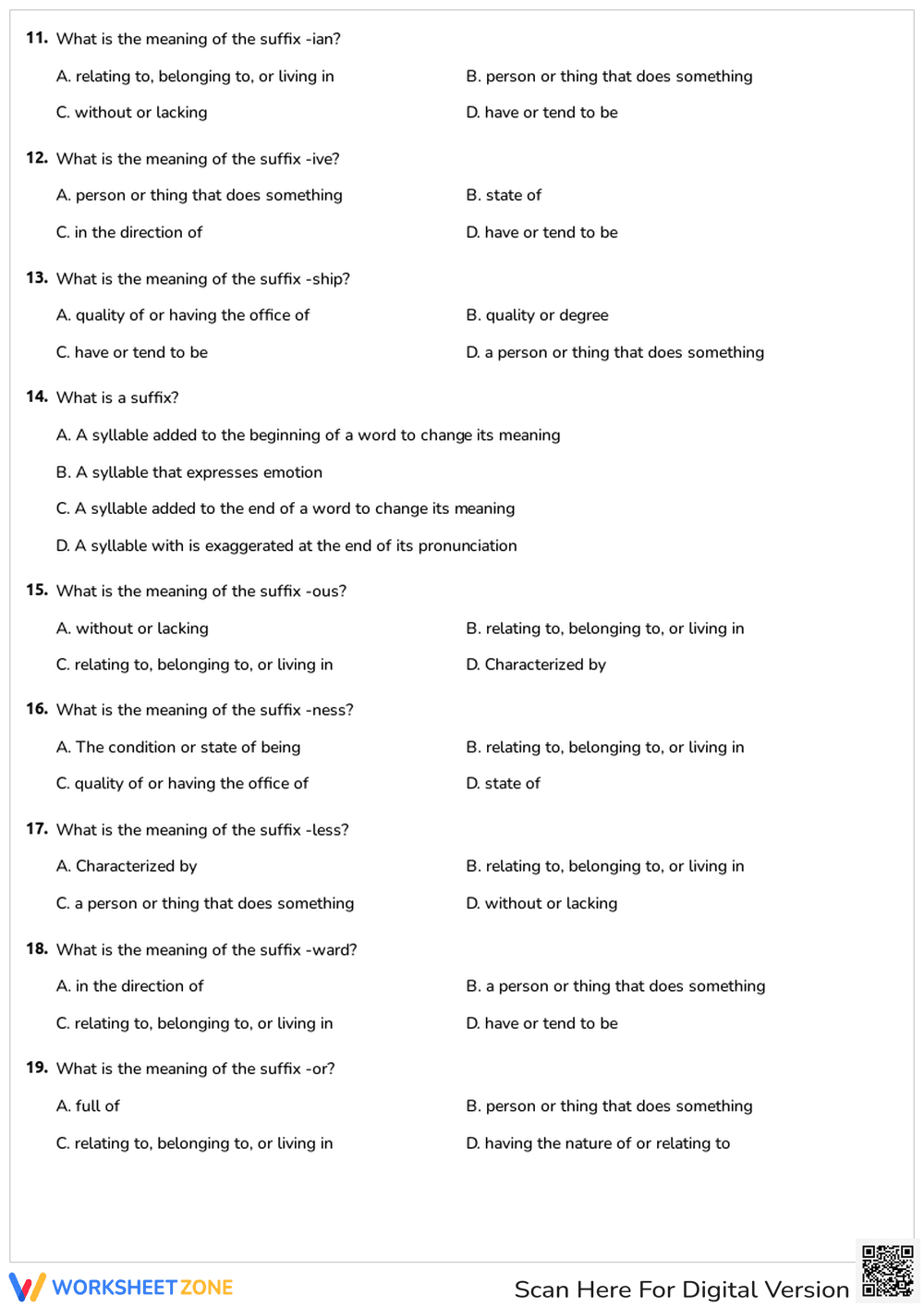

Essential Suffixes Quiz Worksheet | Grades 4-6 ELA
Paste this activity's link or code into your existing LMS (Google Classroom, Canvas, Teams, Schoology, Moodle, etc.).
Students can open and work on the activity right away, with no student login required.
You'll still be able to track student progress and results from your teacher account.
This comprehensive suffixes quiz helps students in upper elementary and middle school master the meanings of common word endings. By identifying the definitions of 19 different affixes, learners build the morphological awareness necessary to decode complex vocabulary and improve overall reading comprehension. It provides a clear assessment of word-pattern knowledge.
At a Glance
- Grade: 4-6 · Subject: ELA Grammar
- Standard:
CCSS.ELA-LITERACY.L.4.4.B— Use common affixes and roots as clues to word meaning- Skill Focus: Suffix Definitions & Meanings
- Format: 2 pages · 19 problems · Answer key included · PDF
- Best For: Formative assessment or vocabulary review
- Time: 15–20 minutes
This two-page PDF features 19 multiple-choice questions designed to test a student's grasp of common suffixes like -able, -ment, -ness, and -less. The first 13 questions focus on specific suffix meanings, while question 14 assesses the fundamental definition of a suffix. The final questions cover more advanced directional and descriptive suffixes, providing a thorough overview of word patterns.
- Guided practice: The initial questions focus on high-frequency suffixes such as "-able" and "-al," allowing students to apply prior knowledge to familiar word endings.
- Supported practice: Mid-quiz items introduce more complex affixes like "-ative" and "-ance," requiring students to distinguish between subtle differences in meaning across four options.
- Independent practice: The final section challenges students with less common suffixes like "-ward" and "-or," testing their ability to generalize morphological rules without contextual clues.
This progression follows a gradual-release model, moving from foundational recognition to comprehensive mastery of affix definitions.
The primary focus of this resource is CCSS.ELA-LITERACY.L.4.4.B, which requires students to use common, grade-appropriate Greek and Latin affixes and roots as clues to the meaning of a word. It also supports L.5.4.B and L.6.4.B by reinforcing the structural analysis of words. Both standard codes can be copied directly into lesson plans, IEP goals, or district curriculum mapping tools.
Use this worksheet as a summative quiz after a unit on word parts to measure student growth. Alternatively, assign it as a pre-assessment before direct instruction to identify which specific suffixes require the most teaching time. For a formative check, observe students as they work; if they struggle with question 14, they may need a refresher on the difference between prefixes and suffixes. Completion typically takes 15 to 20 minutes.
This resource is ideal for general education students in grades 4 through 6, as well as English Language Learners (ELLs) who benefit from explicit vocabulary instruction. It pairs naturally with an anchor chart displaying common affixes or a direct instruction lesson on morphological analysis.
Research from the RAND AIRS 2024 report emphasizes that morphological awareness—the ability to recognize and manipulate the smallest units of meaning in words—is a significant predictor of reading success in the upper elementary grades. By isolating suffixes in a quiz format, this worksheet aligns with evidence-based practices that encourage students to deconstruct words into their constituent parts. Fisher & Frey (2014) highlight that explicit instruction in affixes allows students to expand their generative vocabulary, where learning one suffix can reveal the meaning of dozens of unfamiliar words. This worksheet provides the structured practice necessary to move these definitions from short-term memory into long-term linguistic application. Utilizing a multiple-choice format helps reduce the cognitive load of spelling while focusing entirely on the semantic relationship between the suffix and its definition, a key component of the CCSS.ELA-LITERACY.L.4.4.B standard for Grade 4 through Grade 6 learners.


