


























Views
Downloads

Essential Suffixes Worksheet | Grade 2 ELA Printable
Paste this activity's link or code into your existing LMS (Google Classroom, Canvas, Teams, Schoology, Moodle, etc.).
Students can open and work on the activity right away, with no student login required.
You'll still be able to track student progress and results from your teacher account.
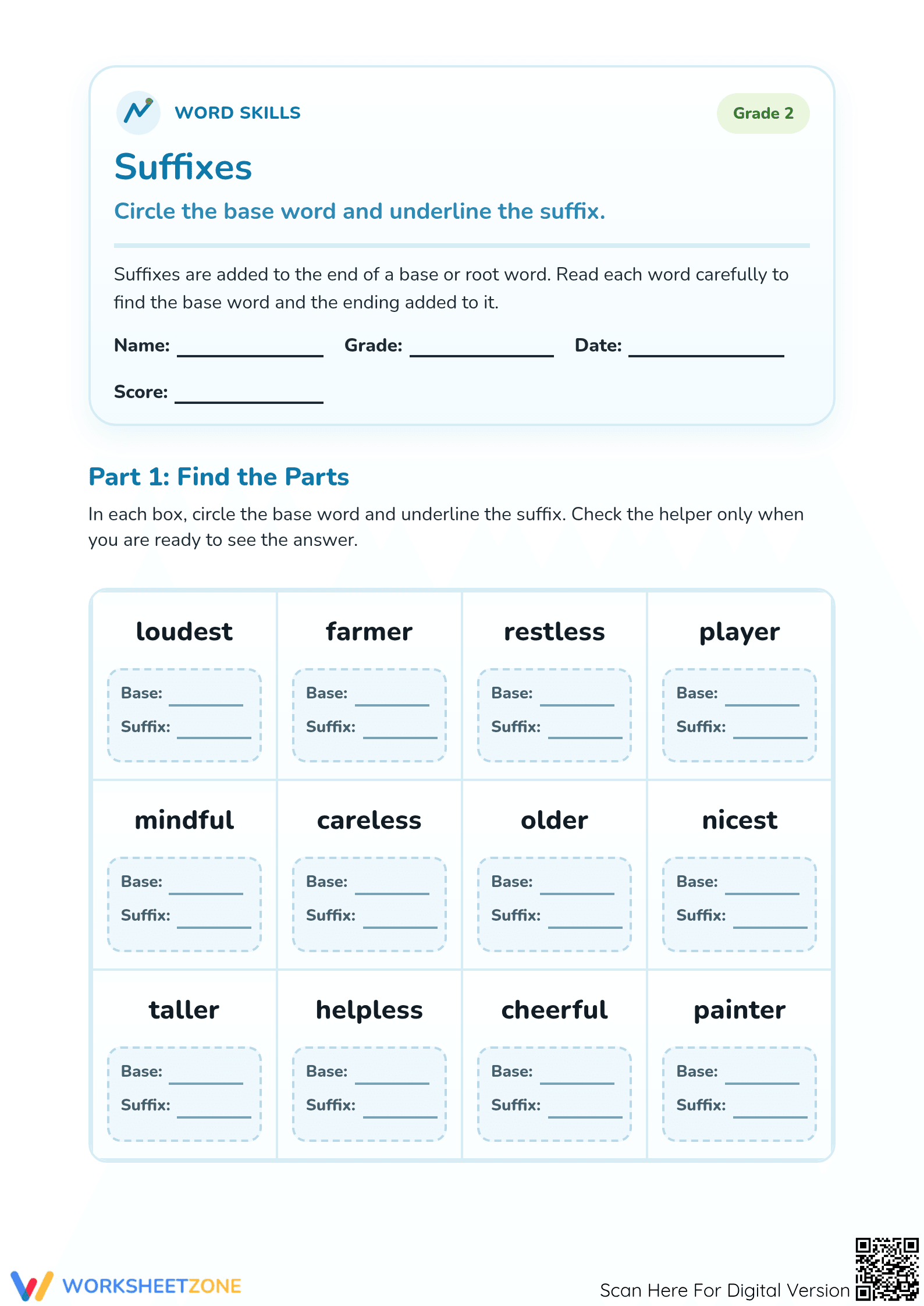
This Grade 2 ELA worksheet provides targeted practice for students learning to deconstruct words into base components and functional suffixes. By identifying the root and the ending, learners strengthen morphological awareness and vocabulary skills. This resource ensures students can independently verify word structures to improve reading fluency and spelling accuracy.
At a Glance
- Grade: 2 · Subject: ELA
- Standard:
L.2.4.B— Determine the meaning of words formed with known suffixes- Skill Focus: Morphological Analysis (Suffixes)
- Format: 2 pages · 16 problems · Answer key included · PDF
- Best For: Independent practice and word study centers
- Time: 15–20 minutes
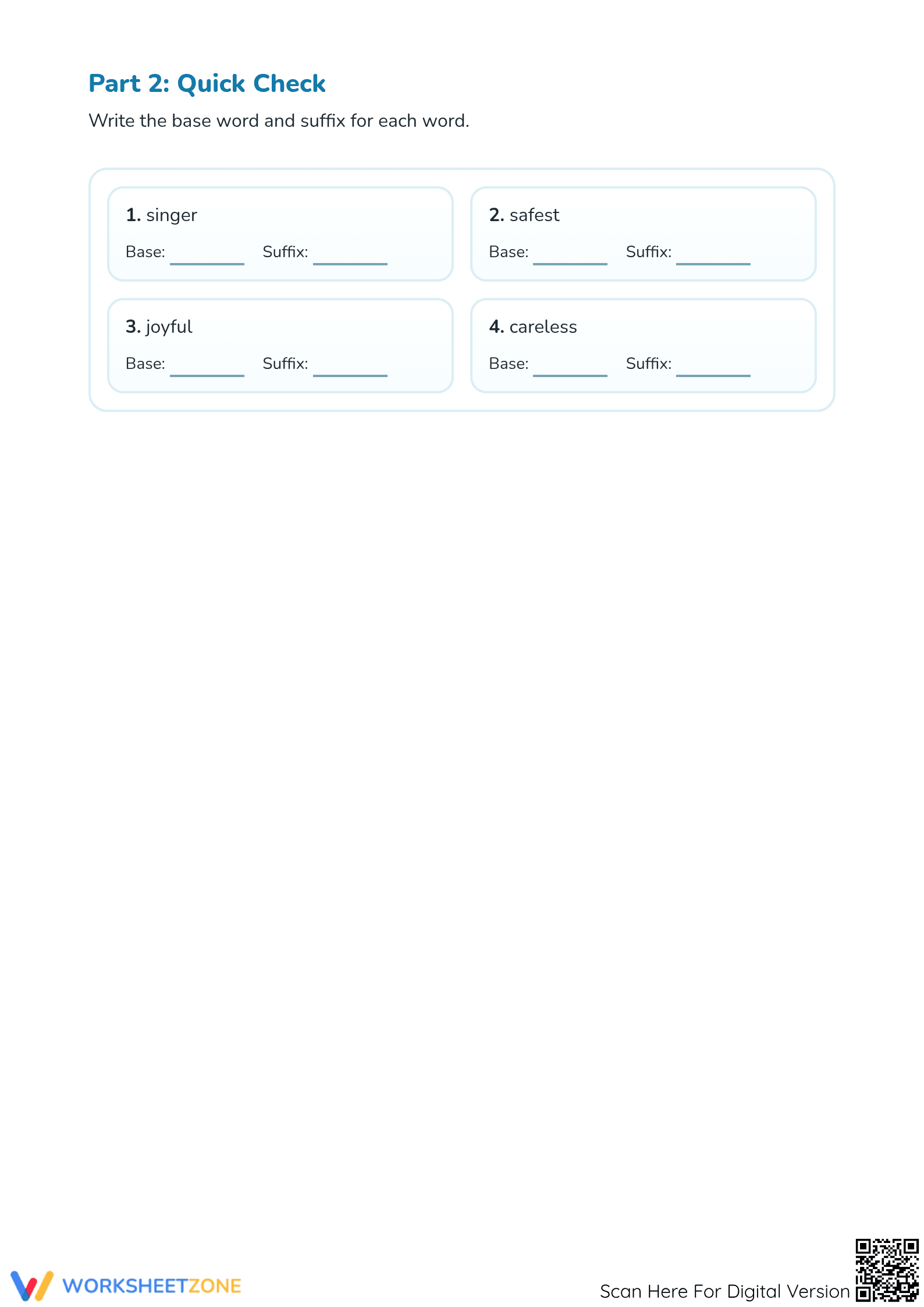
This two-page PDF resource features 16 distinct vocabulary words designed for morphological breakdown. The layout includes structured boxes with dedicated lines for writing both the base word and the suffix. The visual cues, such as circling and underlining instructions, help students focus on the specific transition between the root and the ending. A full answer key is provided for rapid grading.
The worksheet follows a logical skill progression to ensure student mastery:
- Guided Practice: Part 1 features 12 problems where students visually segment common words like "farmer" and "restless."
- Supported Practice: Students use explicit prompts to write out the base and suffix separately in structured boxes.
- Independent Practice: Part 2 offers a "Quick Check" where students synthesize knowledge without visual scaffolding.
This structure follows the gradual-release model, moving from identification to independent application.
This resource is meticulously aligned with CCSS.ELA-LITERACY.L.2.4.B, which requires students to determine the meaning of the new word formed when a known suffix is added to a known word. It also supports CCSS.ELA-LITERACY.L.1.4.B by providing foundational practice with frequently occurring affixes. Both standard codes can be copied directly into lesson plans, IEP goals, or district curriculum mapping tools.
Use this worksheet as a summative assessment following a direct instruction lesson on common suffixes like -est, -er, -less, and -ful. It is also an effective tool for a warm-up activity during small-group literacy rotations. Teachers can use the results as a formative assessment to observe which suffixes cause the most confusion before moving on to complex multi-syllabic words.
This worksheet is ideal for second-grade students and advanced first-graders. It serves as an excellent resource for English Language Learners (ELL) who benefit from explicit word-structure analysis. Pair this with a suffixes anchor chart or a Suffix Hunt in a familiar reading passage to deepen the connection between isolated practice and real-world reading application.
Morphological awareness is a critical predictor of literacy success in early elementary education. According to research published by Fisher & Frey (2014), explicit instruction in word parts, including suffixes and base words, significantly enhances a student's ability to decode unfamiliar vocabulary and comprehend complex texts. This worksheet addresses CCSS.ELA-LITERACY.L.2.4.B by providing 16 high-frequency examples that require students to actively segment lexical units. By isolating the suffix from the base word, students internalize the functional rules of English grammar and word formation. The structured format of this resource aligns with the "I Do, We Do, You Do" instructional model, offering a clear pathway from identification to independent application. This systematic approach is essential for bridging the gap between basic phonics and advanced reading comprehension. Educators can use the included answer key to provide immediate feedback, a strategy proven to accelerate the mastery of foundational linguistic skills.


