


























Views
Downloads

Printable Suffixes Worksheet | Grade 1-2 ELA Practice
Paste this activity's link or code into your existing LMS (Google Classroom, Canvas, Teams, Schoology, Moodle, etc.).
Students can open and work on the activity right away, with no student login required.
You'll still be able to track student progress and results from your teacher account.
Mastering suffixes is a foundational step in vocabulary development and reading fluency. This Grade 1-2 suffixes worksheet provides students with a structured way to identify base words and their endings, helping them decode complex words with ease. By focusing on common suffixes like -less, -ful, -er, and -est, students build the confidence needed to tackle new text independently.
At a Glance
- Grade: 1–2 · Subject: ELA
- Standard:
CCSS.ELA-LITERACY.L.1.4.B— Use frequently occurring affixes as a clue to the meaning of a word- Skill Focus: Suffix Identification and Word Building
- Format: 2 pages · 16 problems · Answer key included · PDF
- Best For: Independent practice or small group instruction
- Time: 15–20 minutes
What's Inside
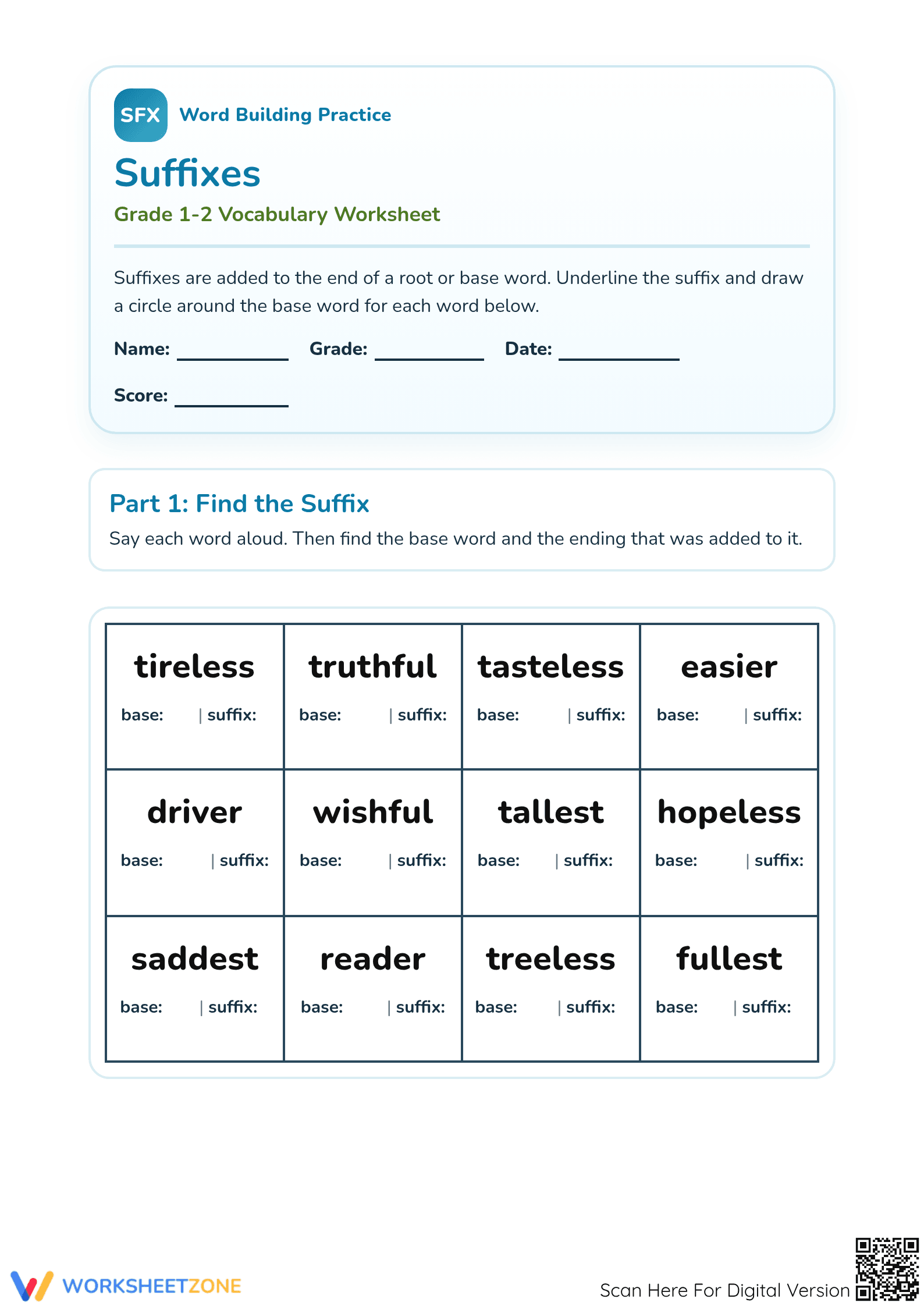
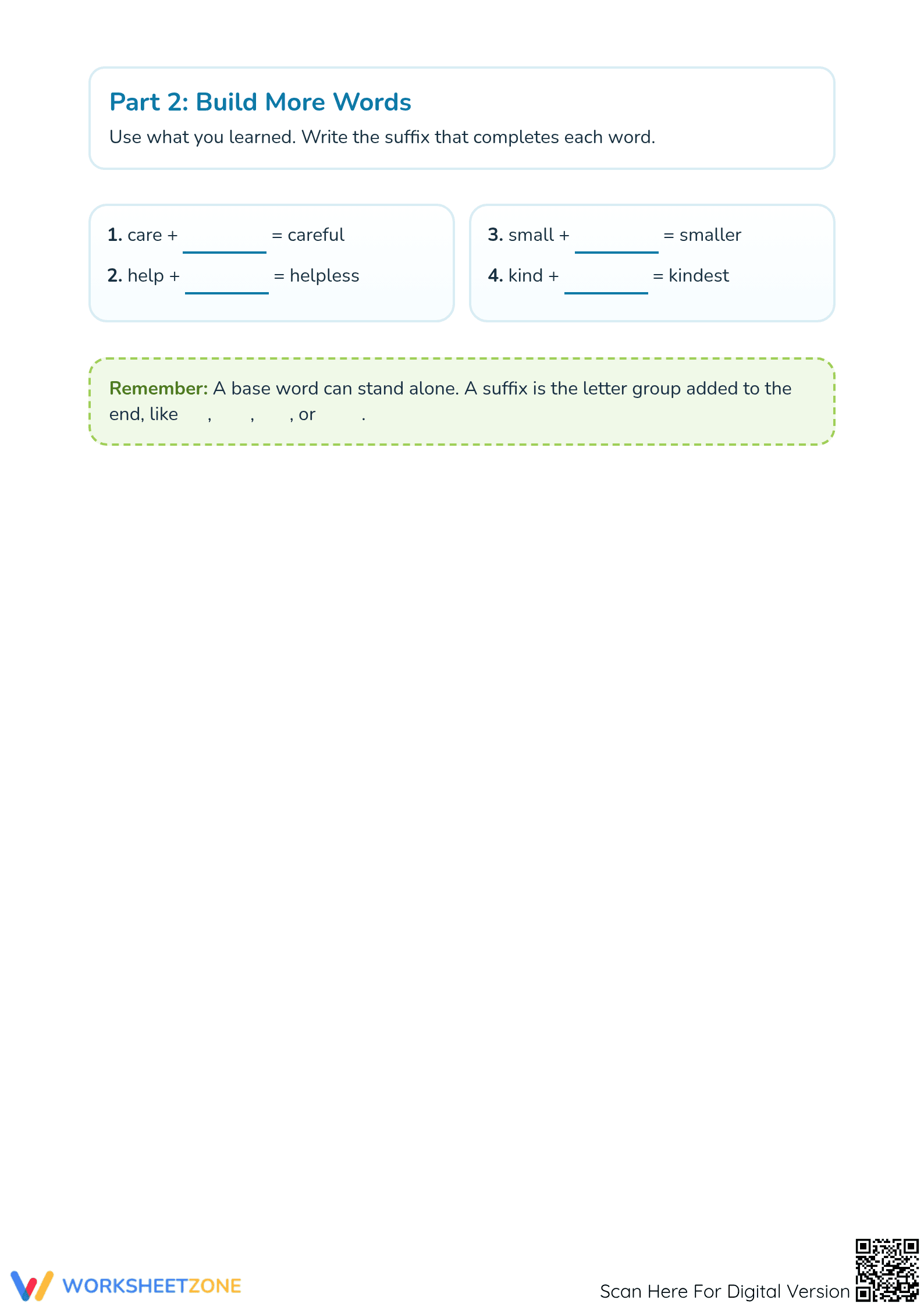
This comprehensive 2-page resource features 16 targeted tasks designed to reinforce word-building mechanics. The first page contains a grid of 12 words where students must isolate the base word and the suffix. The second page includes a "Build More Words" section with 4 additional challenges and a helpful "Remember" box that defines base words and suffixes to support student memory during the activity.
Skill Progression
- Guided Practice: The worksheet begins with clear instructions and 4 examples for teacher-led modeling of suffix identification.
- Supported Practice: Students progress to 8 words in the grid, applying knowledge to suffixes like -less and -ful.
- Independent Practice: The second page challenges students to write correct suffixes independently, ensuring application in new contexts.
This gradual-release approach ensures that learners move from simple identification to active word construction, mirroring the "I Do, We Do, You Do" instructional framework.
Standards Alignment
The primary focus of this worksheet is `CCSS.ELA-LITERACY.L.1.4.B`, which requires students to use frequently occurring affixes as a clue to the meaning of a word. By deconstructing and rebuilding words, students also meet the criteria for `CCSS.ELA-LITERACY.L.2.4.B`. Both standard codes can be copied directly into lesson plans, IEP goals, or district curriculum mapping tools.
How to Use It
This resource is perfect for use during the "practice" phase of a direct instruction lesson on word parts. Alternatively, assign it as a formative assessment after teaching the specific suffixes included. Teachers should observe whether students can identify the base word "care" in "careful" without confusion, providing a clear window into their morphological awareness. Most students will complete the tasks in 15–20 minutes.
Who It's For
This worksheet is ideal for Grade 1 and Grade 2 students working on lexical word classes. It is particularly helpful for English Language Learners (ELL) who benefit from seeing how words are transformed. Pair this resource with a suffix anchor chart or a short reading passage to see these words in a broader narrative context.
According to the RAND AIRS 2024 report, explicit instruction in morphological awareness—specifically the identification of base words and suffixes—is a critical predictor of later reading comprehension success. This worksheet aligns with the ScienceDirect TpT Analysis findings that structured, repetitive practice on word parts significantly reduces cognitive load during decoding. By isolating common suffixes like -less and -ful, students learn to treat suffixes as manageable units of meaning rather than random letter strings. This Grade 1-2 resource specifically addresses CCSS.ELA-LITERACY.L.1.4.B by providing 16 opportunities for students to use affixes as clues to word meaning. Research from Fisher & Frey (2014) supports this gradual-release design, moving students from guided identification to independent application. Implementing such targeted practice ensures that early elementary students develop the linguistic tools necessary for academic vocabulary mastery across all content areas. This evidence-based approach makes the worksheet an essential component of any literacy block.


