


























Views
Downloads

Subtract from 10 and 20 Worksheet | Grade 1 Math Printable
Paste this activity's link or code into your existing LMS (Google Classroom, Canvas, Teams, Schoology, Moodle, etc.).
Students can open and work on the activity right away, with no student login required.
You'll still be able to track student progress and results from your teacher account.
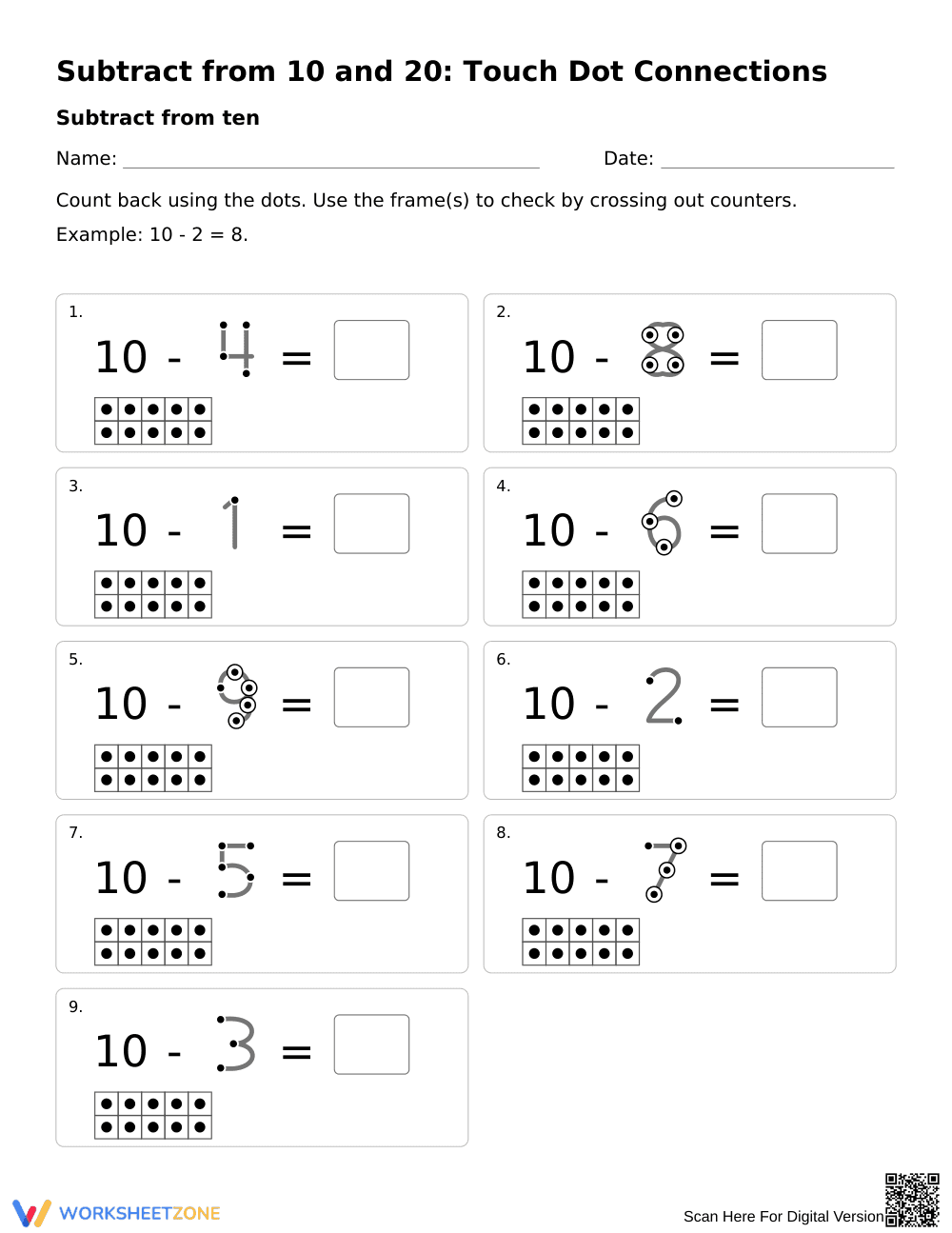
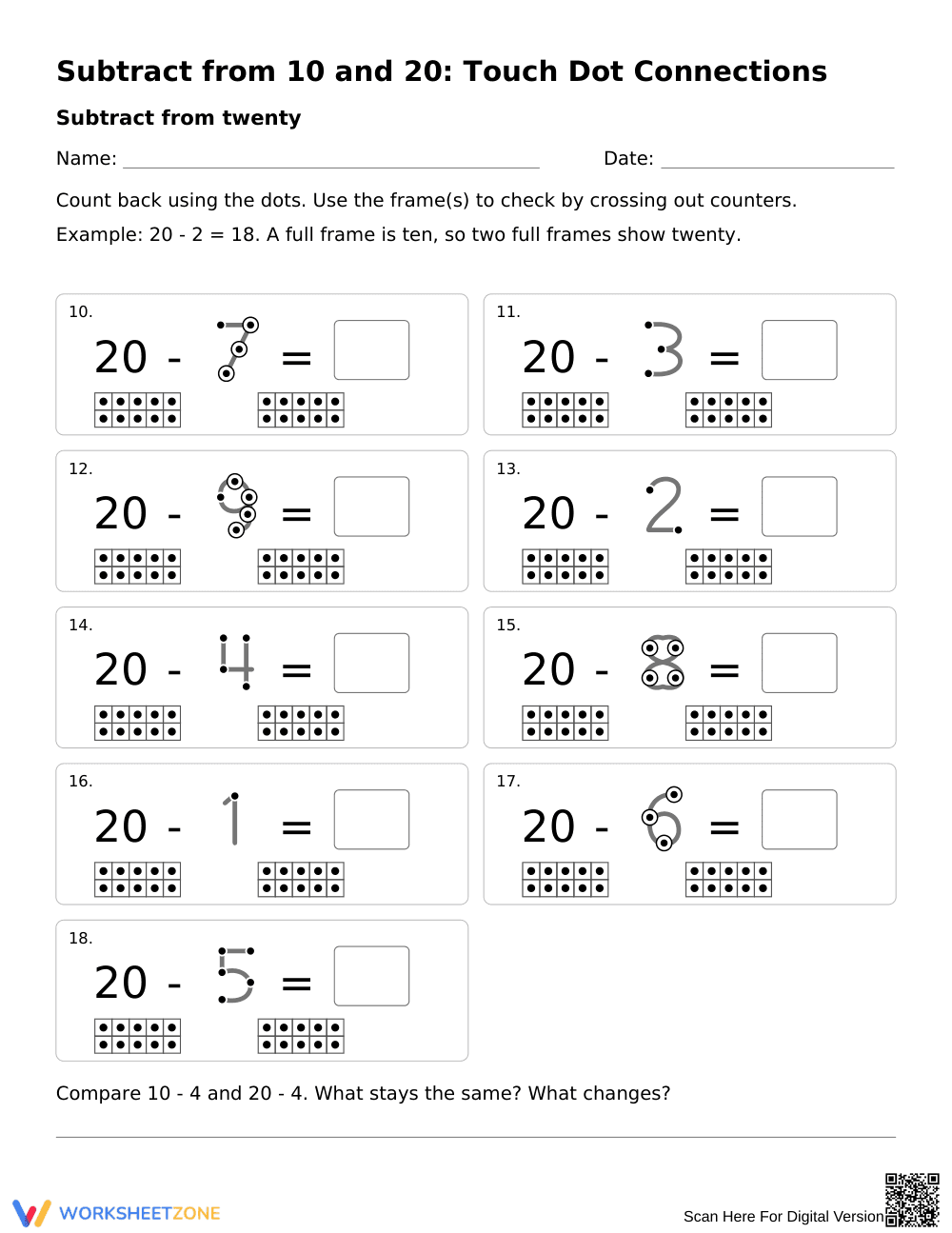
This foundational math worksheet helps first-grade students master subtracting from 10 and 20 using multisensory strategies. By combining touch dot numbers and ten frames, young learners can visually and physically count back to solve equations, building essential number sense and subtraction fluency before moving to mental math.
At a Glance
- Grade: 1 · Subject: Math
- Standard:
CCSS.MATH.CONTENT.1.OA.C.6— Add and subtract within 20 using multiple strategies- Skill Focus: Subtracting from 10 and 20
- Format: 3 pages · 19 problems · Answer key included · PDF
- Best For: Independent practice and math centers
- Time: 15–20 minutes
This resource features two student pages and a comprehensive answer key. Page one focuses on subtracting from 10, while page two advances to subtracting from 20. Each of the 18 standard equations includes a touch dot subtrahend and a corresponding ten frame visual to support counting back. A final reflection question prompts students to compare two related equations, encouraging deeper mathematical thinking.
Skill Progression
- Guided practice: The worksheet begins with an explicit example showing how to use the touch dots and cross out counters in the ten frame to find the difference.
- Supported practice: Students work through 18 equations, relying on the provided visual scaffolds to accurately count back from 10 and 20.
- Independent practice: The final reflection question asks students to compare 10 - 4 and 20 - 4, pushing them to articulate patterns without visual aids.
This gradual-release approach builds confidence through the I Do, We Do, You Do model.
Standards Alignment
This worksheet is directly aligned to CCSS.MATH.CONTENT.1.OA.C.6: Add and subtract within 20, demonstrating fluency for addition and subtraction within 10. By utilizing touch dots and ten frames, the activity supports the standard's emphasis on using strategies such as counting on or back and decomposing numbers. This standard code can be copied directly into lesson plans, IEP goals, or district curriculum mapping tools.
How to Use It
Use this worksheet during math centers or independent practice after direct instruction. Teachers can use the visual ten frames as a formative assessment tool; observe whether students are crossing out dots one-by-one or recognizing chunks of five, which indicates advancing number sense. The structured format also makes it an excellent resource for morning work or homework. Most students will complete the activity within 15 to 20 minutes.
Who It's For
This printable is designed for first-grade students developing their subtraction fluency, but it also serves as an excellent intervention tool for second graders who need additional concrete and representational support. The built-in scaffolds make it highly accessible for diverse learners. Pair this worksheet with physical base-ten blocks or a classroom anchor chart detailing the counting-back strategy for maximum impact.
Developing robust subtraction strategies is a critical milestone in early elementary mathematics. The RAND AIRS 2024 report notes that providing students with visual scaffolds like ten frames significantly improves their transition from concrete counting to abstract mental math. This worksheet directly supports CCSS.MATH.CONTENT.1.OA.C.6 by helping students add and subtract within 20 using multiple strategies. By explicitly connecting the physical act of counting back on touch dots with the visual representation of crossing out counters in a ten frame, learners build a deeper conceptual understanding of subtraction. This dual-scaffold approach reduces cognitive load, allowing students to focus on the mathematical relationships between numbers rather than the mechanics of counting, ultimately fostering long-term fluency and mathematical confidence.


