


























Views
Downloads

Student Learning Reflection | Grade 3-6 Essential
Paste this activity's link or code into your existing LMS (Google Classroom, Canvas, Teams, Schoology, Moodle, etc.).
Students can open and work on the activity right away, with no student login required.
You'll still be able to track student progress and results from your teacher account.
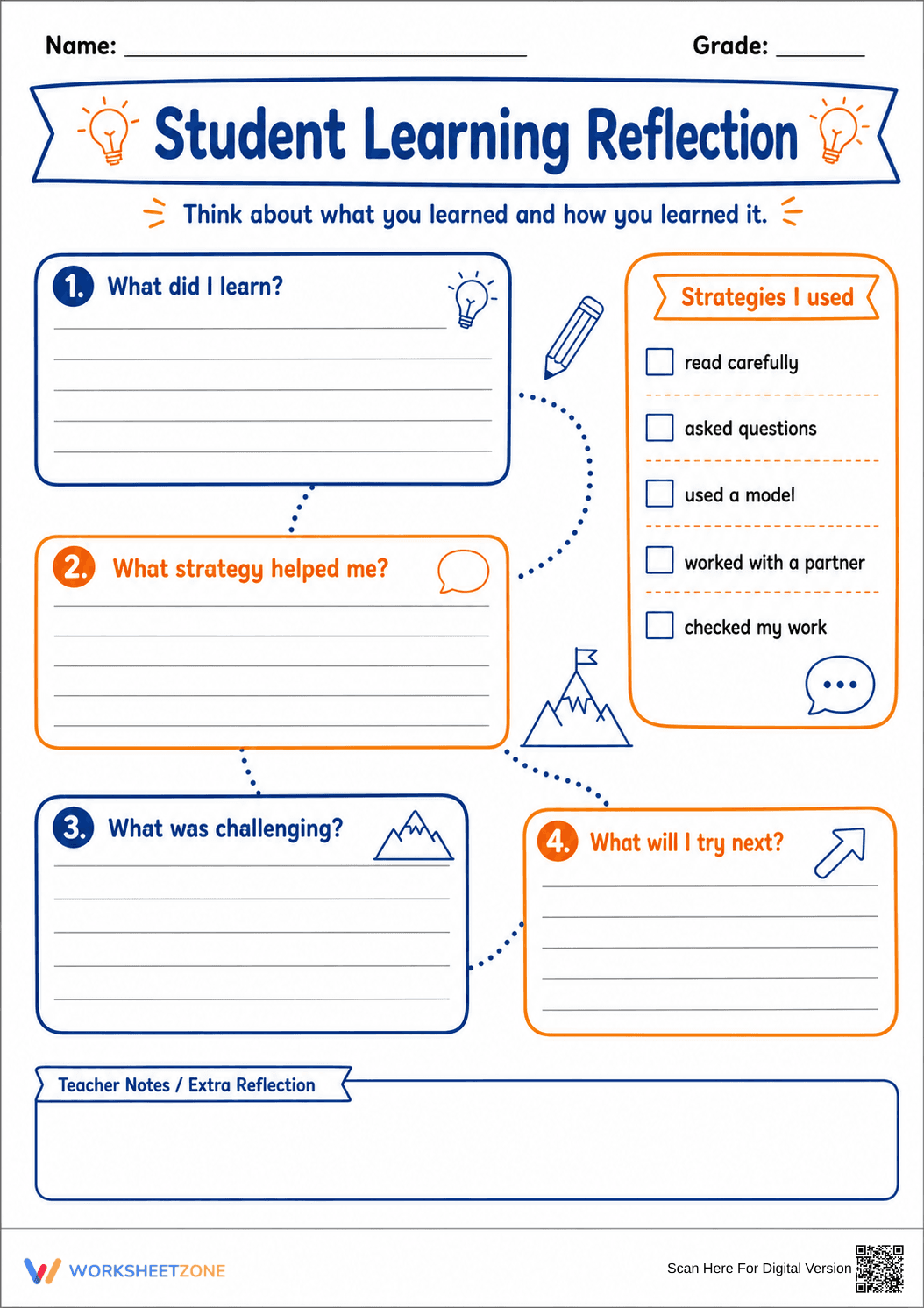
This Grade 3-6 student learning reflection worksheet empowers learners to evaluate their academic progress and metacognitive strategies after any lesson. By documenting what they learned and identifying specific challenges, students develop the self-awareness necessary for independent growth. This tool transforms passive completion into active mastery through structured, guided prompts.
At a Glance
- Grade: 3-6 · Subject: ELA / Reflection
- Standard:
CCSS.ELA-LITERACY.W.5.10— Write routinely for a range of discipline-specific tasks and purposes- Skill Focus: Metacognition and Self-Evaluation
- Format: 1 page · 5 tasks · Answer key N/A · PDF
- Best For: Post-lesson assessment and goal setting
- Time: 10–15 minutes
What's Inside
This single-page PDF features a creative reflection path layout designed to reduce student anxiety. It includes four rounded writing panels with generous ruled lines for open-ended responses. A dedicated sidebar provides a checklist of five common learning behaviors, such as asking questions and checking work. The visual design uses blue and orange accents to guide the student's eye.
Zero-Prep Workflow
The zero-prep workflow is designed for immediate classroom integration. First, print the single-page PDF in under 30 seconds. Second, distribute the worksheet immediately following a core lesson or unit assessment. Third, allow students to complete the reflection independently while you circulate to provide feedback. This resource requires no teacher setup and is an ideal component for emergency sub plans.
Standards Alignment
This resource aligns with `CCSS.ELA-LITERACY.W.5.10`, which requires students to write routinely over shorter time frames for a range of discipline-specific tasks and purposes. By engaging in regular reflection, students practice the habit of academic writing while processing content-area knowledge. This standard code can be copied directly into lesson plans, IEP goals, or district curriculum mapping tools.
How to Use It
Use this worksheet as a formative assessment tool immediately following a challenging math or science lesson. It provides a clear window into student misconceptions that a standard quiz might miss. Alternatively, assign it as a weekly wrap-up to help students track their growth over time. Expect completion within 10 to 15 minutes, depending on the depth of the preceding lesson.
Who It's For
This worksheet is designed for general education students in grades 3 through 6, but it is particularly effective for students who require explicit scaffolding for executive functioning. It pairs naturally with any informational text or direct instruction lesson. The visual path layout supports English Language Learners by providing clear, non-verbal cues for the sequence of tasks.
Metacognitive reflection is a cornerstone of effective pedagogy, as highlighted in the Fisher & Frey (2014) framework for intentional interest and student agency. Research indicates that when students explicitly identify the strategies that lead to their success, they are significantly more likely to transfer those skills to novel academic challenges. This worksheet facilitates that transfer by requiring students to connect their learning outcomes directly to specific actions, such as using a model or working with a partner. By documenting challenges and future goals, students move beyond rote memorization toward a mastery-oriented mindset. Furthermore, the visual path design encourages students to view learning as a journey rather than a destination, promoting a growth mindset that is essential for long-term academic resilience. This structured approach to self-evaluation, aligned with CCSS.ELA-LITERACY.W.5.10, provides teachers with actionable data to differentiate future instruction based on student-reported difficulties.


