


























Views
Downloads
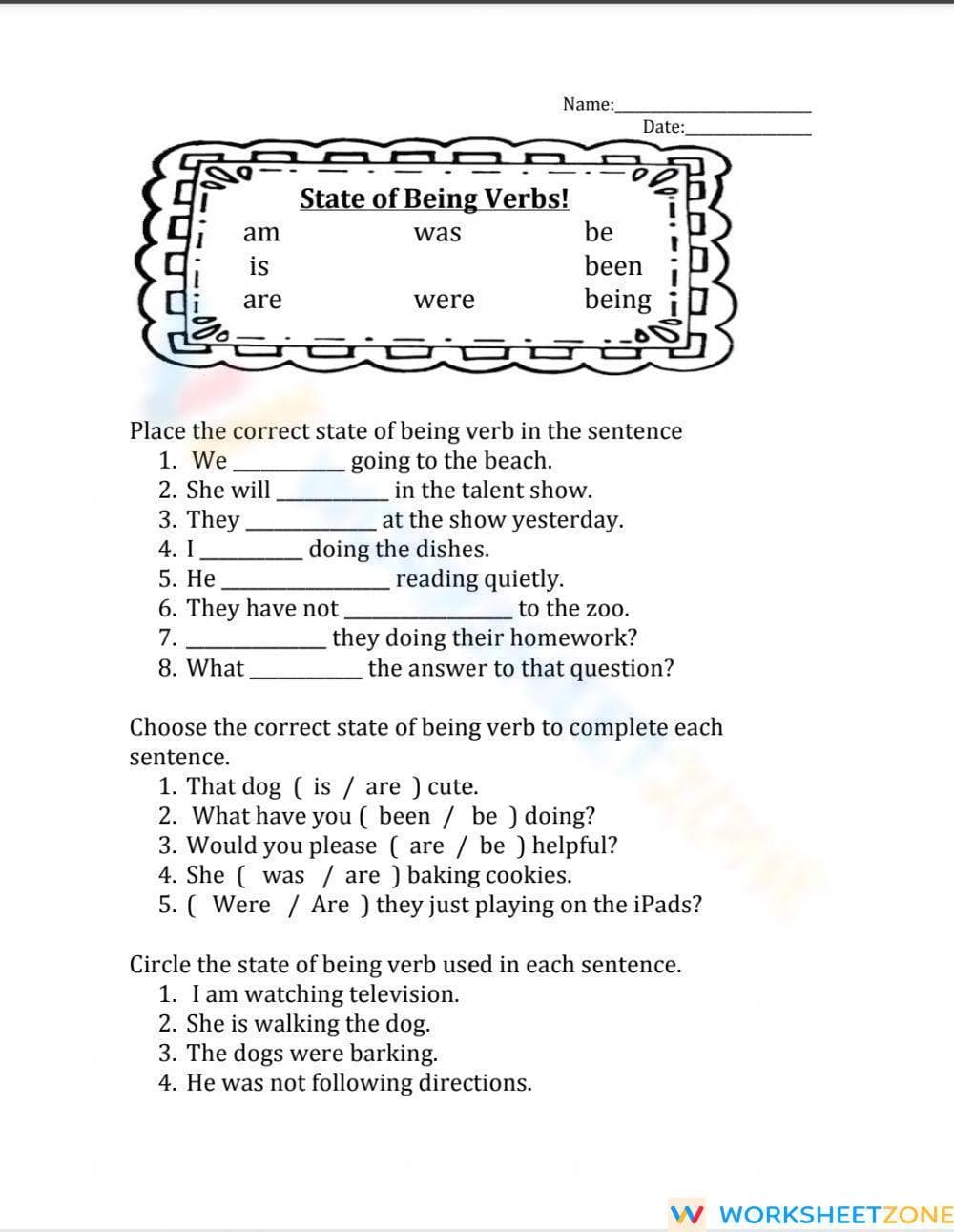

State of Being Verbs Worksheet | Grade 3 Printable
Paste this activity's link or code into your existing LMS (Google Classroom, Canvas, Teams, Schoology, Moodle, etc.).
Students can open and work on the activity right away, with no student login required.
You'll still be able to track student progress and results from your teacher account.
Mastering "state of being" verbs is foundational for sentence fluency and grammatical accuracy. This worksheet provides targeted practice with common linking verbs: am, is, are, was, and were. Students identify and apply these essential parts of speech across multiple contexts to build writing confidence and mastery of English conventions.
At a Glance
- Grade: 3 · Subject: ELA
- Standard:
CCSS.ELA-LITERACY.L.3.1— Demonstrate command of the conventions of standard English grammar and usage when writing.- Skill Focus: State of Being Verbs (Linking Verbs)
- Format: 1 page · 17 problems · Answer key included · PDF
- Best For: Grammar reinforcement and quick skill checks
- Time: 15–20 minutes
This one-page PDF focuses on the primary state of being verbs. The worksheet features three sections: eight fill-in-the-blank sentences, five multiple-choice selection tasks, and four identification circles. A visual word bank header supports students as they work through the 17 problems. A full answer key is included for rapid grading.
Skill Progression
- Guided practice: Students use a word bank to complete 8 blanks, providing immediate support for identifying correct verb forms.
- Supported practice: Learners choose between two verb forms in five sentences to sharpen subject-verb agreement skills.
- Independent practice: Students circle state of being verbs within four sentences without prompts, demonstrating mastery of identification.
This sequence follows a gradual-release model, moving from scaffolded help to independent recognition. This ensures students understand the role of linking verbs before moving to complex writing tasks.
Standards Alignment
This resource aligns to CCSS.ELA-LITERACY.L.3.1, focusing on the conventions of standard English grammar. It specifically addresses verb forms that indicate a state of existence rather than a physical action. This standard code can be copied directly into lesson plans, IEP goals, or district curriculum mapping tools to ensure instructional alignment with state and national requirements.
How to Use It
Use this worksheet as a formative assessment after teaching linking verbs. It works well as a quick "do-now" or a homework assignment. Observe if students check the sentence subject before selecting a verb; this provides a chance for immediate feedback on singular/plural agreement. Most students will complete the 17 tasks in approximately 15 to 20 minutes.
Who It's For
This worksheet is designed for Grade 3 but serves Grade 2 learners or Grade 4 students needing a refresher. It is particularly helpful for English Language Learners (ELL) navigating "to be" verb nuances. Pair this with an anchor chart or a reading passage where students can highlight similar verbs in a narrative context.
The explicit teaching of linking verbs is essential for developing grammatical accuracy in early writing. According to the RAND AIRS 2024 analysis of elementary instruction, focused practice with state of being verbs (am, is, are, was, were) improves a student's ability to maintain consistent verb tense and subject-verb agreement. By isolating these verbs from action verbs, learners better understand how sentences establish identity or existence. This worksheet provides 17 tasks aligned to CCSS.ELA-LITERACY.L.3.1, moving students from recognition to application. Educators can use the included answer key to identify common misconceptions regarding singular and plural agreement. This ensures the plain-English skill of identifying "being" words is mastered before introducing complex auxiliary structures. This approach follows research-backed strategies for grammar acquisition in the middle elementary grades, supporting long-term writing development.


