


























Views
Downloads

Essential St. Patrick's Day Reading Comprehension: Grade 6-8
Paste this activity's link or code into your existing LMS (Google Classroom, Canvas, Teams, Schoology, Moodle, etc.).
Students can open and work on the activity right away, with no student login required.
You'll still be able to track student progress and results from your teacher account.
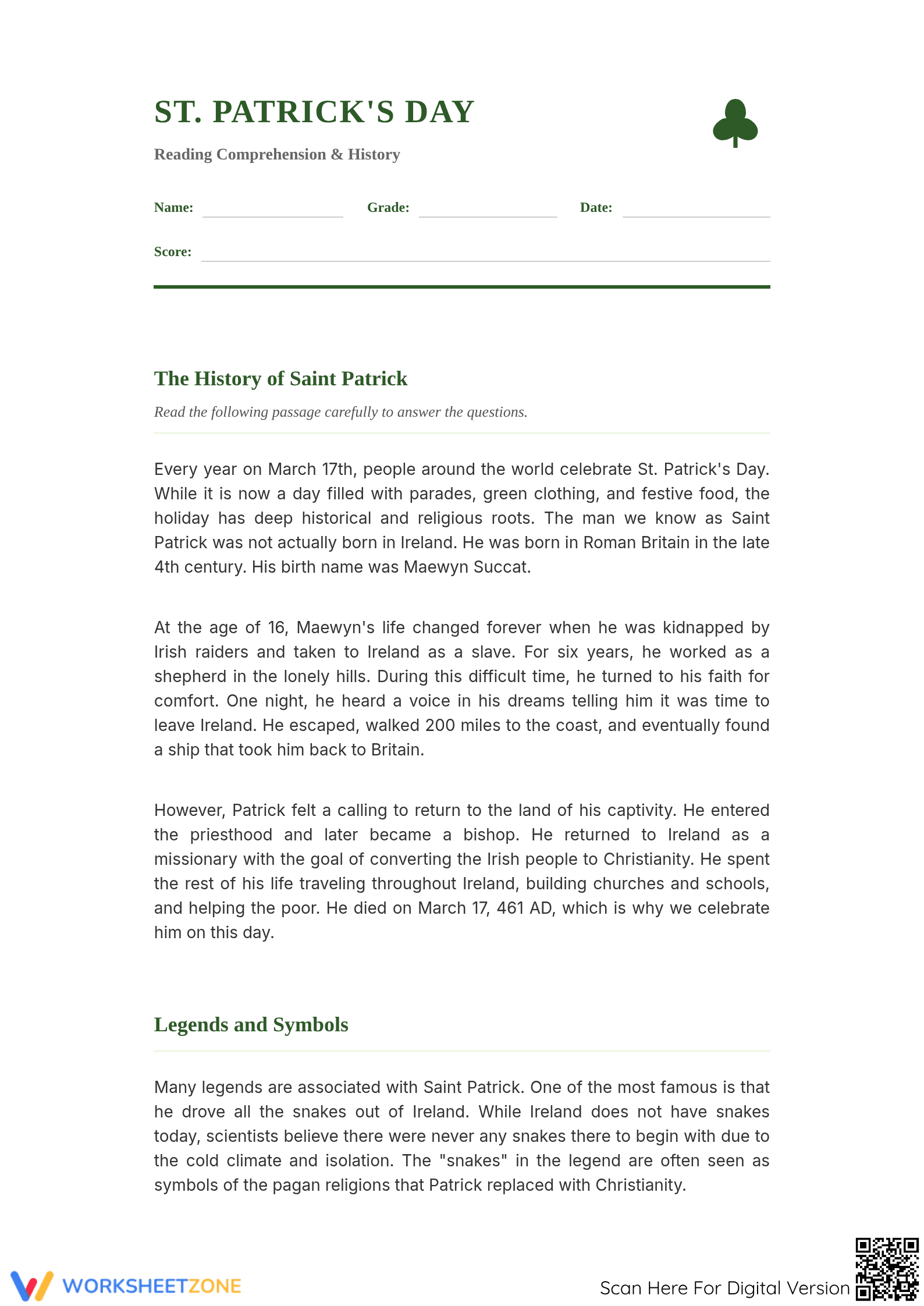
This Grade 6-8 reading comprehension worksheet provides students with a detailed historical account of Saint Patrick, moving beyond modern celebrations to explore his origins and legacy. Students analyze text to identify key facts, interpret symbols like the shamrock, and understand the evolution of cultural traditions. It ensures mastery of informational text analysis through structured questioning.
At a Glance
- Grade: 6-8 · Subject: ELA
- Standard:
CCSS.ELA-LITERACY.RI.6.1— Cite textual evidence to support analysis of what the text says explicitly- Skill Focus: Historical Reading Comprehension
- Format: 4 pages · 14 problems · Answer key included · PDF
- Best For: Holiday-themed informational text analysis
- Time: 30–45 minutes
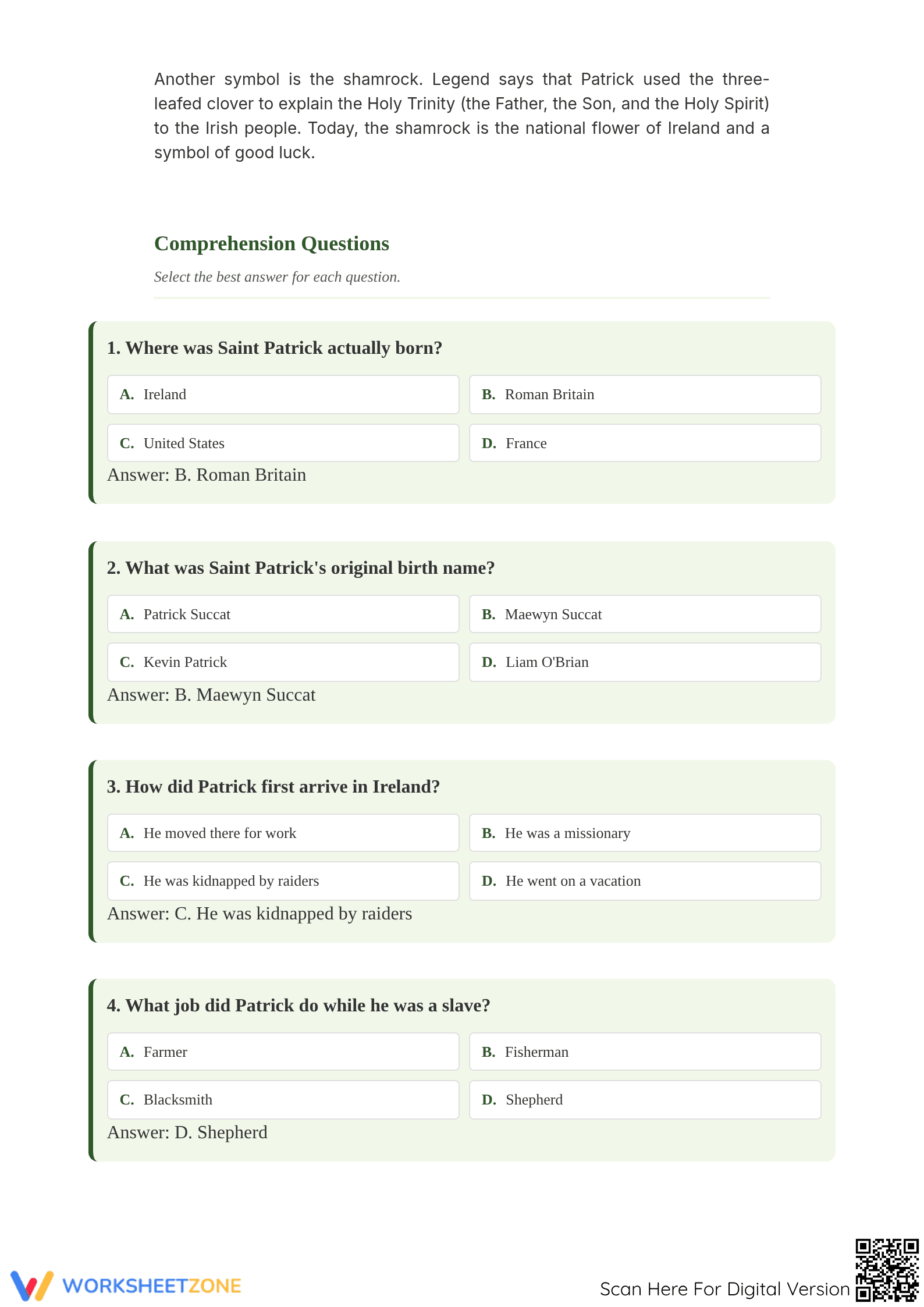
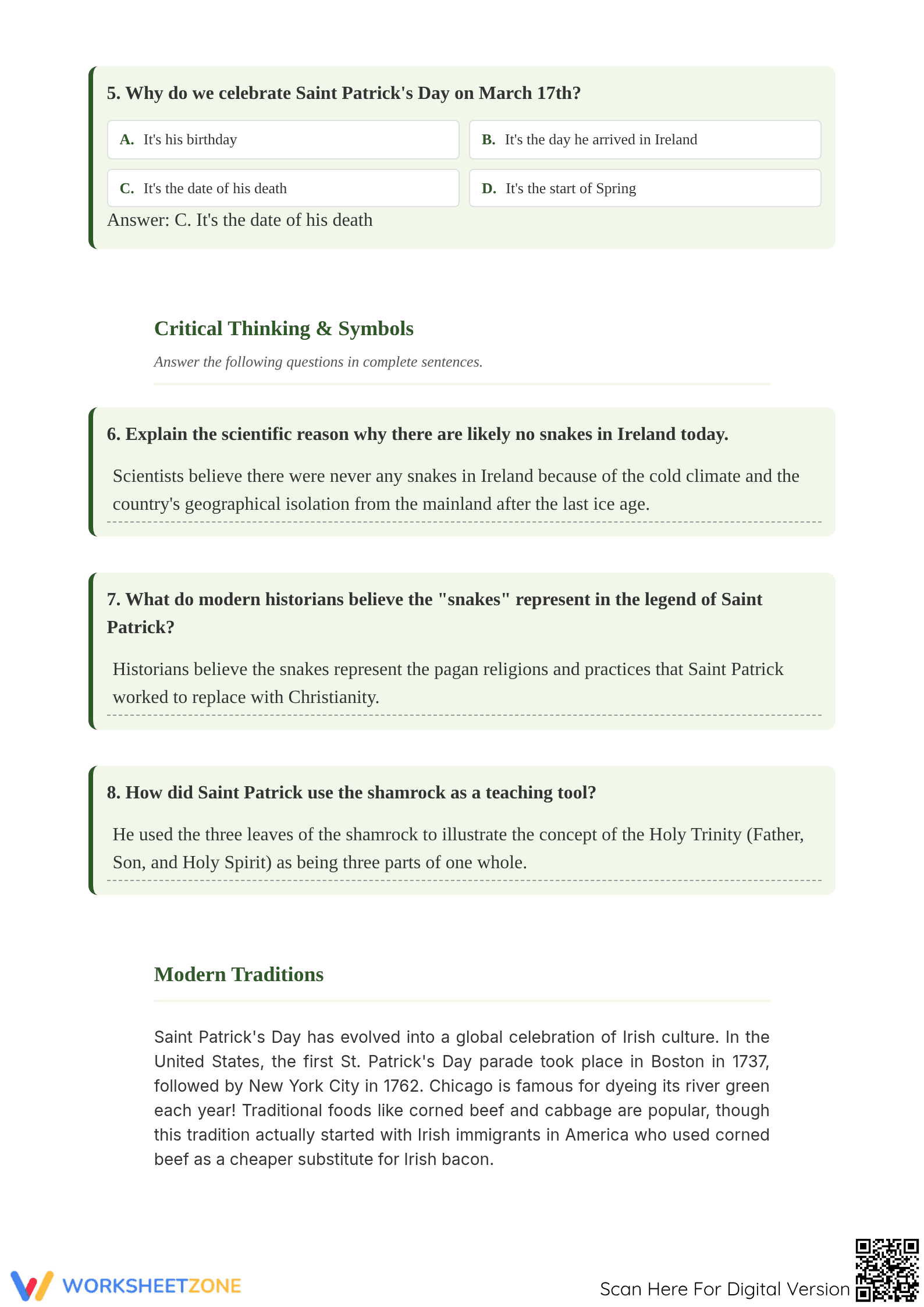
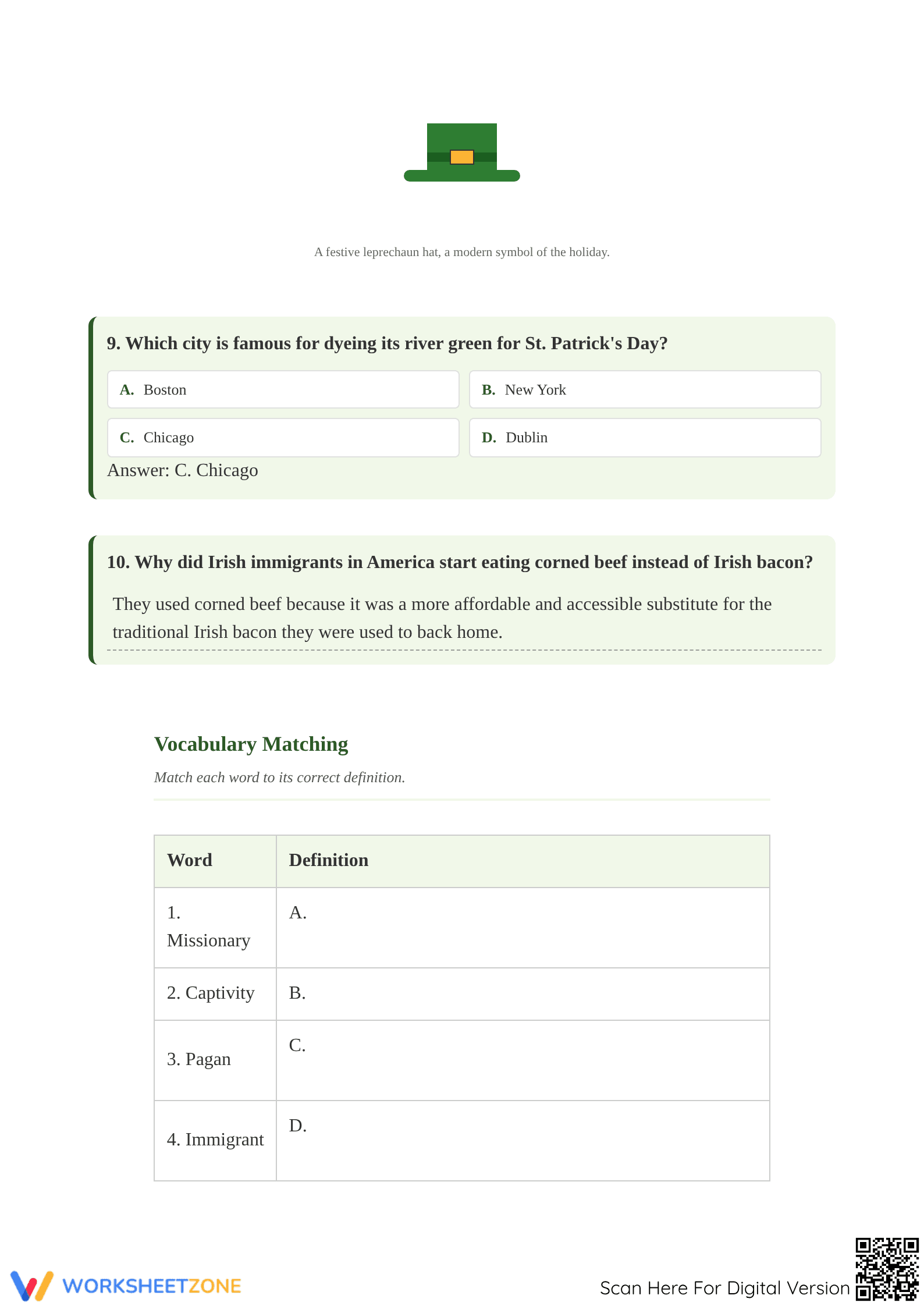
The resource contains a multi-paragraph reading passage divided into thematic sections: The History of Saint Patrick, Legends and Symbols, and Modern Traditions. It includes 10 comprehension questions—ranging from multiple-choice to critical thinking short answers—and a 4-term vocabulary matching table. A comprehensive answer key is provided for immediate feedback and easy grading.
The zero-prep workflow is designed for maximum efficiency. First, print the four-page PDF (30 seconds). Second, distribute the packets to students for independent or paired reading (1 minute). Third, review the answers using the included key or collect for grading (under 1 minute). This makes it an ideal solution for emergency sub plans or seasonal bell-ringers during the busy month of March.
This worksheet is aligned to `CCSS.ELA-LITERACY.RI.6.1`, requiring students to cite specific textual evidence when explaining the history of Saint Patrick and the meaning of Irish symbols. It also supports RI.7.1 and RI.8.1 by increasing the complexity of inference required in the short-answer sections. Both standard codes can be copied directly into lesson plans, IEP goals, or district curriculum mapping tools.
Use this as a mid-morning literacy block activity during the week of March 17th. It works effectively after a brief direct instruction session on Irish culture or as a standalone formative assessment. Teachers should observe if students refer back to the "Legends and Symbols" section to answer the critical thinking questions. Completion typically takes 35 minutes for most middle school learners.
This is designed for middle school students in grades 6, 7, and 8 who are developing their ability to distinguish between historical fact and legend. It is particularly useful for inclusive classrooms needing clear, segmented text. Pair this with a map of Ireland or an anchor chart on the "Five Ws" of informational writing to provide additional context.
Research from Fisher & Frey (2014) emphasizes that complex informational texts are most effective when paired with text-dependent questions that require students to return to the source material. This worksheet implements that strategy by aligning with CCSS.ELA-LITERACY.RI.6.1, ensuring students practice the essential skill of citing evidence. By focusing on the historical context of St. Patrick's Day, the resource provides the background knowledge necessary for high-level reading comprehension as identified in the NAEP frameworks. The 14 structured tasks provide a balanced mix of retrieval and inference, which supports cognitive load management during holiday-themed instruction. According to the RAND AIRS 2024 report, high-quality supplemental materials that reduce teacher preparation time while maintaining rigorous alignment to standards significantly improve instructional consistency across diverse middle school ELA classrooms. This resource serves as a reliable tool for building literacy through cultural history.


