


























Views
Downloads

Essential St. Patrick's Day Multiplication Practice (Grade 3)
Paste this activity's link or code into your existing LMS (Google Classroom, Canvas, Teams, Schoology, Moodle, etc.).
Students can open and work on the activity right away, with no student login required.
You'll still be able to track student progress and results from your teacher account.
Strengthen your students' multiplication fluency with this themed seasonal activity. This St. Patrick's Day Multiplication worksheet helps Grade 3 learners master basic facts while applying their knowledge to realistic scenarios. By the end of these exercises, students will demonstrate proficiency in identifying unknown factors and solving multi-step group-based word problems.
At a Glance
- Grade: 3 · Subject: Math
- Standard:
3.OA.A.4— Determine the unknown whole number in a multiplication equation relating three numbers- Skill Focus: Multiplication Word Problems & Missing Factors
- Format: 2 pages · 8 problems · Answer key included · PDF
- Best For: Seasonal practice and multiplication skill reinforcement
- Time: 15–20 minutes
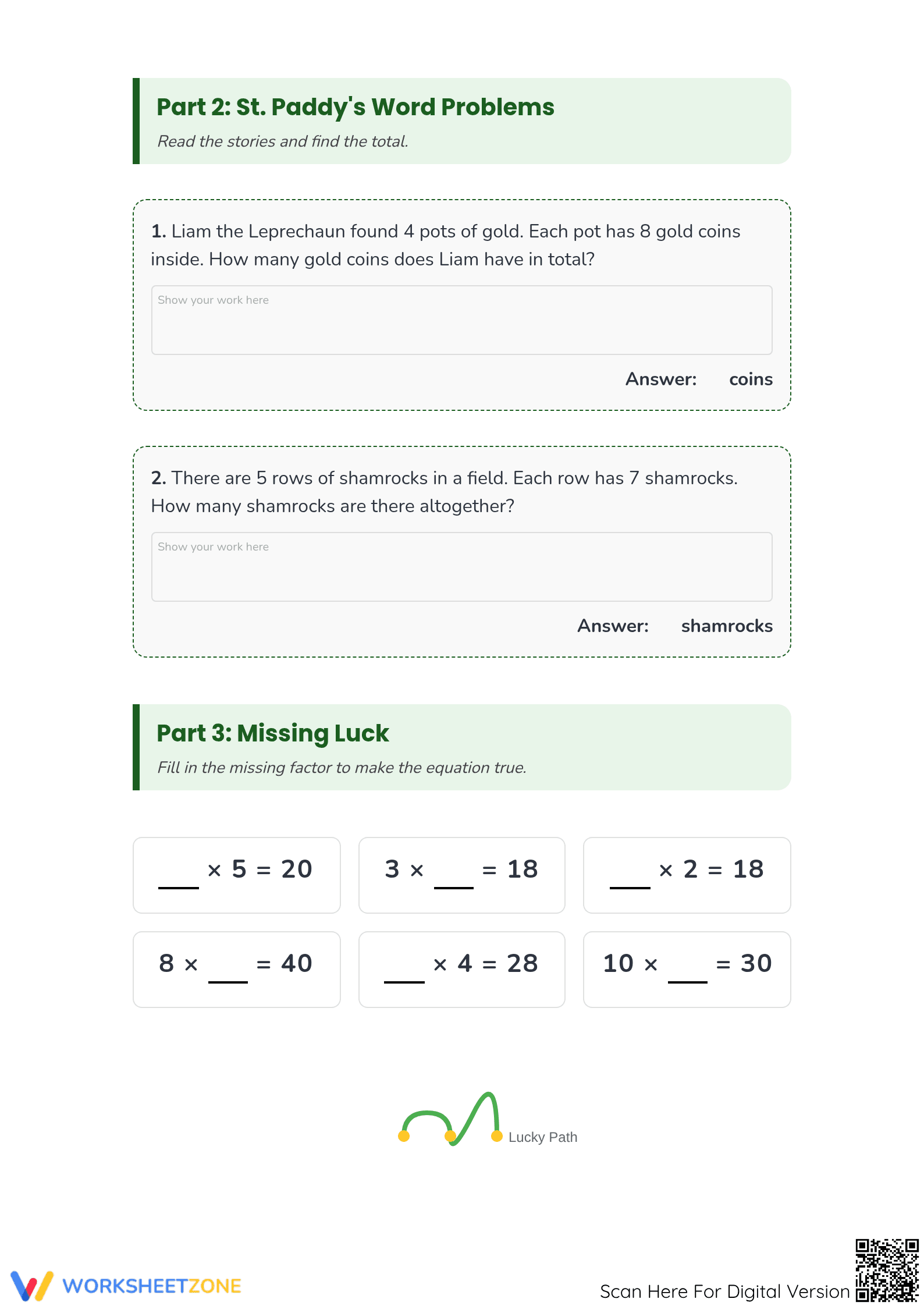
This comprehensive two-page PDF includes eight distinct math tasks designed to challenge and engage. Part 2 features "St. Paddy's Word Problems," where students read short narratives about leprechauns and gold to find totals. Part 3, "Missing Luck," requires students to find the missing factor in equations such as 3 x _ = 18. A complete answer key is provided to facilitate quick grading or student self-checking.
Skill Progression
- Guided Practice: The word problems in Part 2 provide a concrete context, allowing students to visualize equal groups of gold coins and shamrocks before performing calculations.
- Supported Practice: The "show your work" boxes offer designated space for students to draw arrays or repeated addition models, bridging the gap between concrete and abstract math.
- Independent Practice: The "Missing Luck" section removes the context, challenging students to recall multiplication facts fluently to solve for unknown variables in equations.
This gradual-release approach ensures that students build confidence with word problems before moving to more abstract algebraic thinking.
Standards Alignment
The primary focus of this resource is 3.OA.A.4, which requires students to determine the unknown whole number in a multiplication or division equation. Additionally, the word problems support 3.OA.A.3 by involving equal groups and arrays. Both standard codes can be copied directly into lesson plans, IEP goals, or district curriculum mapping tools.
How to Use It
This worksheet is ideal for use during a math center rotation in mid-March or as a festive homework assignment. Teachers can use the word problem section as a "Check for Understanding" halfway through a lesson on multiplication properties. Observe whether students use drawings or mental math to solve the missing factor equations to gauge their level of procedural fluency. Expected completion time is 15 to 20 minutes.
Who It's For
This resource is tailored for third-grade students working on multiplication mastery. It also serves as excellent enrichment for second graders or as a review for fourth graders needing a luck-themed refresher. The layout is clean and accessible for students requiring minimal visual distractions.
Research from EdReports 2024 emphasizes that high-quality mathematics instructional materials must balance procedural fluency with conceptual understanding and real-world application. This St. Patrick's Day Multiplication worksheet aligns with those findings by transitioning students from contextual word problems (Part 2) to abstract algebraic thinking through missing factor equations (Part 3). According to the EdReports analysis, such scaffolding is critical for Grade 3 students as they develop a deep understanding of the properties of operations and the relationship between multiplication and division. By providing a seasonal theme, this resource reduces math anxiety while maintaining the cognitive demand required by the 3.OA.A.4 standard. The inclusion of space for students to show your work encourages the use of multiple representations, such as arrays or equal groups, which is a hallmark of effective elementary math instruction documented in recent meta-analyses of student achievement.


