


























Views
Downloads

Spring Flower Paper Project | Grade 2-3 Printable
Paste this activity's link or code into your existing LMS (Google Classroom, Canvas, Teams, Schoology, Moodle, etc.).
Students can open and work on the activity right away, with no student login required.
You'll still be able to track student progress and results from your teacher account.
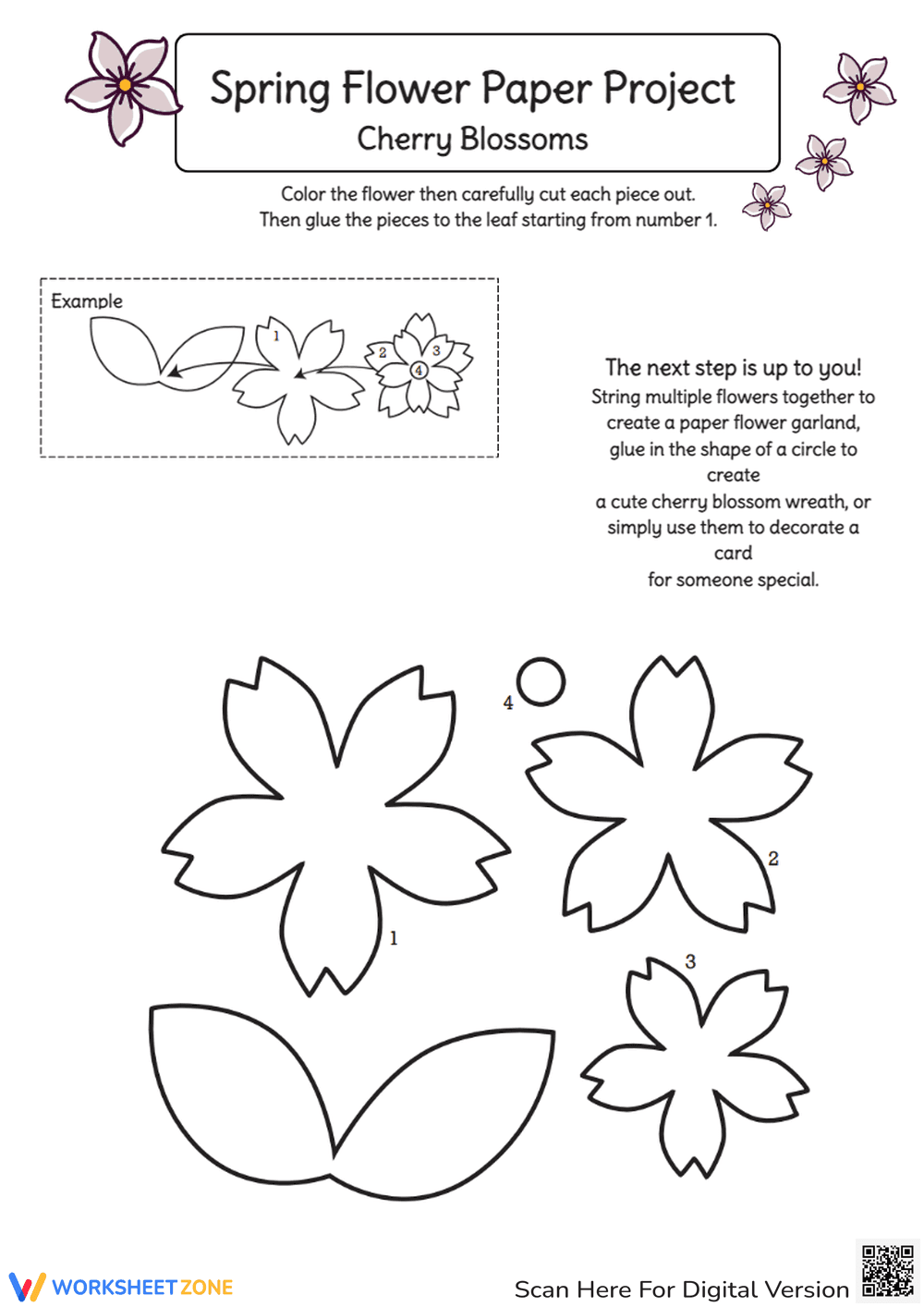
This Grade 2-3 Spring Flower Paper Project provides a hands-on way for students to celebrate the season while refining essential fine motor skills. By engaging in a multi-step process of coloring, cutting, and assembly, learners produce a beautiful cherry blossom that can be used for wreaths, garlands, or greeting cards. This activity transforms simple paper into a 3D artistic expression.
At a Glance
- Grade: 2-3 · Subject: Arts & Crafts
- Standard:
VA:Cr2.1.2a— Experiment with various materials and tools to explore personal interests in art- Skill Focus: Fine motor precision and following multi-step directions
- Format: 1 page · 4 assembly pieces · No answer key needed · PDF
- Best For: Spring seasonal activity or morning work
- Time: 15–25 minutes
The worksheet features a clear, numbered template for a cherry blossom flower. It includes four distinct pieces: two large petal layers, a center stamen, and a set of leaves. A visual "Example" box provides a scaffolded guide, showing students exactly how to layer the pieces starting from number 1. The layout ensures that the cutting lines are bold and accessible for developing hands.
The zero-prep workflow is designed for maximum efficiency. First, print the single-page PDF for each student (30 seconds). Second, distribute the sheets along with scissors, glue, and coloring supplies (1 minute). Third, review the numbered assembly example box (30 seconds). Total teacher preparation time is under 2 minutes, making this an ideal solution for unexpected schedule changes or as a high-quality sub plan filler.
This resource is aligned with VA:Cr2.1.2a, which focuses on experimenting with various materials and tools to explore personal interests in a work of art or design. Students must demonstrate control over scissors and glue to successfully assemble the cherry blossom. Additionally, it supports procedural following skills. Both standard codes can be copied directly into lesson plans, IEP goals, or district curriculum mapping tools.
Use this project as a calming morning activity or a creative station. It works well after lessons on seasonal changes or plant life cycles. Teachers should observe students' scissor grip and their ability to follow the 1-4 sequence as a formative assessment of manual dexterity. Completion typically takes 20 minutes depending on coloring detail.
This worksheet is designed for Grade 2 and Grade 3 students and is highly suitable for occupational therapy sessions. It pairs naturally with a science unit on cherry blossoms. Students can glue their finished flowers onto cardstock to create personalized spring greeting cards for family members or school staff.
According to Fisher & Frey (2014), the integration of tactile, multi-step projects in the primary classroom supports the development of executive functioning and fine motor precision. This Spring Flower Paper Project, aligned with VA:Cr2.1.2a, requires students to execute a sequence of coloring, precise cutting, and layered gluing. Research from the NAEP indicates that hands-on arts integration correlates with higher engagement levels in early elementary learners. By following the numbered assembly guide, students practice spatial reasoning and directional following. This resource provides a structured yet creative outlet for Grade 2 and Grade 3 students to demonstrate mastery of basic tool use while producing a tangible artifact. Such activities are essential for developing the manual dexterity required for advanced writing and technical tasks in later grades. The project serves as a practical application of artistic standards within a seasonal curriculum framework.


