




























Views
Downloads
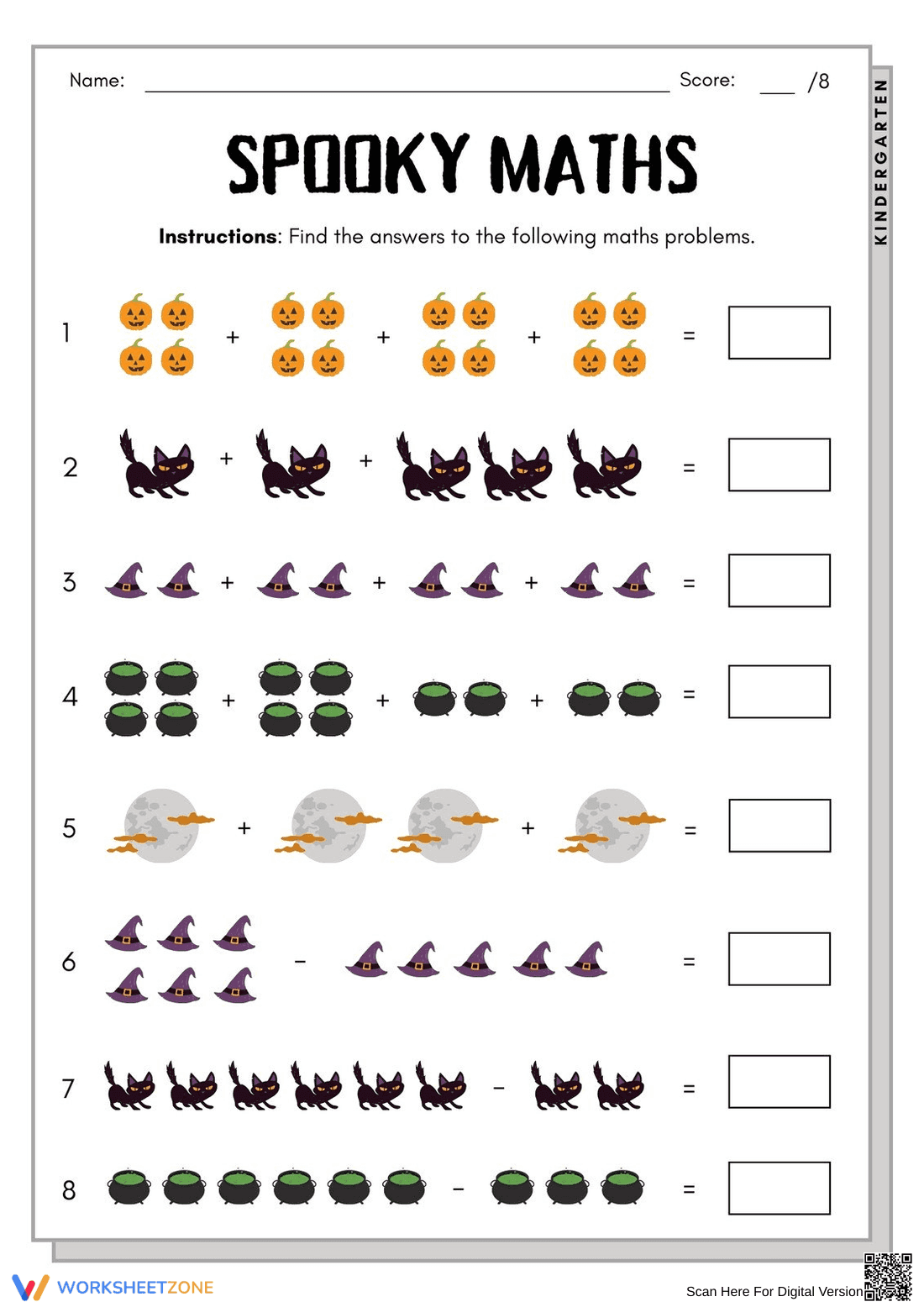

Kindergarten Spooky Math — Printable Halloween Worksheet

Paste this activity's link or code into your existing LMS (Google Classroom, Canvas, Teams, Schoology, Moodle, etc.).
Students can open and work on the activity right away, with no student login required.
You'll still be able to track student progress and results from your teacher account.
This printable Kindergarten math worksheet combines seasonal Halloween excitement with foundational arithmetic practice. Students solve eight visual addition and subtraction problems by counting spooky themed objects. It provides an engaging way to build early numeracy skills and achieve mastery in basic operations.
At a Glance
- Grade: Kindergarten · Subject: Math
- Standard:
CCSS.MATH.CONTENT.K.OA.A.1— Represent addition and subtraction with drawings and objects- Skill Focus: Visual addition and subtraction
- Format: 1 page · 8 problems · Answer key not included · PDF
- Best For: Halloween math centers
- Time: 15–20 minutes
This single-page PDF features an engaging layout decorated with high-quality Halloween graphics. The worksheet contains eight problems: five multi-group addition equations and three subtraction equations. Each problem uses clear illustrations—such as jack-o'-lanterns, black cats, and cauldrons—to represent numbers visually. A score box at the top allows for quick grading out of eight points, while a name line ensures easy classroom organization.
The zero-prep workflow makes this resource exceptionally easy to integrate into a busy October schedule. First, print the single-page PDF in under one minute. Next, distribute the sheets to your students in less than thirty seconds, requiring no complex instructions due to the intuitive visual layout. Finally, review the eight answers together, completing the entire cycle with minimal teacher preparation time. This efficient design makes it an ideal sub plan or emergency morning work activity.
This activity aligns directly with the Common Core State Standards for Mathematics, specifically CCSS.MATH.CONTENT.K.OA.A.1. This standard requires students to represent addition and subtraction with objects or drawings. By using distinct groups of spooky illustrations, this worksheet helps kindergarteners bridge the gap between concrete counting and abstract thinking. Both standard codes can be copied directly into lesson plans, IEP goals, or district curriculum mapping tools.
Incorporate this worksheet during independent practice after a direct instruction lesson on counting and combining groups. It works perfectly as a thematic math center activity during October to keep engagement high. Teachers can use this as a formative assessment by observing whether students count every individual object. Expect students to spend between 15 and 20 minutes completing the eight problems.
This resource is designed for general education kindergarten students learning foundational operations, but it also serves as an excellent remedial tool for first graders. It provides excellent support for English language learners because the math concepts are communicated entirely through pictures. Pair this worksheet naturally with a concrete counter activity using plastic pumpkins to support tactile learners.
According to research from EdReports 2024, utilizing thematic visual representations in early childhood mathematics significantly increases student engagement and helps solidify abstract operational concepts. This worksheet directly supports that methodology by translating numerical values into recognizable, concrete illustrations aligned with CCSS.MATH.CONTENT.K.OA.A.1. By structuring the eight problems with clear groupings of pumpkins, cats, and cauldrons, the resource allows young learners to practice the foundational skills of combining and separating sets. This visual scaffolding aligns with best practices highlighted by early math educators, ensuring that students develop a robust conceptual understanding of addition and subtraction before transitioning to purely symbolic equations. Incorporating these high-interest seasonal themes ensures that mathematical practice remains both rigorous and accessible during high-distraction holiday periods in the classroom.


