


























Views
Downloads
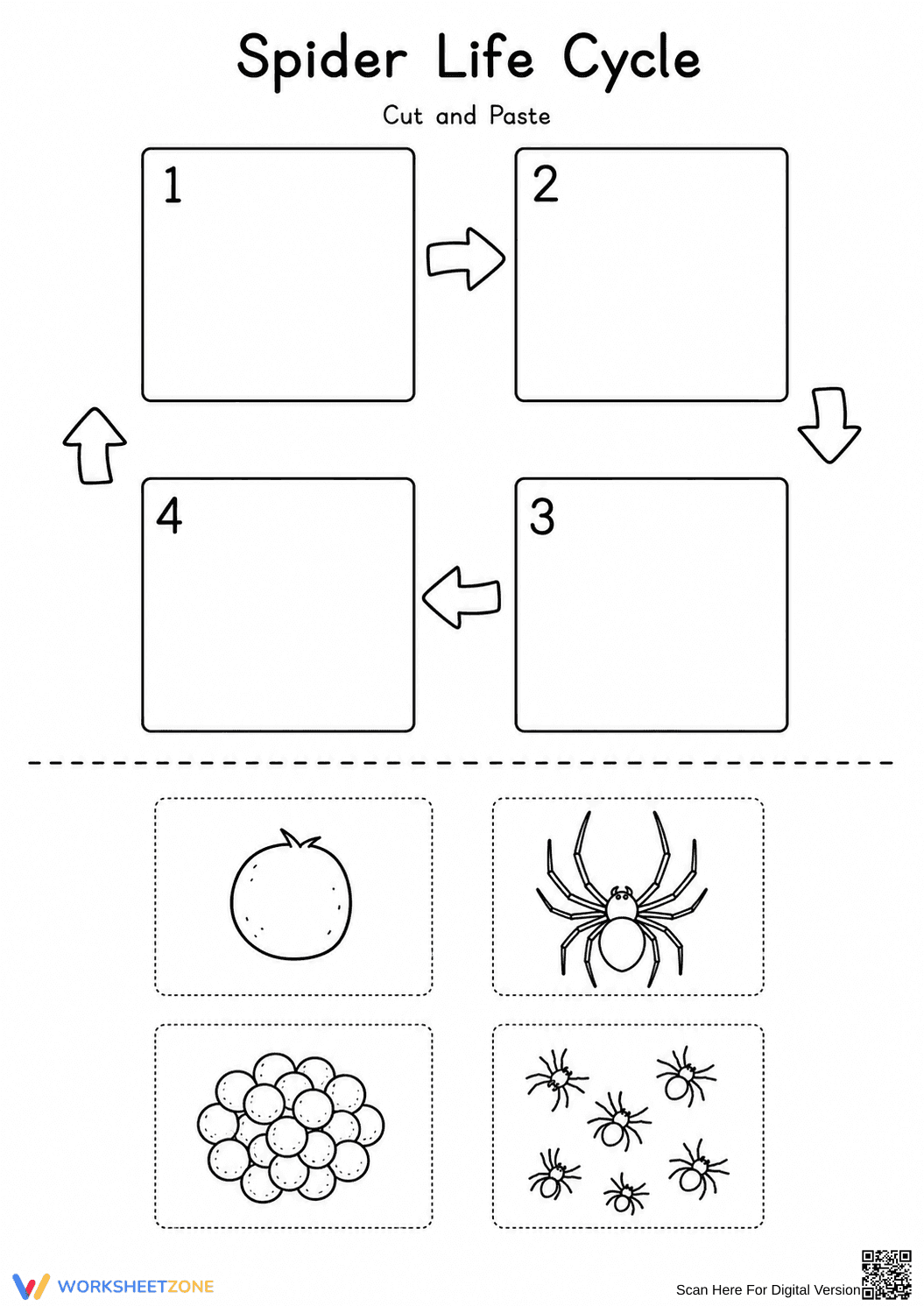

Spider Life Cycle Worksheet | Grade 3 Essential
Paste this activity's link or code into your existing LMS (Google Classroom, Canvas, Teams, Schoology, Moodle, etc.).
Students can open and work on the activity right away, with no student login required.
You'll still be able to track student progress and results from your teacher account.
This Grade 3 spider life cycle worksheet provides a hands-on approach for students to visualize biological growth and development. By engaging in a tactile sequencing task, learners identify the transition from eggs to spiderlings and eventually to adult spiders. This activity ensures students can articulate the cyclical nature of arachnid life while developing fine motor skills.
At a Glance
- Grade: 3 · Subject: Science
- Standard:
3-LS1-1— Develop models to describe that organisms have unique and diverse life cycles- Skill Focus: Life cycle sequencing
- Format: 1 page · 4 problems · Answer key included · PDF
- Best For: Independent science center activity
- Time: 15–20 minutes
This single-page PDF features a clear, four-stage cycle diagram with directional arrows to guide student thinking. The bottom section contains four distinct illustrations—an egg, an egg sac, spiderlings, and an adult spider—designed for cutting and pasting. The numbered boxes provide a structural scaffold that helps students organize their observations into a logical chronological sequence.
The zero-prep workflow for this resource is designed for maximum efficiency in busy classrooms. First, print the required number of copies (30 seconds). Next, distribute the sheets along with scissors and glue sticks to your students (1 minute). Finally, review the completed cycles as a whole group to check for conceptual understanding (5 minutes). Total teacher preparation time is under 2 minutes, making it an ideal choice for emergency sub plans or last-minute science blocks.
This resource is specifically aligned with `3-LS1-1`, which requires students to develop models to describe that organisms have unique and diverse life cycles but all have in common birth, growth, reproduction, and death. By physically constructing the model, students demonstrate their understanding of these biological stages. This standard code can be copied directly into lesson plans, IEP goals, or district curriculum mapping tools.
Use this worksheet during the "Explore" phase of a 5E instructional model after reading a text about arachnids. It serves as an excellent formative assessment to gauge if students can distinguish between the egg sac and individual egg stages. Expect students to complete the activity in 15 to 20 minutes, allowing for a quick transition to a writing prompt about spider characteristics.
This activity is tailored for Grade 2 and Grade 3 students, particularly those who benefit from kinesthetic learning and visual aids. It is highly effective for English Language Learners (ELLs) as it relies on pictorial representation rather than heavy text. Pair this worksheet with a spider-themed anchor chart or a short video clip of a spider hatching to provide a comprehensive learning experience.
According to research by Fisher & Frey (2014) on the gradual release of responsibility, tactile activities like this cut-and-paste worksheet bridge the gap between direct instruction and independent mastery. The `3-LS1-1` standard emphasizes the importance of modeling in science education, and this resource provides a concrete entry point for young learners to grasp complex biological concepts. By manipulating physical representations of the spider life cycle, students internalize the sequence of birth, growth, and reproduction more effectively than through passive observation alone. This worksheet facilitates the development of mental models that are foundational for later studies in ecology and environmental science. Educational analysis suggests that integrating fine motor tasks with core science content increases engagement and retention rates among elementary students. This printable resource ensures that every learner has a clear, physical record of their understanding of the spider's developmental journey.


