




























Views
Downloads

Spider Life Cycle Worksheet | Grade 3 Essential

Paste this activity's link or code into your existing LMS (Google Classroom, Canvas, Teams, Schoology, Moodle, etc.).
Students can open and work on the activity right away, with no student login required.
You'll still be able to track student progress and results from your teacher account.
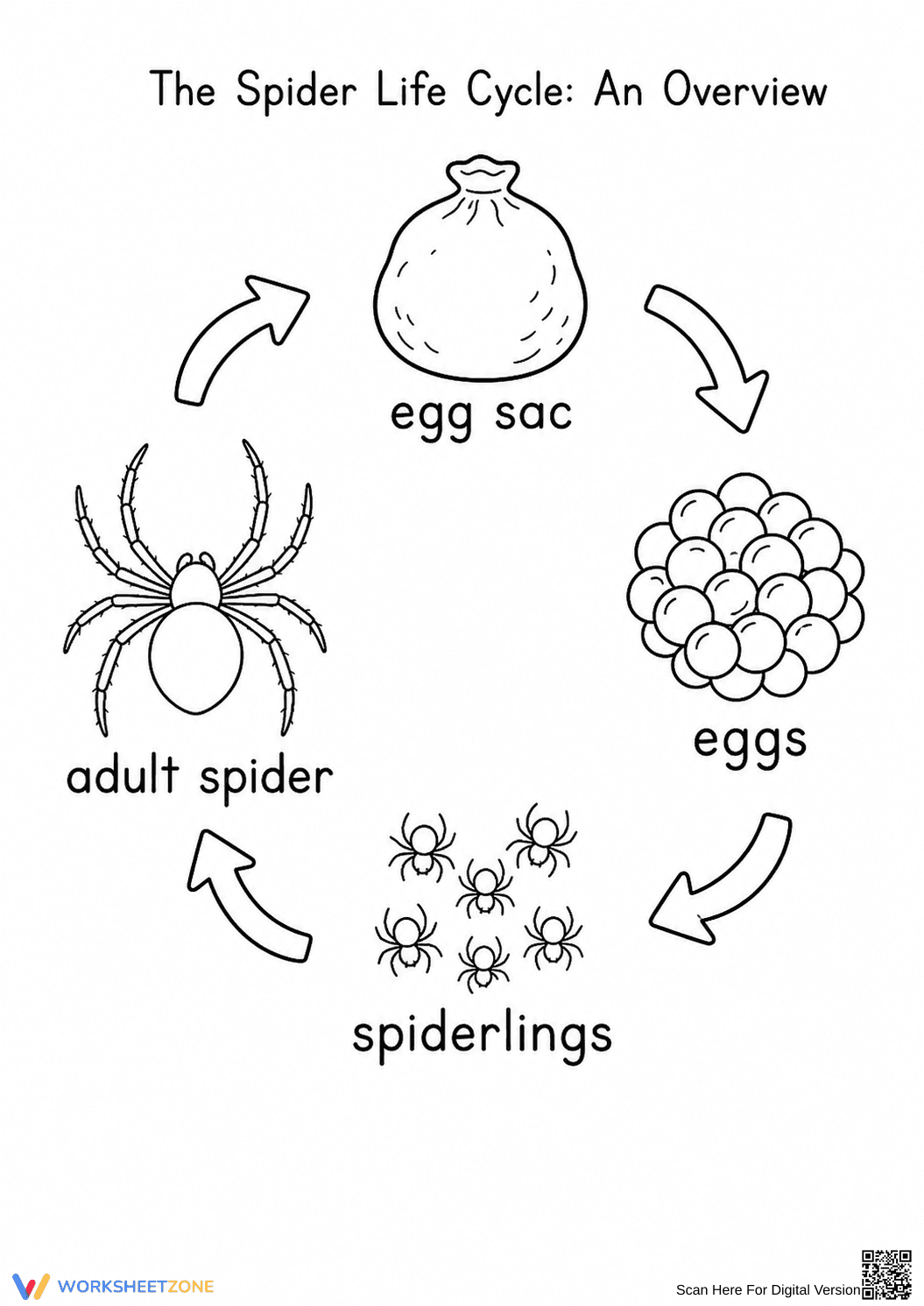
This Grade 3 spider life cycle worksheet provides a clear visual model for students to identify and sequence the four primary stages of arachnid development. By engaging with the diagram, learners master the progression from egg sac to adult, building a foundational understanding of biological growth and reproduction in the animal kingdom.
At a Glance
- Grade: 3 · Subject: Science
- Standard:
3-LS1-1— Develop models to describe that organisms have unique and diverse life cycles- Skill Focus: Spider life cycle stages
- Format: 1 page · 4 stages · Answer key included · PDF
- Best For: Introduction to animal life cycles
- Time: 15–20 minutes
What's Inside
This resource features a high-quality line-art diagram illustrating the four key phases: the protective egg sac, the individual eggs, the emerging spiderlings, and the mature adult spider. The one-page layout includes directional arrows to emphasize the cyclical nature of development, making it an ideal tool for both coloring and scientific labeling. The clear, uncluttered design ensures that students focus on the biological sequence without distraction.
Zero-Prep Workflow
- Print (30 seconds): Simply download the PDF and send it to your printer for immediate classroom use.
- Distribute (1 minute): Hand out the single-page sheet to your class or small group during your science block.
- Review (5 minutes): Use the visual diagram to lead a whole-class discussion on the biological transitions and growth patterns.
Total teacher preparation time is under 2 minutes, making this an excellent choice for emergency sub plans or quick morning work.
Standards Alignment
This worksheet aligns with `3-LS1-1`, which requires students to develop models to describe that organisms have unique and diverse life cycles but all have in common birth, growth, reproduction, and death. It also supports 2-LS4-1 by observing the diversity of life in different habitats. Both standard codes can be copied directly into lesson plans, IEP goals, or district curriculum mapping tools to ensure compliance with state and national frameworks.
How to Use It
Use this worksheet during the "Explore" phase of a 5E lesson on life cycles to allow students to visualize arachnid growth before comparing it to insects or mammals. It also serves as an effective formative assessment exit ticket; ask students to explain the difference between an egg sac and an individual egg as they turn in their work. Expected completion time ranges from 15 to 20 minutes depending on whether students color the illustrations.
Who It's For
This resource is designed for third-grade general education classrooms, but its visual nature makes it highly accessible for English Language Learners and students with IEPs requiring modified science content. It pairs naturally with a non-fiction text about spiders or an anchor chart detailing the characteristics of arachnids. It is also suitable for homeschool parents looking for a structured way to introduce biology concepts.
The use of visual models in early science education is critical for cognitive development, as noted in the RAND AIRS 2024 report on elementary STEM literacy. This worksheet addresses the 3-LS1-1 standard by providing a concrete representation of the spider life cycle, a specific biological process that students must understand to grasp broader ecological concepts. Research by Fisher & Frey (2014) emphasizes that visual scaffolds, such as the sequenced diagrams found in this resource, significantly improve the retention of domain-specific vocabulary in young learners. By identifying the egg sac, eggs, spiderlings, and adult stages, students engage in evidence-based observation that aligns with national science frameworks. This printable tool ensures that educators can deliver high-quality, standards-aligned instruction with minimal preparation, supporting the goal of equitable access to rigorous science curriculum across diverse classroom settings.


