


























Views
Downloads


Printable Spelling Worksheet: Short A Words for Grade 1
Paste this activity's link or code into your existing LMS (Google Classroom, Canvas, Teams, Schoology, Moodle, etc.).
Students can open and work on the activity right away, with no student login required.
You'll still be able to track student progress and results from your teacher account.
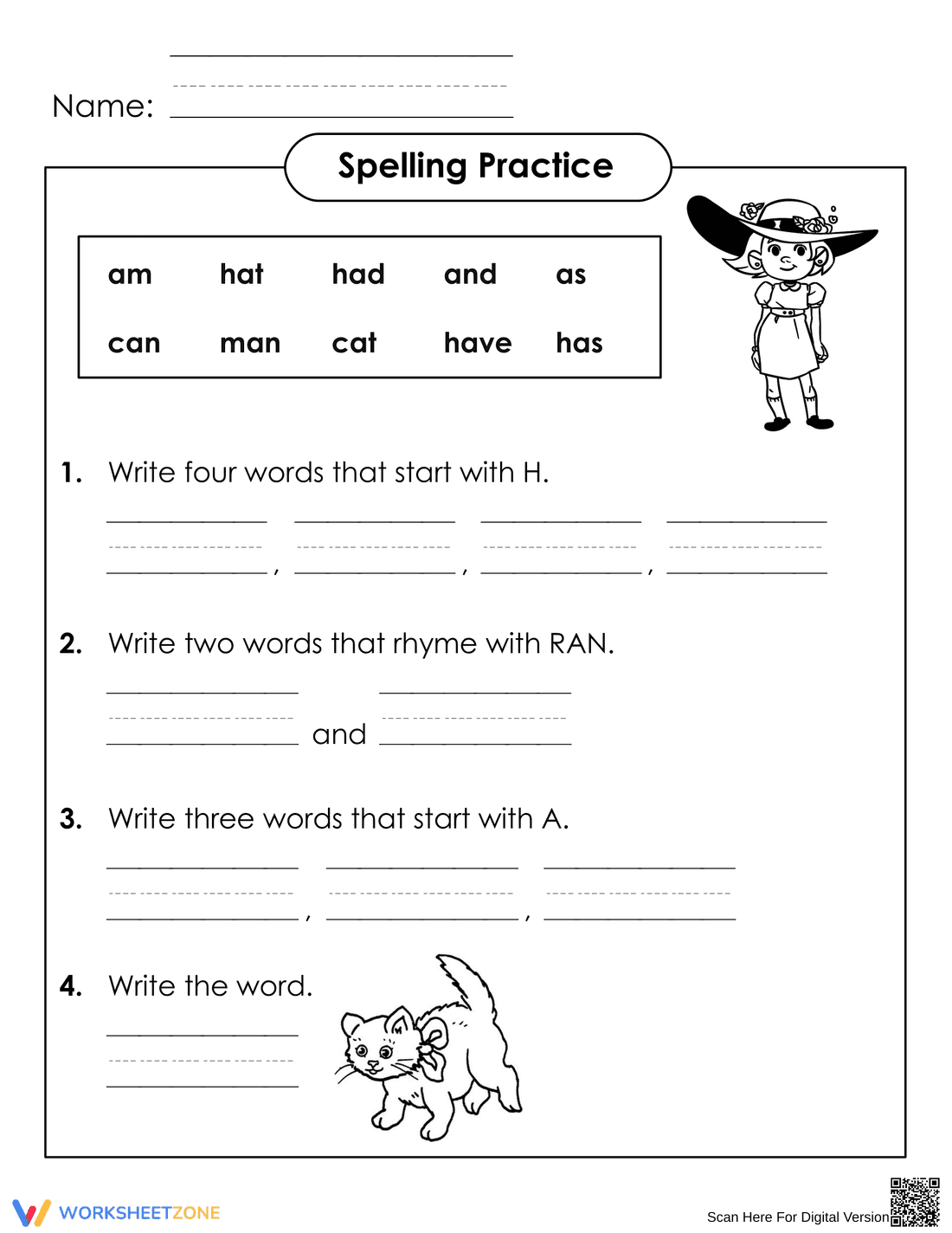
This printable spelling worksheet helps first-grade students master short "a" word families through targeted phonics exercises. Students identify, categorize, and write ten common short "a" words to build foundational reading and writing fluency. The structured layout ensures learners independently apply spelling patterns to achieve immediate word-recognition success.
At a Glance
- Grade: Grade 1 · Subject: English Language Arts
- Standard:
CCSS.ELA-LITERACY.RF.1.3— Know and apply grade-level phonics and word analysis skills in decoding words- Skill Focus: Short a spelling and rhyming patterns
- Format: 2 pages · 4 problems · Answer key included · PDF
- Best For: Morning work or independent phonics practice
- Time: 10–15 minutes
This resource contains a single-page student worksheet and a complete teacher answer key. The student page features a clear word bank containing ten short "a" vocabulary words, including "am," "hat," "had," "and," "as," "can," "man," "cat," "have," and "has." A friendly character illustration guides students through four distinct tasks that require sorting words by starting letters, identifying rhyming pairs, and labeling a cute animal illustration.
This resource is designed for an efficient, zero-prep classroom workflow. First, print the single-page student sheet in under one minute. Second, distribute the copies to your class, which takes less than thirty seconds. Third, review student answers using the provided answer key in under one minute. The total teacher preparation time is less than two minutes, making this resource highly suitable for emergency sub plans or quick morning transitions.
The primary focus of this activity aligns with CCSS.ELA-LITERACY.RF.1.3, which requires students to know and apply grade-level phonics and word analysis skills in decoding words. Additionally, it supports CCSS.ELA-LITERACY.L.1.2.D by encouraging students to spell untaught words phonetically. Both standard codes can be copied directly into lesson plans, IEP goals, or district curriculum mapping tools.
Use this worksheet during the independent practice portion of your phonics lesson, immediately following direct instruction on short "a" word families. Alternatively, assign it as a quick formative assessment at the end of the week to gauge spelling mastery. While students work, observe whether they correctly group the words starting with "H" and "A" to check their letter-sound recognition. Students typically complete the four tasks within ten to fifteen minutes.
This worksheet is ideal for first-grade students learning basic spelling patterns, though it also serves as a helpful review for second graders or an extension activity for advanced kindergarteners. Teachers can differentiate by providing physical letter tiles for struggling readers to build the words before writing them. Pair this activity with a short "a" decodable reader or an anchor chart displaying common word families.
This spelling resource targets foundational literacy skills aligned with CCSS.ELA-LITERACY.RF.1.3 by focusing on short "a" word families and phonics patterns. According to research from Fisher & Frey (2014) on the gradual release of responsibility, structured word-sorting tasks and rhyming exercises reinforce orthographic mapping in early readers. By prompting students to categorize words based on starting letters and phonetic endings, this worksheet strengthens the cognitive connections between graphemes and phonemes. The inclusion of a clear word bank scaffolds the writing process, allowing young learners to build confidence in their spelling abilities. Educators can utilize this tool to gather quick diagnostic data on student decoding skills. The structured format ensures that students practice high-frequency words in a meaningful context, supporting long-term retention and reading automaticity in early childhood classrooms.


