


























Views
Downloads
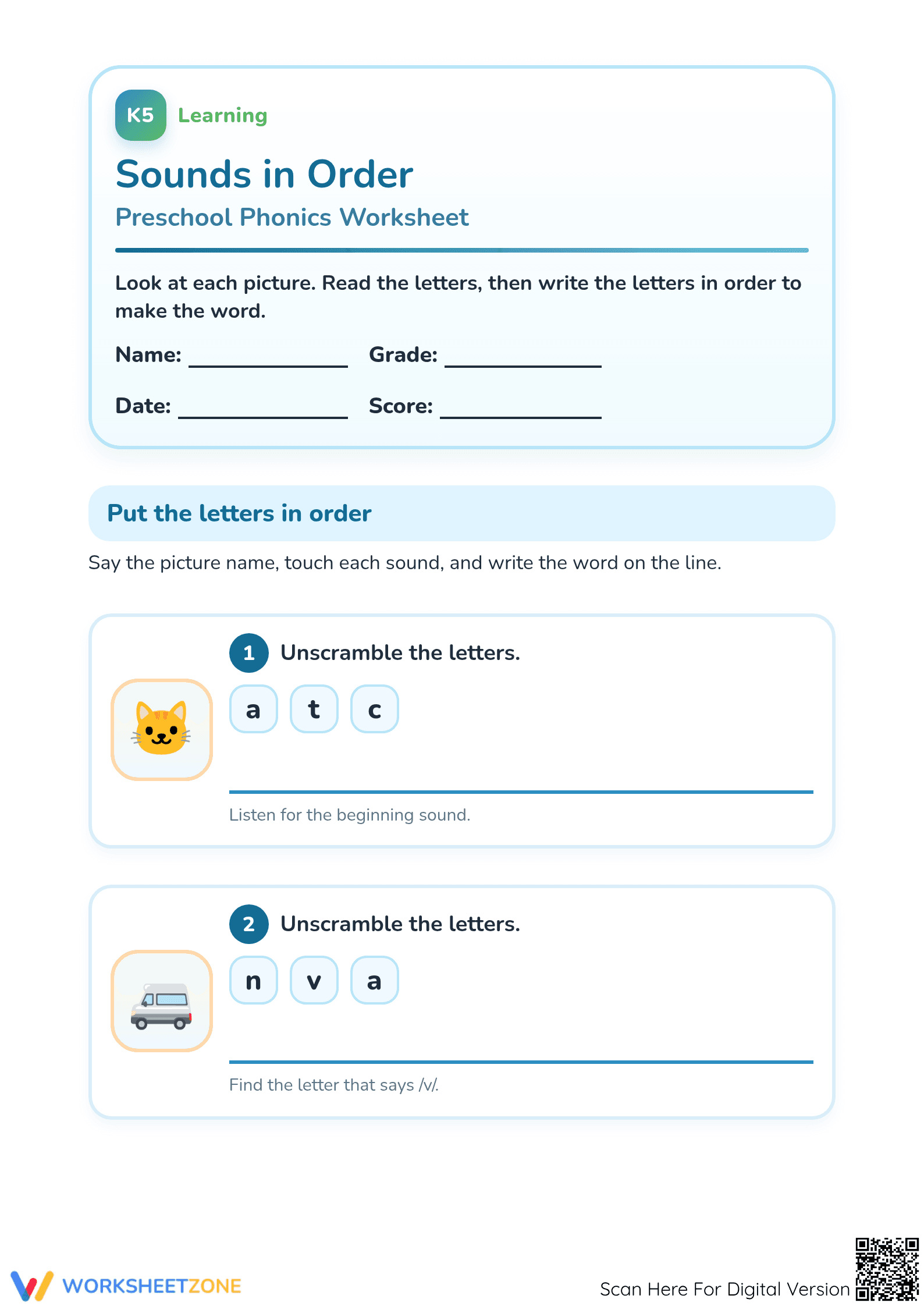
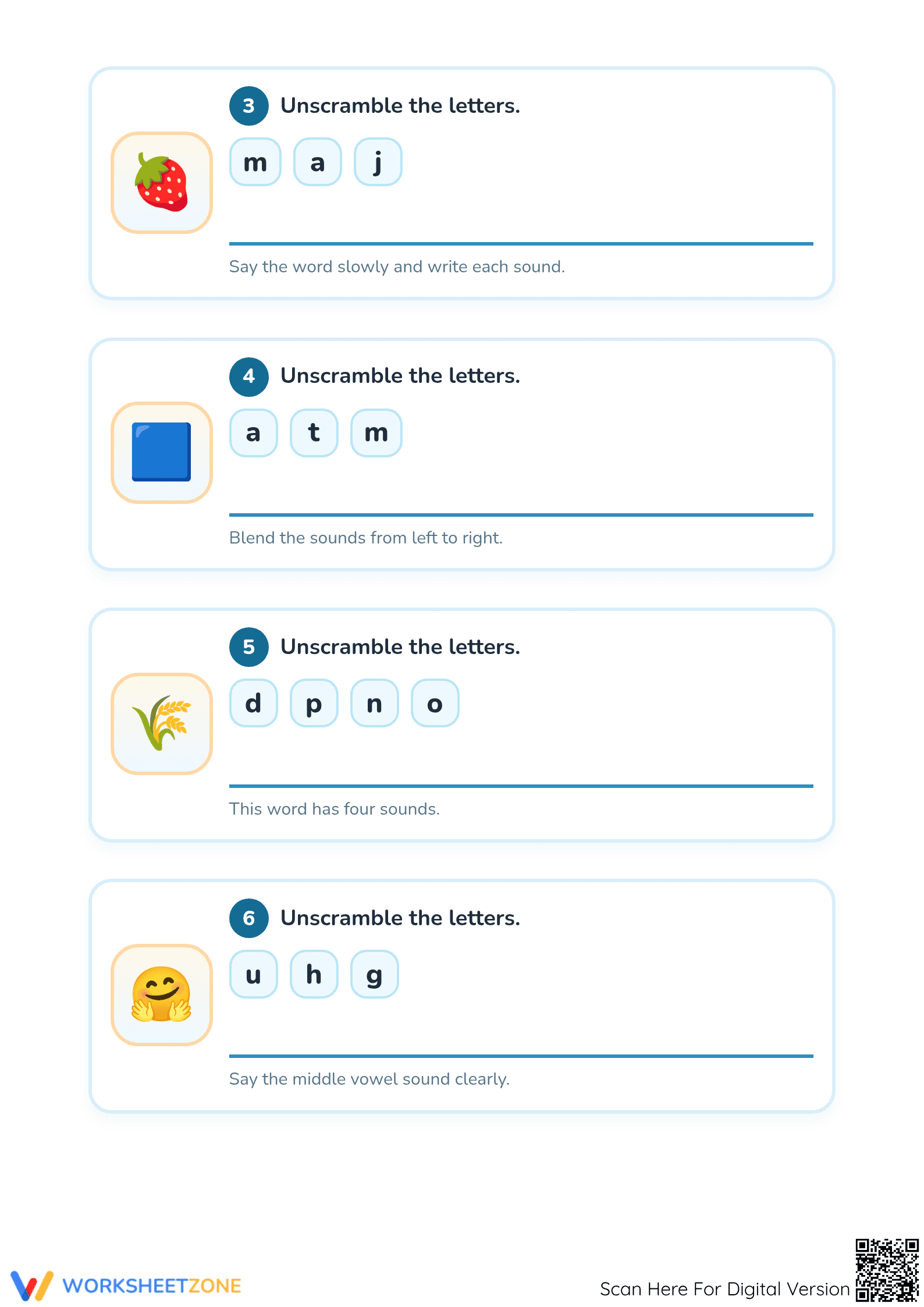

Preschool Sounds in Order — Printable No-Prep Worksheet
Paste this activity's link or code into your existing LMS (Google Classroom, Canvas, Teams, Schoology, Moodle, etc.).
Students can open and work on the activity right away, with no student login required.
You'll still be able to track student progress and results from your teacher account.
This foundational Preschool phonics worksheet strengthens phonemic awareness by requiring students to unscramble letters and write words in their correct sequence. By engaging with these structured tasks, early learners practice isolating individual sounds and mapping them to specific characters, facilitating a smoother transition from letter recognition to fluent word construction.
At a Glance
- Grade: Preschool · Subject: English Language Arts
- Standard:
CCSS.ELA-LITERACY.RF.K.2.D— Isolate and pronounce initial, medial vowel, and final sounds in words- Skill Focus: Phonemic sequencing and letter-sound correspondence
- Format: 2 pages · 6 problems · Answer key included · PDF
- Best For: Early phonics practice and small group instruction
- Time: 10–15 minutes
The resource consists of two PDF pages containing six distinct word-scramble tasks. Each task features a clear visual prompt, such as a cat, van, or strawberry, followed by a set of scrambled letters. Students are prompted to unscramble the letters and write the complete word on a provided writing line. The layout includes specific hints for beginning sounds and medial vowels to scaffold the learning process effectively.
Zero-Prep Workflow
This zero-prep worksheet is designed for immediate classroom implementation with three simple steps. First, print the two-page document (30 seconds). Second, distribute the copies to students for independent or guided practice (1 minute). Third, review student responses using the included answer key (1 minute). The total teacher preparation time is under two minutes, making it an ideal choice for busy morning routines or emergency sub plans.
Standards Alignment
The primary standard addressed is `CCSS.ELA-LITERACY.RF.K.2.D`, which focuses on isolating and pronouncing the initial, medial vowel, and final sounds in three-phoneme words. This worksheet provides direct practice in these areas by requiring students to identify the correct sequence of sounds to form recognizable words. This standard code can be copied directly into lesson plans, IEP goals, or district curriculum mapping tools.
How to Use It
Use this worksheet during the 'You Do' phase of a lesson to assess individual progress in phonemic awareness. It also serves as a focused formative assessment tool; observe whether students start with the beginning sound or struggle with the medial vowel. The estimated completion time of 10 to 15 minutes makes it suitable for a quick center rotation or a transition activity between instruction blocks.
Who It's For
This resource is specifically crafted for Preschool and Kindergarten students beginning their phonics journey. It offers necessary scaffolding for English Language Learners and students with speech goals through clear visual aids. For a comprehensive lesson, pair this activity with a CVC word-family anchor chart or a hands-on phoneme-segmentation exercise to reinforce the relationship between spoken sounds and written symbols.
Effective phonics instruction relies on the explicit connection between phonemic awareness and grapheme representation. This worksheet aligns with standard CCSS.ELA-LITERACY.RF.K.2.D by providing students with structured practice in isolating and sequencing sounds within simple words. According to RAND AIRS 2024, early exposure to systematic phonics tasks significantly predicts later reading fluency. By requiring students to unscramble 6 tasks, the activity reinforces the understanding that the order of sounds determines word meaning. This systematic approach allows educators to identify specific gaps in a student's ability to isolate initial, medial, or final phonemes. The inclusion of clear visual cues ensures that practice remains accessible while maintaining high cognitive demands for literacy development. This resource serves as a reliable instrument for documenting progress toward foundational literacy benchmarks in early childhood settings.


